
Welcome to the latest edition of Hidden Gems Weekly. In recent weeks, we have dug into opportunities across a debt-free gem front-running the data centre cycles, a real estate company, a Birla lineage packaging company and an engineering gem. This week, we turn to a different kind of transition. Restaurant Brands Asia is a quick service restaurant chain where expansion built scale and the economics of that scale are only now beginning to emerge.
Restaurant chains do not become profitable simply by opening more stores.
They become profitable when scale begins to change economics.
Rent becomes easier to negotiate. Supply chains become more efficient. Procurement costs decline. Marketing spend spreads across a larger base. Fixed costs grow slower than revenue.
This is the phase Restaurant Brands Asia, the master franchisee of Burger King in India, appears to be approaching.
Expansion built the network. The more important question now is whether that network begins to generate sustained profitability.
The company has already done the harder part of building scale. The more valuable part may be beginning.
Q3 Analysis: Dissecting the 5,773 Million Revenue Surge Restaurant Brands Asia ended the December 2025 quarter with 577 restaurants. The company added 67 stores over the past year. Revenue rose 16.5% year-on-year to Rs 5,773 million in the quarter, driven by both store additions and improving same-store performance.
The Road to 800 Stores: FY2029 Projections
Management has maintained its guidance to add 60–80 restaurants annually, targeting around 800 stores by FY2029.
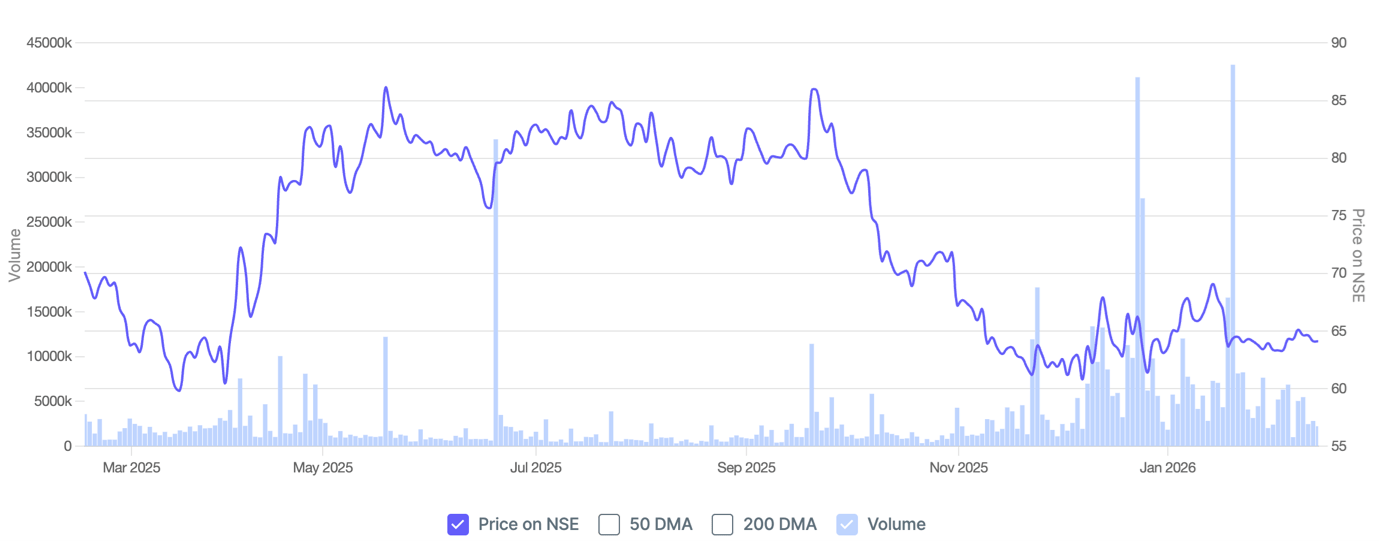
Restaurant Brands Asia 1-Year Share Price Chart
Expansion remains central to the strategy. But expansion alone does not create profits.
What matters is whether each store becomes economically stronger over time.
Early signs suggest that shift may be underway. Same-store sales grew 4.5% in the quarter, while average daily sales reached Rs 117,000 per store, reflecting improving store productivity.
This matters because once fixed costs stabilise, incremental revenue contributes disproportionately to profit.
That is how operating leverage emerges.
Margins are improving ahead of expectations
Gross margins reached 69.9% in Q3FY26, expanding over 200 basis points year-on-year. This achieved the company’s earlier target of reaching around 70% gross margin by FY2029, well ahead of schedule.
Restaurant-level EBITDA (Earnings Before Interest, Taxes, Depreciation and Amortisation) margins improved to 13.0% in Q3FY26, up from 12.0% a year earlier. This reflects stronger store-level profitability as revenue growth outpaced operating costs.
Company-level EBITDA margins also expanded to 7.0% from 6.2% a year ago, indicating early signs of operating leverage at the consolidated level.
These improvements were driven not by price increases alone, but by structural changes. Supply chain optimisation reduced input costs. Delivery profitability improved through lower discounting. Utility efficiencies and distribution synergies lowered operating expenses.
These changes alter the cost structure gradually. Incremental revenue now translates more efficiently into profit.
Restaurant businesses rarely improve suddenly. They improve through cumulative efficiency gains.
Digital adoption is strengthening unit economics
Restaurants have historically been labour-intensive businesses. Digital ordering is changing that equation.
As of Q3FY26, about 92% of orders flowed through digital channels, including kiosks, mobile apps and self-ordering systems. Monthly active users increased 47% over the past year, strengthening customer engagement.
Digital ordering improves throughput, reduces dependence on manual ordering and lowers labour intensity per transaction. More importantly, it improves customer retention.
Over time, this improves revenue predictability and strengthens margins.
Scale becomes more valuable when supported by technology.
Indonesia remains a drag and Popeyes explains why
Indonesia remains the weakest part of Restaurant Brands Asia’s portfolio. The company operates 163 restaurants in the country, including 138 Burger King outlets and 25 Popeyes stores.
While Burger King’s economics have begun to improve, Popeyes remains too small to absorb its fixed costs. Losses have widened.
Revenue from Indonesia declined 4.4% year-on-year in Q3FY26 and the segment continues to report negative EBITDA.
Restaurant economics reward scale. Until Popeyes reaches sufficient scale, or exits, Indonesia is likely to remain a weak link.
This contrast reinforces the central lesson. Scale improves economics. Lack of scale weakens them.
Valuation depends on operating leverage, not expansion alone
Restaurant Brands Asia should not be valued solely on current profitability. It should be valued on whether scale translates into sustained cash flows.
Valuation models assume continued expansion, margin improvement and operating leverage. These assumptions depend on execution.
If margins continue to expand and EBITDA grows faster than revenue, scale will begin to generate meaningful free cash flow.
If operating leverage strengthens, future cash flows could justify valuation expectations.
If not, expansion alone will not be enough.
The valuation question is ultimately an economic one, not a growth one.
Boardroom transition reflects the next phase of the business
Restaurant Brands Asia’s board reflects both operating continuity and changing ownership priorities. The company continues to be led by CEO Rajeev Varman, who brings over 27 years of experience across Burger King and global quick service restaurant systems and remains responsible for execution and expansion.
Ajay Kaul serves as a Non-Executive Director, providing strategic guidance rather than operational oversight. He previously led Jubilant FoodWorks as CEO, where he helped scale Domino’s Pizza into India’s largest quick service restaurant chain. At Restaurant Brands Asia, he contributes to board decisions on expansion, capital allocation and profitability and also serves on the board of the company’s Indonesia subsidiary.
Ownership is also changing. Inspira Global is acquiring a controlling stake through a combination of promoter stake purchase and fresh capital infusion. This marks a transition from private equity ownership under Everstone, which focused on building store scale, to strategic ownership under a restaurant operator.
Private equity builds networks. Strategic owners focus on extracting returns from them.
This shift comes at a time when operating leverage is beginning to emerge.
The economics of scale are beginning to show
Restaurant Brands Asia remains in expansion mode. But expansion is no longer the only story.
Margins are improving. EBITDA is expanding. Store productivity is rising. Digital adoption is strengthening efficiency. Cost structures are becoming more favourable.
The company has already built scale. The next phase will determine whether that scale translates into sustained profitability.
Operational Leverage: Why Scale Changes Everything
Restaurant chains do not rerate simply because they open more stores. They rerate when those stores begin to generate consistent cash flows.
Restaurant Brands Asia has spent years building its network.
The more important question now is how much profit that network can generate.
The answer is beginning to emerge.
Disclaimer:
Note: We have relied on data from www.Screener.in throughout this article. Only in cases where the data was not available, have we used an alternate, but widely used and accepted source of information.
The purpose of this article is only to share interesting charts, data points and thought-provoking opinions. It is NOT a recommendation. If you wish to consider an investment, you are strongly advised to consult your advisor. This article is strictly for educative purposes only.
Manvi Aggarwal has been tracking the stock markets for nearly two decades. She spent about eight years as a financial analyst at a value-style fund, managing money for international investors. That’s where she honed her expertise in deep-dive research, looking beyond the obvious to spot value where others didn’t. Now, she brings that same sharp eye to uncovering overlooked and misunderstood investment opportunities in Indian equities. As a columnist for LiveMint and Equitymaster, she breaks down complex financial trends into actionable insights for investors.
Disclosure: The writer and her dependents do not hold the stocks discussed in this article. The website managers, its employee(s) and contributors/writers/authors of articles have or may have an outstanding buy or sell position or holding in the securities, options on securities or other related investments of issuers and/or companies discussed therein. The content of the articles and the interpretation of data are solely the personal views of the contributors/ writers/authors. Investors must make their own investment decisions based on their specific objectives, resources and only after consulting such independent advisors as may be necessary.