Gold started 2026 on a strong footing, following a remarkable 65% price increase in 2025. But it quickly ran into headwinds and is still stuck at roughly the same level it was at the start of the year — at $4,500 an ounce.
What went wrong? The Iran war. The conflict immediately triggered a surge in oil prices, which strengthened the dollar and fuelled inflationary pressure — a combination that is rarely good for gold.
Even though talks of a US-Iran deal are underway, the outcome remains uncertain. What looks more certain is that the US Federal Reserve is likely to keep interest rates higher for longer and avoid cutting them in a hurry. The recently published April US CPI and PPI data both point towards persistent inflationary pressures.
What is even more surprising is that markets are now talking about a possible rate hike at the December FOMC meeting.
So the question is: what do interest rates have to do with gold prices — and how will gold react if the US Fed hikes rates?
The Inverse Relationship — How It Works
Gold and interest rates are considered to have an inverse relationship. Simply put: when rates go up, gold prices tend to fall. Since gold is a non-yielding asset, it becomes less attractive when rates rise — investors can earn meaningful returns from dollar-backed assets like US Treasuries instead. When other assets gain strength on account of higher rates, the shine of gold fades.
And this is exactly what is happening right now. The 10-year and 30-year bond yields spiked this month, putting gold under pressure.
But this relationship does not always hold. The performance of any asset class is influenced by several interconnected factors. The gold-interest rate inverse relationship can break down during geopolitical crises, periods of financial system stress, or heavy central bank buying — when safe-haven demand overrides the rate logic entirely.
What History Actually Shows
In the 1970s, gold prices increased significantly alongside rising interest rates — the opposite of what the inverse relationship would suggest. Conversely, the 1980s saw falling interest rates and a declining gold market.
By 1981, US interest rates had surged over fourfold to 16%, coinciding with a dramatic increase in gold prices from under $200 to almost $2,000 an ounce — showing a strong positive correlation between the two, not an inverse one.
However, an inverse relationship did show up more recently. The Fed initiated its latest rate-hiking cycle in March 2022 — coinciding with Russia’s invasion of Ukraine, which initially drove gold prices up as that may have been driven more by geopolitical tensions than by rate dynamics.
US Fed started a rate hike campaign in February 2022, from near zero-rates to as high as 5.5%, with intermittent pauses but no cuts throughout until July 2023. The gold price during this period remained within a range of $1,800 and $2,000, and the inverse relationship sustained.
After that, the gold rally gained real momentum. Even though the US Fed kept rates unchanged until September 2024, the writing on the wall was clear — rates were going to fall in the months ahead. With that expectation, the inverse relationship did not hold.
Gold prices rallied from $1,800 in May 2023 to touch a record high of $5,602 by January 2026 — a jump of over 200% in less than three years. Gold currently trades around $4,500 and faces several headwinds, including the prospect of a rate hike.
The chart below shows how the gold price moved against the US Fed funds rate over the last 10 years.
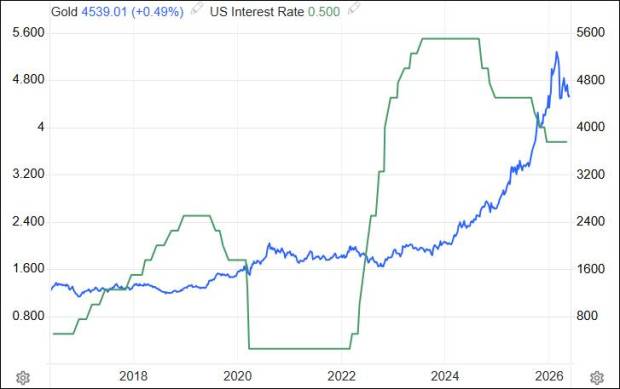
Source: Tradingeconomics; As of May 29, 2026.
What to Expect From Here
As history shows, the inverse relationship between gold and interest rates does not always work — but right now, it appears to be in play.
A positive outcome from the Iran war could bring oil prices lower, easing inflation and giving the US Fed room to cut rates. In that scenario, expect gold to move higher. If the conflict drags on and inflation stays sticky, expect the opposite — at least in the short term.
But here is an important reminder. Market volatility and economic uncertainty are inherent in financial markets. As the past has repeatedly shown, new factors emerge that completely change narratives and market dynamics. Keep an eye on the macros — but do not try to time the market. If gold is already a part of your investment portfolio, stick to the plan of allocating 10-15% without going overboard.
Disclaimer: This article is for general informational purposes only and does not constitute investment, financial, or trading advice. Past relationships between gold prices and interest rates are not indicative of future performance. Readers are advised to consult a SEBI-registered investment advisor or qualified financial professional before making any gold-related investment decisions.