and family offices, with the sharpest growth in roles tied to artificial intelligence integration, compliance and risk.
That is a hard turn from the years after 2019, when street protests, a national security law and some of the world’s strictest pandemic controls emptied trading floors and departure halls in equal measure. The question for anyone weighing a move is whether the pull is a cyclical bounce or something more durable.
What the money actually says
The headline number is striking. Total funds raised in Hong Kong, counting initial public offerings (IPOs) and follow-on issuance, rose 76% year on year to roughly USD 83.5 billion in the first eight months of 2026.
Strip out secondary fundraising and the listings story is stronger still. IPO proceeds alone reached HKUSD 342.4 billion, about USD 43.7 billion, up 153% on the same period a year earlier, according to Hong Kong Exchanges and Clearing.
The bourse recorded 106 new listings over the eight months, an 80% increase, and closed August with 2,761 listed companies carrying a combined market value of about HKUSD 47.2 trillion. Average daily turnover ran at HKUSD 282.5 billion, 14% higher than a year ago, and topped HKUSD 300 billion in June and July.
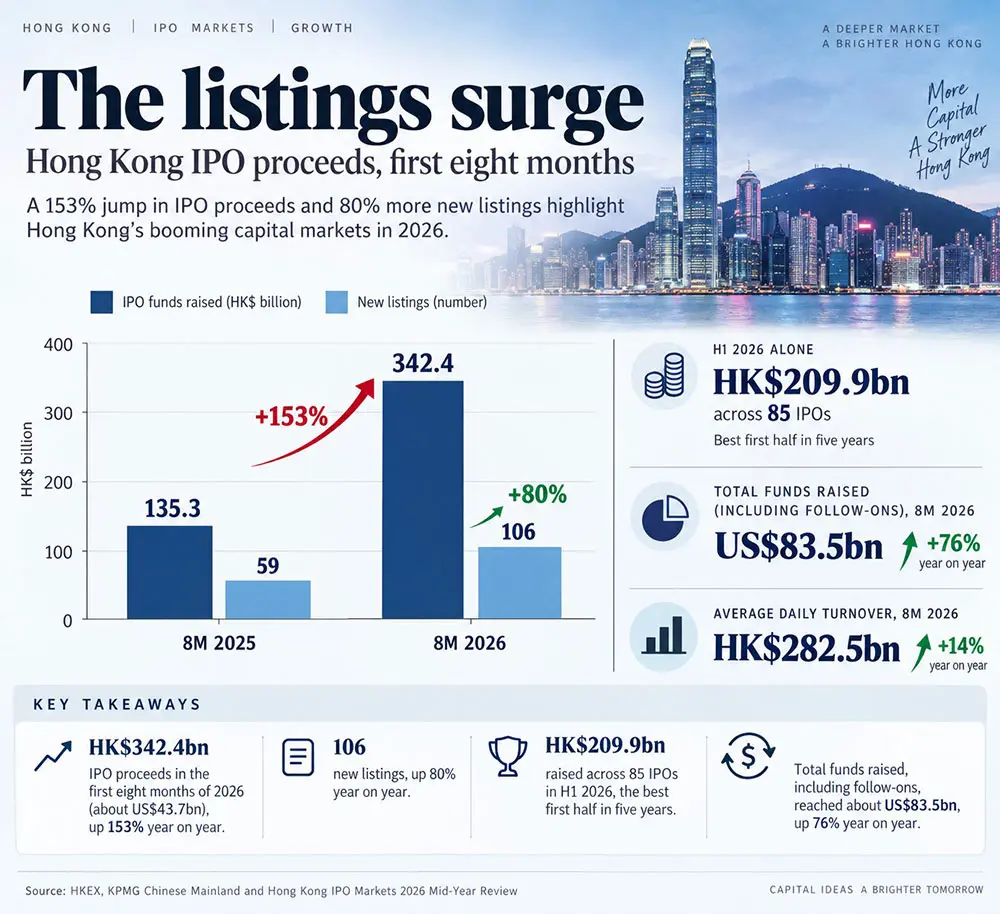
The composition matters more than the totals. KPMG’s mid-year review found Hong Kong raised HKUSD 209.9 billion across 85 IPOs in the first half, its best opening six months in five years, with 24 A+H listings and 13 specialist technology flotations together accounting for more than 70% of proceeds.
Both categories had already passed their full-year 2025 tallies by June. This is a market being rebuilt on mainland corporate demand for offshore capital and on a rule change, the Chapter 18C technology route, that Hong Kong wrote for itself.
Globally, Hong Kong finished the first half second only to Nasdaq, which was carried to the top by SpaceX’s $86.3 billion listing, the largest in history. Second place in a year containing that deal is a respectable result.
The wealth crown
Underneath the listings boom sits a quieter structural shift. Boston Consulting Group’s Global Wealth Report 2026 found that cross-border wealth booked in Hong Kong rose 10.7% during 2025 to USD 2.95 trillion, narrowly displacing Switzerland at USD 2.94 trillion and making the city the world’s largest offshore booking centre for the first time.
BCG expects the gap to widen rather than close. Hong Kong and Singapore are each forecast to grow cross-border assets at around 9% a year through 2030, against roughly 6% in Switzerland, leaving Hong Kong near USD 4.6 trillion by the end of the decade.
BCG describes offshore wealth clustering into two networks. One is anchored by Hong Kong and Singapore and serves mainland Chinese, Indian and Southeast Asian capital.
The other runs through Switzerland, the United States and the United Kingdom and handles European, Middle Eastern and Latin American money.
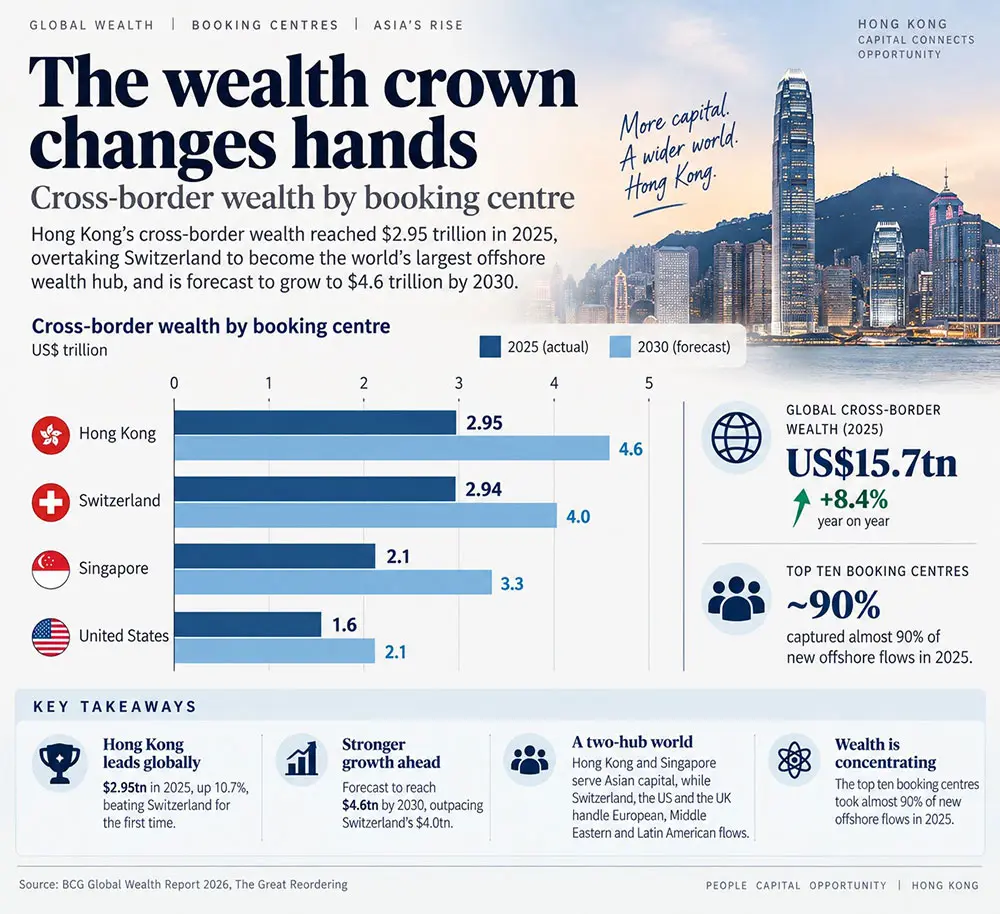
For a returning private banker, that is the relevant statistic. Wealth is concentrating into fewer hubs, and Hong Kong is now the largest of them.
The tax bet
Policy has been aimed squarely at the people, not just the capital. In June the government gazetted the Inland Revenue (Amendment) Bill 2026, covering funds, family-owned investment holding vehicles and carried interest.
Its most consequential clause would extend the existing zero rate on eligible carried interest to a far wider set of funds, structures and investment professionals, allow carry to be paid directly or through a carry vehicle, and apply retrospectively from the 2025/26 year of assessment.
The target is unmistakable. Singapore’s variable capital company regime and its family office concessions have drawn Asian wealth managers for the better part of a decade. Hong Kong’s answer is a cleaner personal tax outcome for the people who actually decide where to sit.
The bill went to the Legislative Council in late June and, as of September, has still not completed passage. Anyone modelling a move on the strength of it is pricing in an outcome that is probable rather than certain.
Property is the tell
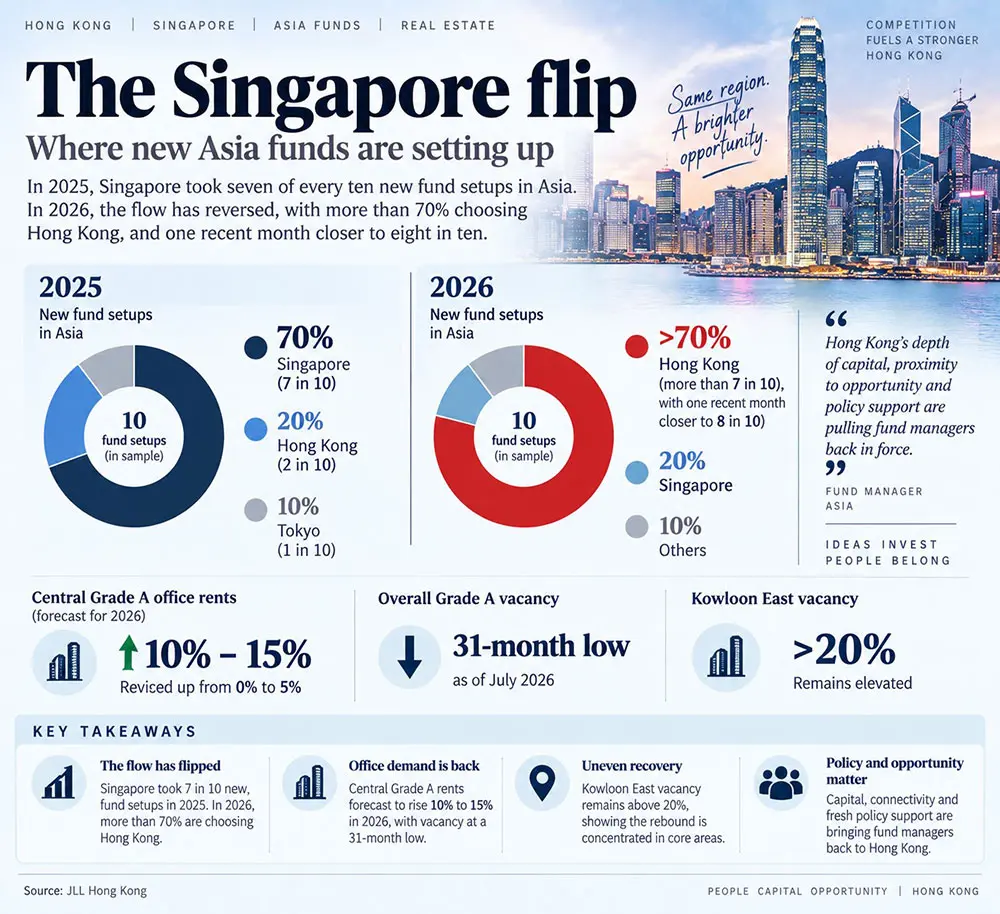
Commercial property offers the least sentimental read on whether firms are genuinely hiring. JLL revised its forecast for Central Grade A office rents upward to growth of 10% to 15% in 2026, from an earlier projection of zero to 5%, citing leasing demand from financial institutions, IPO-related activity, mainland wealth inflows and the anticipated carried interest exemption.
Central’s vacancy rate has fallen for months and overall Grade A vacancy hit a 31-month low in July.
More telling is where new funds choose to plant themselves. JLL reports that in 2025, seven of every ten new fund setups in Asia picked Singapore, against two for Hong Kong.
The visa data supports it.
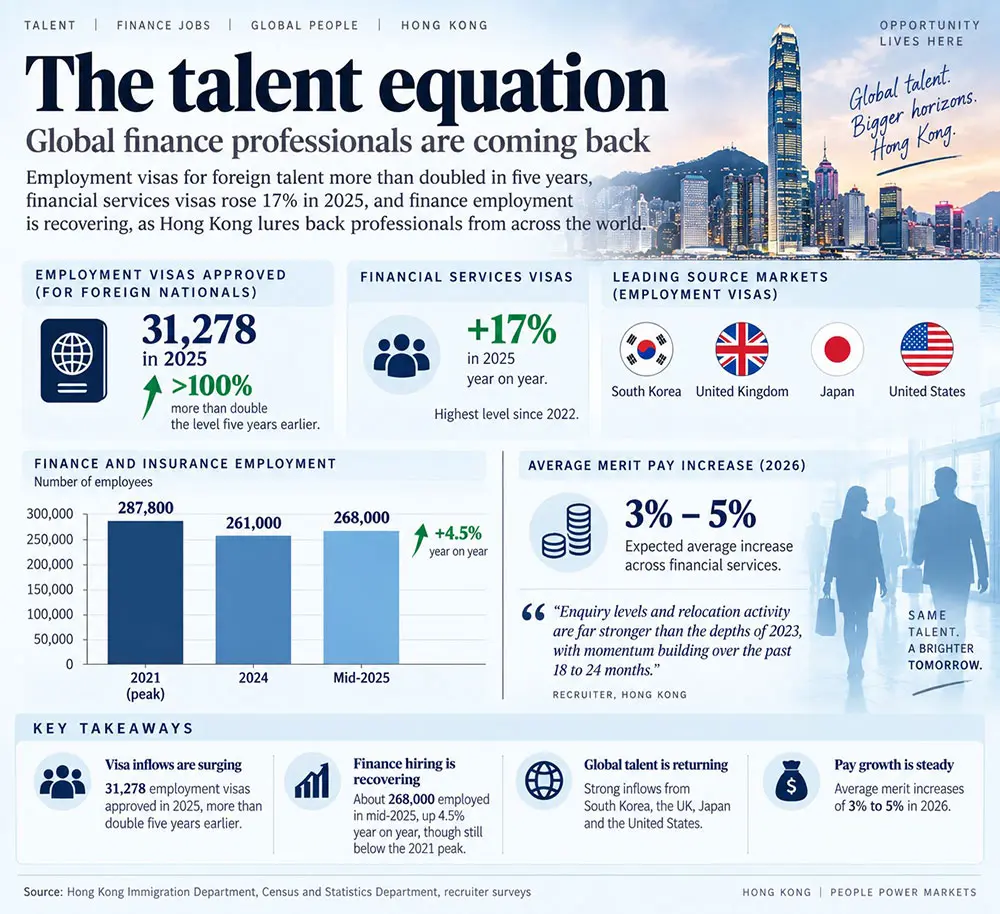
Hong Kong approved 31,278 employment visas for foreign nationals in 2025, more than double the figure of five years earlier, with financial services visas up 17% to their highest level since 2022.
South Korea, the United Kingdom, Japan and the United States led the inflow.
What has not changed
The Hong Kong that professionals are returning to remains structurally different from the one they left. The 2020 national security law criminalises secession, subversion, terrorism and collusion with foreign forces, and has been used against opposition politicians, activists and media figures.
The uncertainty it created over where the lines sit was a real factor in the original exodus. Several years of relative calm appear to have eased those worries for many in finance without removing them.
Employment tells a similarly cautious story. Finance and insurance headcount was running near 268,000 in mid-2025, up 4.5% on the year but still below the 287,800 peak of 2021.
Recruiters describe a market that is functional rather than frenzied, with live roles rising faster than offers and banks still wary after over-hiring in 2021 and 2022 and cutting soon after.
The property recovery is also narrow. Central and Tsimshatsui are tightening while Kowloon East vacancy has been running above 20%, and overall Grade A vacancy near 13.5% reflects years of supply arriving into a shrunken market.
Cost is the other quiet constraint. Residential prices found a floor in 2025 after a six-year slide and are now expected to climb again, which is good news for owners and awkward for anyone arriving with a family and a relocation budget set two years ago.
The largest risk is the one embedded in the success. BCG’s own authors note that Hong Kong is cementing its role as China’s gateway to global markets, and that the same concentration ties the city’s trajectory tightly to economic and regulatory developments on the mainland.
A market whose listings pipeline, wealth inflows and equity performance all depend on one source of capital is not diversified, however large the totals.
The read
The macro backdrop is genuinely strong. GDP grew 5.9% in the first quarter of 2026, the fastest since 2021, and 4.3% in the second, prompting the government to lift its full-year forecast to a range of 3.5% to 4.5%.
The Hang Seng Index added roughly 3,000 points in July alone, its biggest monthly gain in nearly two years.
Hong Kong has recovered its position as a venue.
The harder task, rebuilding the assumption that careers can be planned there over a decade rather than a cycle, is further from done.
The visa numbers say people are arriving. The employment numbers say the industry has not yet grown back.
Both can be true, and for now both are.