Welcome to another edition of Hidden Gems Weekly.
In recent weeks we examined a small-cap tech stock, companies benefiting from railway automation, quick-service restaurant expansion and the data centre investment cycle.
This week we look at a small-cap company positioned at the intersection of two powerful trends: expansion of India’s power transmission infrastructure and The global transition toward renewable and hydrogen-based energy systems.
Every major economic shift creates businesses most people initially overlook.
When the internet spread across the world, companies selling fibre cables quietly became critical infrastructure. When automobiles replaced horses, tyre manufacturers emerged as industry giants.
Energy transitions follow a similar pattern.
The headlines focus on solar panels, wind turbines and electric vehicles. But miss a crucial detail.
Electricity does not move by itself. It travels through transmission lines, cables and grid infrastructure stretching thousands of kilometres.
And that infrastructure must expand as the energy system evolves.
This is where a relatively small company like Advait Energy Transitions Limited comes into the picture.
The company operates in a corner of the power sector that rarely attracts attention — the equipment, tools and engineering required to build and maintain electricity transmission networks.
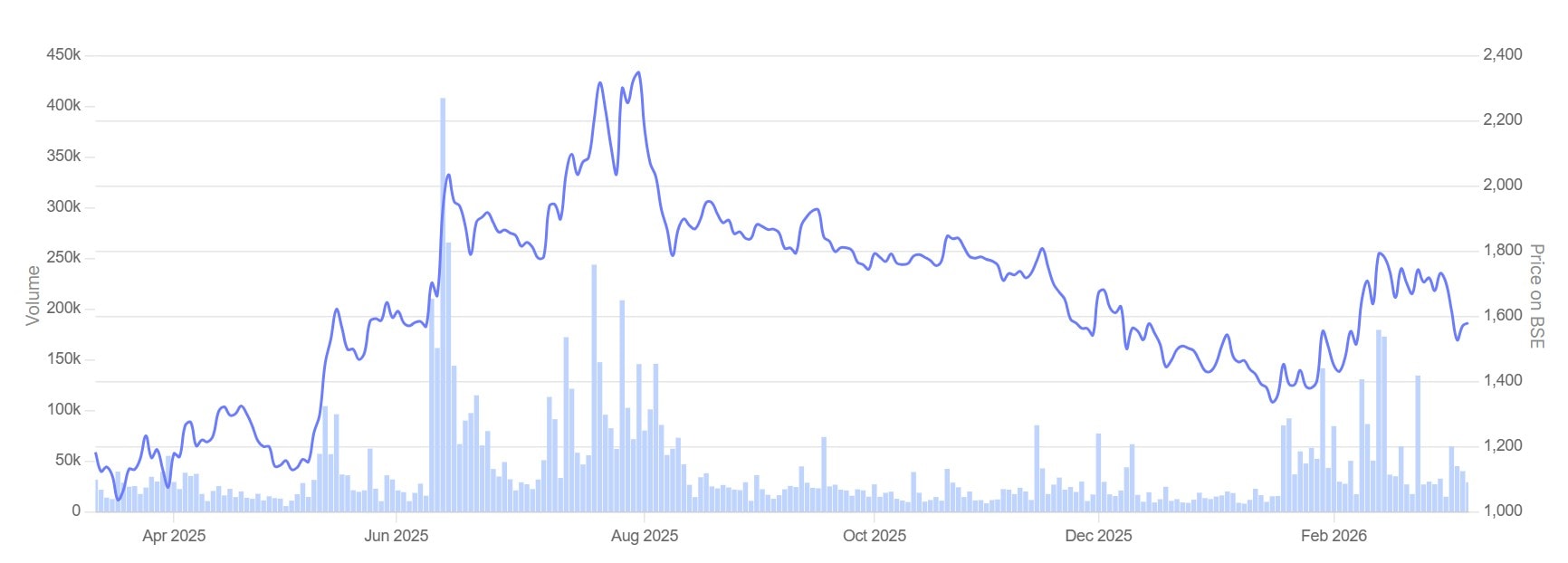
Advait Energy Transitions 1-Year Share Price Chart
A business built around electricity’s journey
Electricity is usually produced far away from where it is consumed.
Solar parks are often built in deserts. Wind farms appear along coastlines. Industrial clusters and cities lie hundreds of kilometres away.
That gap creates demand for transmission infrastructure.
Advait Energy Transitions operates precisely in this space.
The company manufactures specialised products used in power transmission networks, including aluminium-clad steel wires, optical ground wires, emergency restoration systems, and conductor stringing tools. It also undertakes engineering and EPC projects related to transmission upgrades and grid infrastructure.
Today, this remains the core of the business.
The company had an order book of Rs 1,048 crore, as of 31 December 2025. 84% of this came from the Power Transmission Solutions (PTS) division and 16% from the renewable energy segment.
That order book itself has grown rapidly, up 132% year-on-year.
Growth that is visible in the numbers
Revenue has grown rapidly. For the nine months ending December 2025, sales jumped by about 138%.
But growth rarely comes free.
Operating profit rose by around 72%, which is healthy, but not quite as fast as revenue. As a result, operating margins slipped from roughly 15% to around 11%.
The reason lies in the nature of the growth.
A large part of the recent expansion has come from EPC projects for utilities and solar developers. These projects add scale, but they usually carry lower margins than the specialised transmission equipment the company sells.
In simple terms, the company is doing more business, but a larger share of that business earns slightly less on every rupee of revenue.
The balance sheet also tells us something about how the business has evolved.
Infrastructure companies usually carry heavy debt because projects require significant capital. That does not seem to be the case here.
Total debt stood at about Rs 46 crore in FY25, rising slightly to around Rs 56 crore by the first half of FY26. This translates into a debt-to-equity ratio of roughly 0.24. Cash balances remain comfortable as well, with close to Rs 89 crore sitting in bank accounts.
For a company executing EPC projects and supplying transmission equipment, this is a relatively conservative balance sheet.
The return ratios reflect this structure.
Return on capital employed stands at roughly 26%, while return on equity is about 22%. For an infrastructure-oriented business, these are reasonably healthy numbers.
Part of the explanation lies in the nature of the business. Unlike large EPC contractors that require heavy investments in fixed assets, Advait combines specialised product manufacturing with project execution. This allows capital to move through the business a little faster.
Of course, return ratios in such businesses are closely tied to execution. If order inflows remain strong and projects are completed efficiently, returns can hold up. If not, they tend to fall just as quickly.
The company’s next big bet
While transmission infrastructure remains the core business today, management is clearly preparing for the next phase. It is investing in electrolyser manufacturing, equipment used to produce hydrogen by splitting water using electricity.
Management plans to invest around Rs 200 crore over the next two financial years to build the electrolyser manufacturing facility.
The first 30 MW electrolyser assembly plant is expected to become operational by March 2026.
Over time, the company plans to scale this capacity toward 300 MW of manufacturing capability. It estimates that once fully operational, the facility carries the potential to generate about Rs 200–300 crore in annual revenue.
In parallel, the company is also developing a multi-integrated manufacturing facility in Sanand, Gujarat, expected to commence operations around Q3 FY27.
These investments suggest the company wants to move beyond transmission equipment into the broader energy transition ecosystem.
Near-term visibility remains strong
The order book continues to provide near-term growth visibility.
One of the company’s largest recent contracts is a Rs 216 crore EPC order from Paschim Gujarat Vij Company Limited (PGVCL) for replacing existing conductors in distribution lines.
Revenue from this project is expected to begin from Q4 FY26 and continue into the following financial year.
Management has guided for around 40–45% revenue growth in FY26, supported by the current order pipeline and project execution.
Valuation reflects high expectations
At a market price of around Rs 1,583, the stock trades at roughly 37 times earnings.
That valuation suggests investors are already pricing in strong growth.
The market appears to be betting on three things.
First, that India’s power transmission infrastructure spending will continue to expand.
Second, that the company’s manufacturing and EPC capabilities will scale along with that demand.
Third, that newer segments such as hydrogen equipment and battery storage eventually contribute meaningful revenue.
If these assumptions hold, the valuation may prove reasonable.
If they do not, the market’s enthusiasm may fade.
The risks investors should keep in mind
Despite the growth story, a few uncertainties remain.
To begin with, a large portion of the company’s business comes from EPC projects for government utilities and public sector entities. In such projects, timelines are not always predictable. Approvals can take time, projects can get delayed, and revenue recognition often moves along with them.
There is also the question of the newer businesses the company is entering. Segments such as hydrogen equipment and battery storage are still developing industries. The opportunity may be large, but commercial adoption could take longer than expected.
Competition is another factor. Transmission equipment manufacturing and EPC services attract both domestic engineering companies and global suppliers, which can put pressure on margins over time.
Finally, the company is entering a capex phase. New manufacturing facilities and investments in emerging technologies will require capital today in the hope of generating revenue tomorrow. How quickly these investments translate into cash flows will matter.
The larger picture
Energy transitions rarely benefit only power generators.
They also create entire ecosystems of supporting industries — transmission infrastructure, grid upgrades, storage technologies and hydrogen equipment.
Advait Energy Transitions is attempting to position itself across several of these layers.
For now, the company’s core strength lies in transmission infrastructure.
But its longer-term ambitions clearly extend into the wider energy transition.
Whether those ambitions translate into sustained profitability remains to be seen.
But if the global shift toward cleaner energy continues, companies building the infrastructure behind that transition may quietly find themselves in the right place at the right time.
Disclaimer:
Note: We have relied on data from www.Screener.in throughout this article. Only in cases where the data was not available, have we used an alternate, but widely used and accepted source of information.
The purpose of this article is only to share interesting charts, data points and thought-provoking opinions. It is NOT a recommendation. If you wish to consider an investment, you are strongly advised to consult your advisor. This article is strictly for educative purposes only.
Manvi Aggarwal has been tracking the stock markets for nearly two decades. She spent about eight years as a financial analyst at a value-style fund, managing money for international investors. That’s where she honed her expertise in deep-dive research, looking beyond the obvious to spot value where others didn’t. Now, she brings that same sharp eye to uncovering overlooked and misunderstood investment opportunities in Indian equities. As a columnist for LiveMint and Equitymaster, she breaks down complex financial trends into actionable insights for investors.
Disclosure: The writer and her dependents do not hold the stocks discussed in this article. The website managers, its employee(s) and contributors/writers/authors of articles have or may have an outstanding buy or sell position or holding in the securities, options on securities or other related investments of issuers and/or companies discussed therein. The content of the articles and the interpretation of data are solely the personal views of the contributors/ writers/authors. Investors must make their own investment decisions based on their specific objectives, resources and only after consulting such independent advisors as may be necessary.