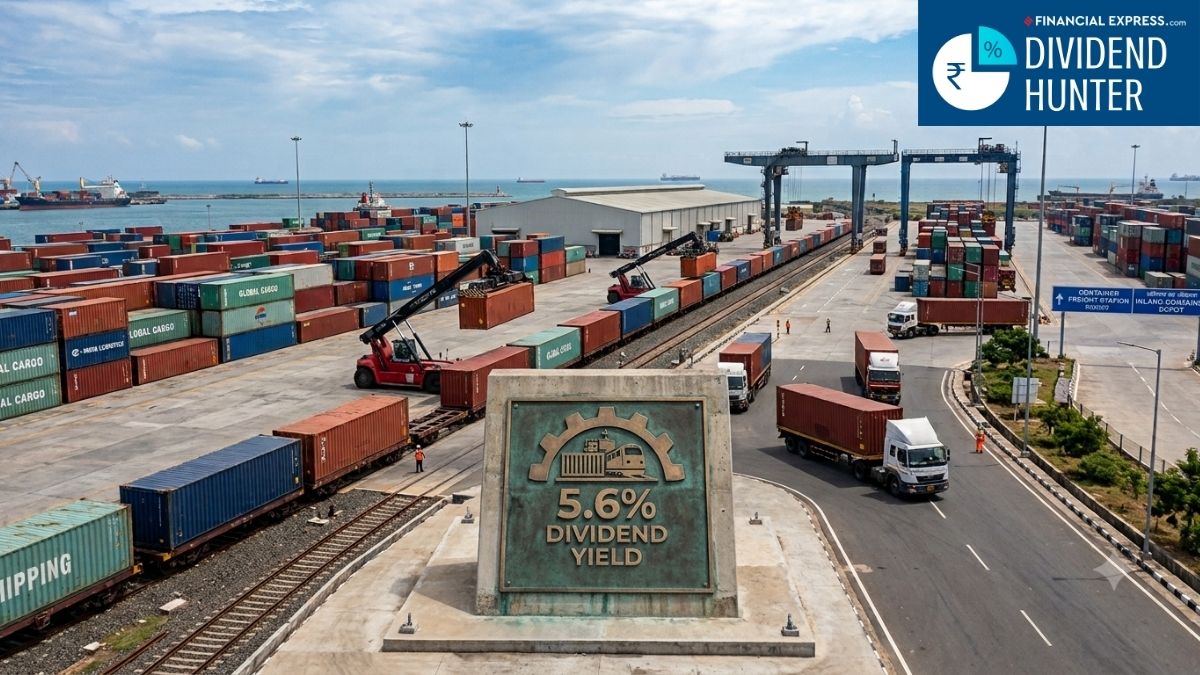
Welcome to the latest edition of Dividend Hunter. Over the past few weeks, we have analyzed companies where strong cash flows could translate into consistent dividends going forward. In our previous edition, we covered an Integrated Utility Company with ₹4,057 crore cash flow and 3.5% dividend yield. Our focus today falls on a prominent logistics provider in India. The enterprise transports cargo between major seaports and inland cities. These daily operations bring in reliable cash. The company uses this cash to reward shareholders.
The company we are focusing on in this edition of Dividend Hunter is Gateway Distriparks Limited, a logistics company.
More than 7 lakh containers, 34 trains, and over 500 transport trailers, and a network of 10 container terminals make Gateway Distriparks one of India’s leading logistics companies. The business serves as a bridge between ports and inland markets, enabling cargo to move across the country.
The company’s growth outlook is further supported by India’s ongoing logistics transformation. The PM GatiShakti National Master Plan, the National Logistics Policy, and the Sagarmala Programme are improving freight efficiency and port connectivity and reducing logistics costs. This should improve cargo movement and increase demand for the logistics provider.
Gateway Distriparks regularly pays out dividends. In fact, the company paid a total dividend of ₹3.25 per share (including a special dividend) during FY26. At a current share price of ₹57.9, that’s a dividend yield of 5.6%. Now, although the company carries some debt on its balance sheet, it has maintained strong operating cash flow generation, resulting in positive free cash flow in each of the last nine years. That’s quite a feat.
But can Gateway Distriparks sustain its dividend payments over the long term? This article attempts to answer that question by analysing the company’s cash flows, earnings, and balance sheet.
Port-to-Inland Connectivity: Inside Gateway’s 10-Terminal Multimodal Freight Network
Gateway Distriparks is a major logistics provider in India. It offers a complete range of services for moving and storing cargo, including rail, warehousing, and road transportation.
The company manages a large network across the country. It owns 10 container terminals and 1 rail-served terminal. This includes 5 Inland Container Depots in cities such as Gurgaon, Ludhiana, and Faridabad. It also operates 5 Container Freight Stations near major seaports, including Navi Mumbai and Chennai.
These facilities help customers handle customs clearance and cargo storage. The company owns a large fleet to move goods. It operates 34 trains and over 560 transport trailers. 21 of these trains are owned directly by the firm, while 13 are leased.
The company’s facilities can handle 830,000 containers at inland depots every year. The coastal freight stations can handle an incremental 525,000 containers. The total number of containers moved reached 764,065 in FY26.
Gateway Distriparks also controls a subsidiary, Snowman Logistics. The firm recently increased its ownership stake in Snowman to over 50%. Snowman specializes in temperature-controlled storage. The company operates 43 warehouses across 20 different cities in India. These facilities hold over 150,000 pallets of goods, such as food and medicine.
The Snowman Consolidation: Why a 31.6% Revenue Surge Masked Muted Net Profit Growth
Over the last 5 years, the company’s consolidated net profit grew at 22% CAGR, reaching ₹259 crore in FY26. Revenue in FY26 rose by 31.6% year-on-year to ₹2,212 crore. The consolidation of Snowman Logistics financials into Gateway Distripark boosted the revenue.
The company’s EBITDA (earnings before interest, tax, depreciation, and amortization) increased 19% to ₹497.5 crore, while margins expanded by 205 bps to 22.5%. However, net profit (without exceptional items) grew at a slower 7% to ₹259.4 crore.
Profit growth lagged revenue growth due to sharp increases in depreciation, finance costs, taxes, and operating expenses, largely driven by the consolidation of Snowman Logistics.
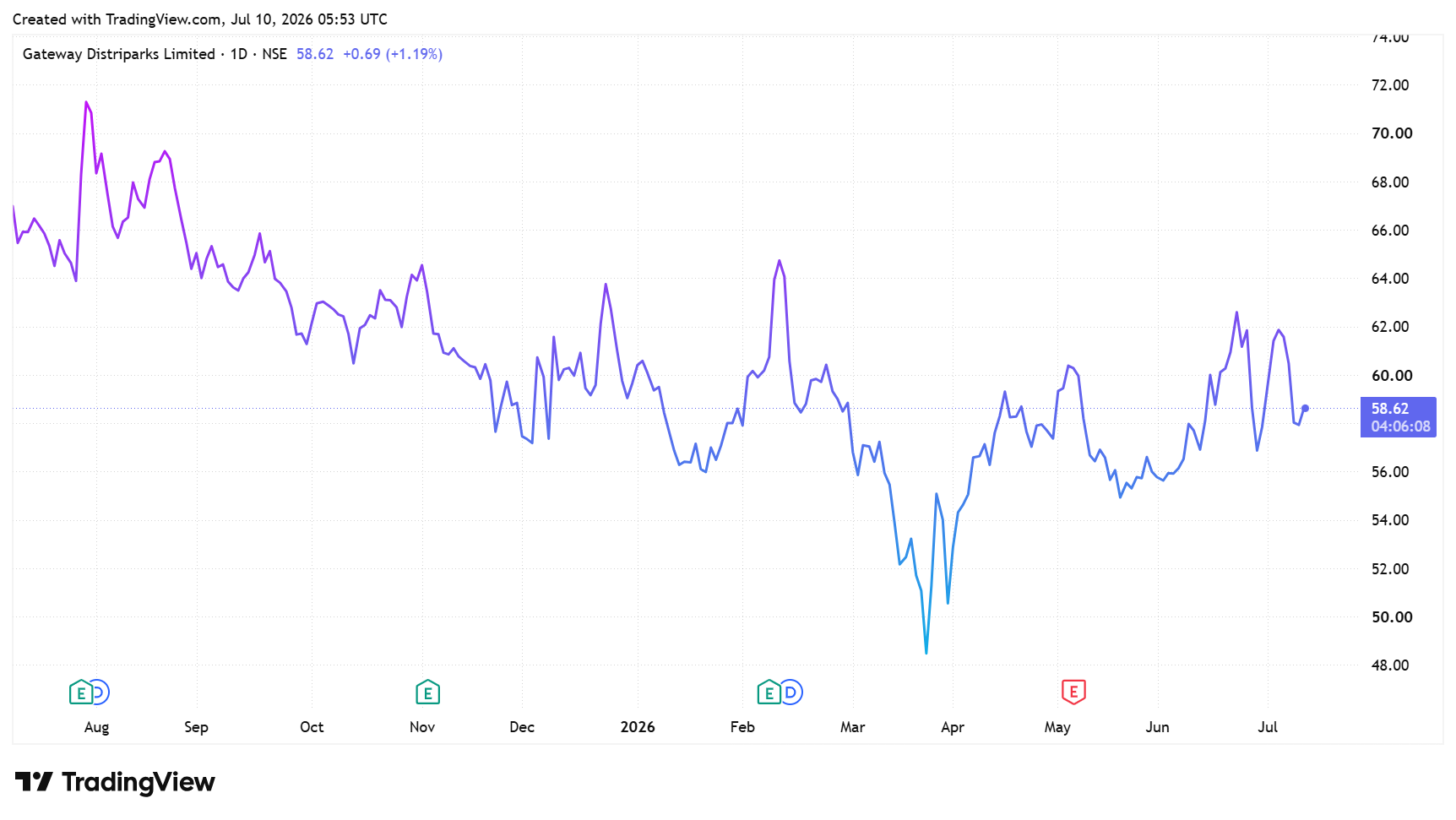
The company’s market cap is ₹2,893.6 crore, as of 9 July 2026.
Gateway Distriparks Share Price
Dissecting the Capital Efficiency: Why Mutual Fund Sales Artificially Boosted ROI to 8%
The company’s return ratios present a mixed picture.
Return on Equity (ROE) stood at 14% in FY26, up from 12% in FY25, indicating a slight improvement in shareholder returns. Return on Capital Employed (ROCE) remained stable at 17%, suggesting the company continues to generate consistent returns from its invested capital.
Gateway Distriparks aims to consistently reward its shareholders with dividends. The company funds these payments directly from cash generated by its daily operations.
Capex vs Liquidity: How ₹469 Crore in Operating Cash Funds Network Expansion
For FY26, the logistics firm reported higher cash generation. The net cash flow from operating activities surged to ₹469.1 crore, up from Rs 384.9 crore in the previous year. This steady stream of operational cash forms the backbone of its dividend policy.
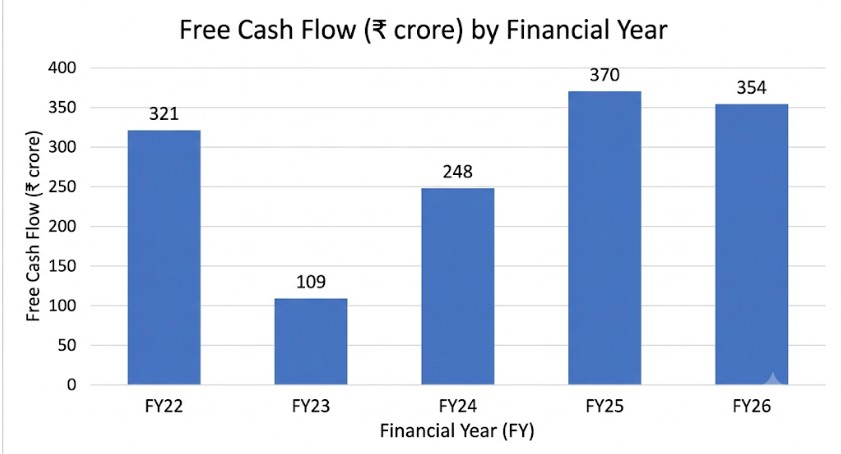
At the same time, the company is investing heavily in expanding its rail and terminal network. The net cash used in investing activities was ₹125.7 crore. A large chunk of this went into buying new property and equipment for ₹116.3 crore. Even after these capital expenses, the company had a free cash flow of ₹354 crore for the year, slightly down from ₹370 crore in FY25.
The company comfortably covered its dividend obligations. It paid out a total of ₹166.6 crore in dividends during the year. The remaining free cash helped the company improve its balance sheet. Gateway Distriparks used a significant portion of its cash for debt repayment.
It repaid ₹114.9 crore of long-term loans, while the total cash used in financing activities stood at ₹338.0 crore. The numbers show that the business generates enough cash to fund its growth, reduce its debt, and sustain its dividend payments. The company ended the year with ₹18.9 crore in cash and cash equivalents.
The Depreciation Buffer: Why Stagnant Net Profit Won’t Derail the 5.6% Yield
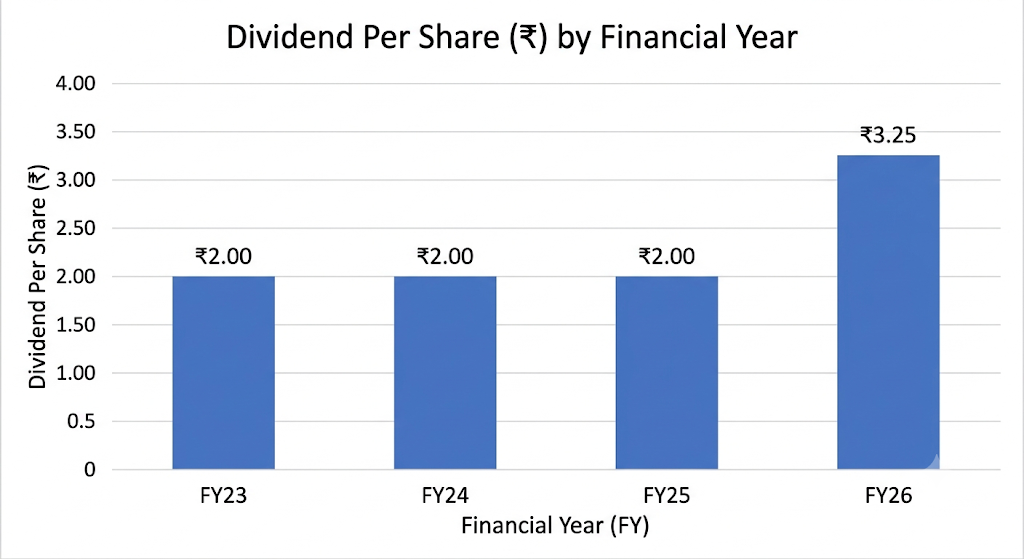
Regarding its dividend per share, the company paid ₹3.25 per share (including a special dividend of ₹1.25) in FY26. At the current share price of ₹57.9, the dividend yield is 5.6%. EX-special dividend yield also stands at a healthy 3.5%.
Prior to FY26, the company paid ₹2.0 per share consistently during FY23-25. The company currently pays mostly an interim dividend twice a financial year in February and August. This is, however, not fixed and can vary.
Dividend payouts have ranged between 27% and 42% during FY23-26. The company’s FY23 dividend payout was 42%. However, since then, it has fallen to 39% in FY26. The payout was 39% in FY24 and 27% in FY25. This may be because the company’s profits have remained stuck between ₹240 and ₹260 crore during this period.
The logistics business requires regular investments in new equipment, land, and inland container depots. This, in turn, increases depreciation expenses, impacting profits. For instance, the company’s depreciation rose from ₹104 crore in FY23 to ₹153 crore in FY26.
This higher depreciation reduces operating and net profits. However, since depreciation is a non-cash expense, it does not directly affect cash generation. As a result, the company has continued to generate healthy operating cash flows, supporting free cash flow despite the pressure on reported earnings.
This implies that even with stagnant profitability, the company can pay dividends. This is also supported by a dividend distribution policy that states the board will periodically declare interim and final dividends to shareholders. The payout, however, depends on performance, cash flows, accumulated reserves, and future outlook.
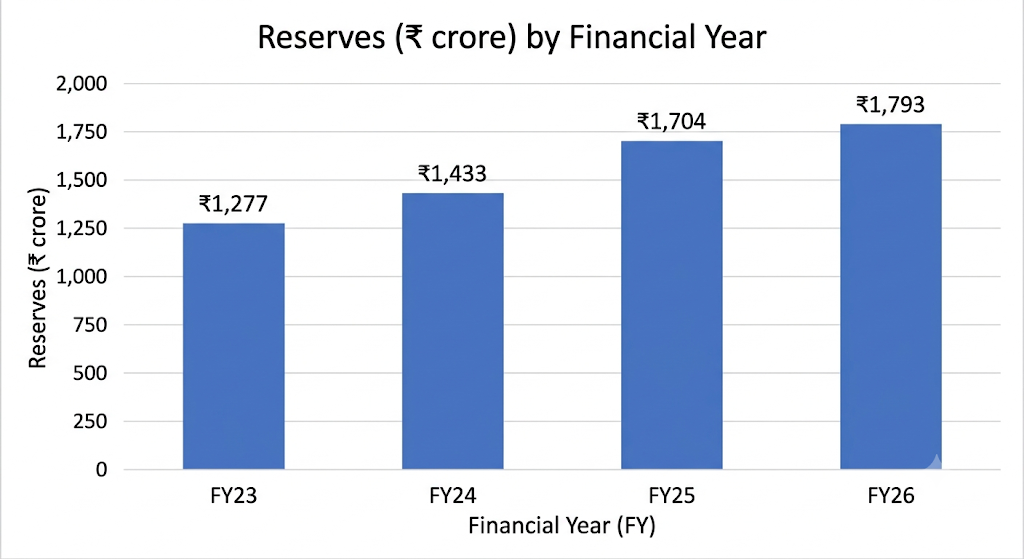
Balance Sheet Runway: How ₹1,793 Crore in Reserves Insulates Payout Durability
Beyond cash flows, the company’s reserves (FY26: ₹1,793 crore) have also steadily grown over the years. This provides an additional financial bandwidth for future dividend distributions and strengthens the company’s ability to maintain dividends even during periods of muted earnings growth. That said, improving earnings would make the payout more durable.
The management has laid out clear growth targets for the coming years.
The FY29 Roadmap: Cold Chain Pivots and Strategic Land Aggregation in Indore and Jaipur
Snowman Logistics is pursuing an ambitious target of reaching ₹ 1,000 crore in revenue by FY29, up from ₹604 crore in FY26. Gateway Distriparks targets a 15% volume growth for its core rail segment. This growth will be supported by the addition of the new terminals in Ankleshwar, Indore, and Jaipur. The container freight station business is expected to grow at a modest 5%.
To grow the business, the company is actively investing in new physical assets. It acquired about 25 acres of land near Indore to build a new inland container terminal with a planned capacity of 120,000 TEUs. This project requires an investment of ₹150 crore. The firm is also setting up another facility in Jaipur on 21.4 acres of land.
The company will fund these expansions using the cash it generates. At the same time, the company is creating new revenue streams by focusing on domestic cargo. It started domestic operations at the Multi-Modal Logistics Park in New Ankleshwar under a 15-year exclusive agreement.
The firm recently secured a tender to handle steel coil rakes for ArcelorMittal at this location. This will help the business counter the volatility in international trade. Snowman’s growth could be fueled by increased demand for cold chains.
It is also intentionally reducing its dry warehousing capacity to accommodate more frozen cargo. This move aims to capture the shift towards frozen goods, which improves the business’s overall yields. The management is also securing price hikes during contract renewals to protect and improve profit margins.
The geopolitical conflicts and supply chain disruptions remain the core risk. For example, disruptions to shipping schedules due to the ongoing conflict in the Middle East impacted its business in FY26.
Relative Valuations: Tracking the Multiple Compression Against Sector Peers
Valuation-wise, Gateway Distripark trades at an EV/EBITDA multiple of 7.2x, a discount to its 10-year historical median (10.2x), the sector median (11.1x), and larger peers such as TVS Supply (8.3x) and Transport Corporation (11.4x). This gap has persisted due to their better profitability.
The Dividend Hunter Verdict: Weighing Capex Allocation Against Long-Term Yield Resilience
The conclusion is that Gateway Distriparks is well-positioned to continue its dividend payments. The business does carry existing loans. But the company generates sufficient cash flow to service this debt and fund expansions directly from its earnings.
The real support for these regular payouts is the core logistics operation. Gateway generates a steady cash flow from its rail transport and container storage activities. This daily business builds a comfortable financial safety net.
This reliable cash generation gives the company the financial room to balance two main targets. It can pour money into long-term physical assets and still return cash to its shareholders. Gateway could be able to sustain its dividend policy as long as the terminal network remains efficient and cargo income remains stable.
Dividend hunters should add this stock to their watchlist.
Disclaimer:
Note: Throughout this article, we have relied on data from http://www.Screener.in and the company’s investor presentation and conference call. Only in cases where the data were unavailable have we used an alternative, widely accepted source of information.
The purpose of this article is only to share interesting charts, data points, and thought-provoking opinions. It is NOT a recommendation. If you wish to consider an investment, you are strongly advised to consult your advisor. This article is strictly for educational purposes only.
About the Author: Madhvendra has been deeply immersed in the equity markets for over seven years, combining his passion for investing with his expertise in financial writing. With a knack for simplifying complex concepts, he enjoys sharing his honest perspectives on startups, listed Indian companies, and macroeconomic trends.
A dedicated reader and storyteller, Madhvendra thrives on uncovering insights that inspire his audience to deepen their understanding of the financial world.
Disclosure: The writer and his dependents do not hold the stocks discussed in this article.
The website managers, their employees (s), and contributors/writers/authors of articles have or may have an outstanding buy or sell position or holding in the securities, options on securities, or other related investments of issuers and/or companies discussed therein. The articles’ content and data interpretation are solely the personal views of the contributors/ writers/authors. Investors must make their own investment decisions based on their specific objectives, resources, and only after consulting such independent advisors as may be necessary.