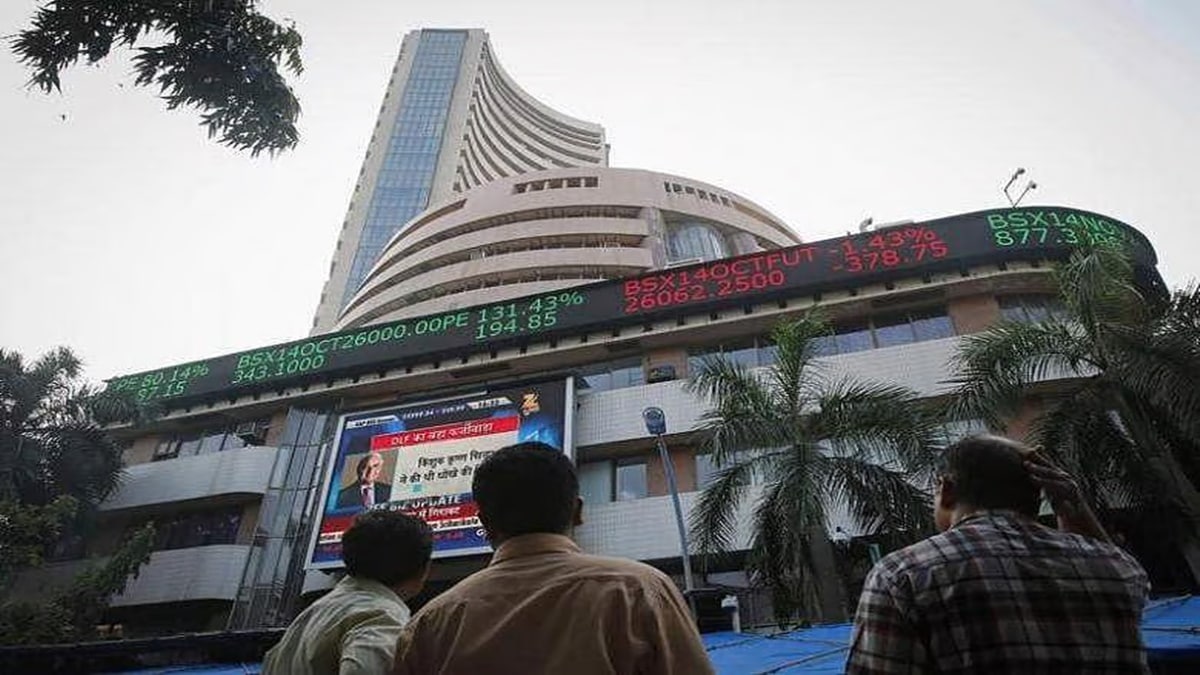
Indian equity benchmarks saw a sharp selloff in the late trade today (May 29). The selloff intensified towards the closing hours, dragging both benchmark indices deep into the red. The Sensex plunged 1092.06 points, or nearly 1.44%, to settle at 74,775.75. On the other hand, the Nifty declined over 359.40 points, or 1.5%, to close below the crucial 23,500 mark.
The Nifty Bank index also came under pressure and dropped 614 points, or 1.12%, to settle near the 54,200 level.
Here’s a closer look at the six major reasons that weighed on Dalal Street during the late trade.
MSCI rejig triggered sharp late trade selloff
A key factor behind Friday’s sharp late-session selloff was the MSCI May 2026 index rebalancing.The sharp increase in volatility was largely linked to passive institutional flows triggered by the index adjustment process. As global index provider MSCI implemented its latest changes, several stocks saw heavy buying and selling activity near market close.
As part of the latest MSCI review, shares of Federal Bank, Indian Bank, Multi Commodity Exchange of India (MCX) and National Aluminium Company were added to the MSCI Global Standard Index.
Weak monsoon outlook and inflation fears trigger caution
Market sentiment turned weak after concerns emerged around the India Meteorological Department’s (IMD) monsoon forecast and the possibility of an El Niño weather pattern impacting rainfall this year.
“The market witnessed broad-based selling pressure following the IMDs monsoon forecasts to 90% of the long period average (LPA), raising concerns among investors. The prospect of deficient rainfall, coupled with the increasing likelihood of an El Niño weather pattern, has heightened fears of elevated food inflation in the coming months,” said Vinod Nair, Head of Research, Geojit Investments.
At the same time, he noted that some downside risks were partially offset by easing crude oil prices and softer bond yields globally.
“However, the downside risk appears partially mitigated by the recent moderation in crude oil prices and bond yields. Additionally, global sentiment remains supported by expectations of a potential diplomatic breakthrough between the US and Iran, which has contributed to a rally in international markets,” he added.
“In the near term, investor attention is expected to shift toward key domestic triggers, particularly the upcoming RBI monetary policy decision and GDP data release, which will provide further insights into the inflation trajectory and overall economic momentum,” he said.
Uncertainty around the US-Iran peace developments
Another biggest triggers behind the market weakness remained uncertainty surrounding the reported ceasefire and shipping agreement between the United States and Iran.
Reports suggested that both countries had reached a preliminary understanding to extend the ceasefire and ease restrictions on shipping movement through the Strait of Hormuz. However, confusion continued after United States President Donald Trump reportedly did not formally approve the agreement, while Iranian state media indicated that the deal had not yet been finalised.
The uncertainty kept global investors cautious because the Strait of Hormuz remains one of the world’s most important crude oil shipping routes.
Heavy selling in market heavyweights
The late-session decline also accelerated because of broad-based selling across heavyweight stocks from multiple sectors including financials, automobiles, metals and consumer goods.
At market close, Hindustan Unilever declined 3%, while Bajaj Finance slipped 3%. Tata Steel fell 3%, and Mahindra & Mahindra dropped 3%.
Meanwhile, InterGlobe Aviation, the parent company of IndiGo, declined 3.5%, while Power Grid Corporation of India emerged among the top laggards, falling over 4% by the closing bell.
Foreign investors continue to remain sellers
Another key factor weighing on sentiment remained continued foreign institutional investor selling.
Persistent global uncertainty, elevated crude oil prices, rising United States bond yields and concerns over emerging market flows have continued to keep overseas investors cautious on Indian equities.
India VIX spikes sharply
Market volatility also increased sharply during the session.
India VIX, often referred to as the market’s fear gauge, jumped nearly 9% to around 16.35 during the session.
A rise in the India VIX typically signals higher uncertainty and nervousness among traders. It also reflects expectations of increased market swings in the near term.
Almost all sectors ended deep in the red
Sectoral weakness remained widespread throughout the session, indicating broad-based risk aversion among investors.
The Nifty Auto index declined nearly 2%, while the metal index also slipped around 2% amid concerns over global demand and commodity price volatility.
Financial stocks remained under pressure, with the Nifty Financial Services index falling over 1.5%.
Meanwhile, pharmaceutical, healthcare and real estate stocks also witnessed sharp declines of more than 1.5% during the session.
The oil and gas sector emerged among the worst-hit pockets of the market, declining nearly 2.5% amid crude oil volatility and geopolitical concerns.