Welcome to the latest edition of Dividend Hunter Weekly. Previously, we examined a debt-free IT Player with a 32% ROE, offering 7% dividend yield, a Public Sector Undertaking with 6% yield, and zero debt, and a debt-free media company offering 6% dividend yield. This week, we examine India’s first private sector port company located on the Southwest Coast of Gujarat.
Gujarat Pipavav Port provides crucial access to India’s North and North-West cargo belt. As a leading multi-cargo port, the company leverages its unique selling proposition (superior rail connectivity and efficient cargo evacuation) to sustain strong and consistent growth in its Liquid and RoRo (automotive) cargo volumes.
This robust volume growth, combined with efficient cash generation and cost-control measures, enables the company to consistently distribute profits to its shareholders as dividends. It recently declared its highest-ever cumulative dividend payout in FY25. But will the payout sustain in the coming years? Let’s find out using our Dividend Hunter Screen.
Gujarat Pipavav Stock: Why it Passed the 7-Point ‘Dividend Hunter’ Screen
In this context, we select stocks that can pay dividends in the upcoming quarters. We select these stocks (excluding InVITs and REITs) using a screen that meets the following broad criteria.
- Dividend yield above 2%.
- Payout ratio below 100%.
- At least one of 3, 5, or 7-year profit growth above 5%.
- Five-year average dividend greater than zero.
- The latest dividend is higher than the five-year average.
- The latest profit is at least 80% of the previous year’s profit.
- Market capitalization above ₹1,000 crore.
After Alldigi Tech, Coal India, and DB Corp, Gujarat Pipavav is the fourth company to meet these criteria. At current prices, the company offers an attractive 5%+ dividend yield (based on historical payouts).
Let’s dig into the company to see how it is performing and whether that can give us any clues about future payouts.
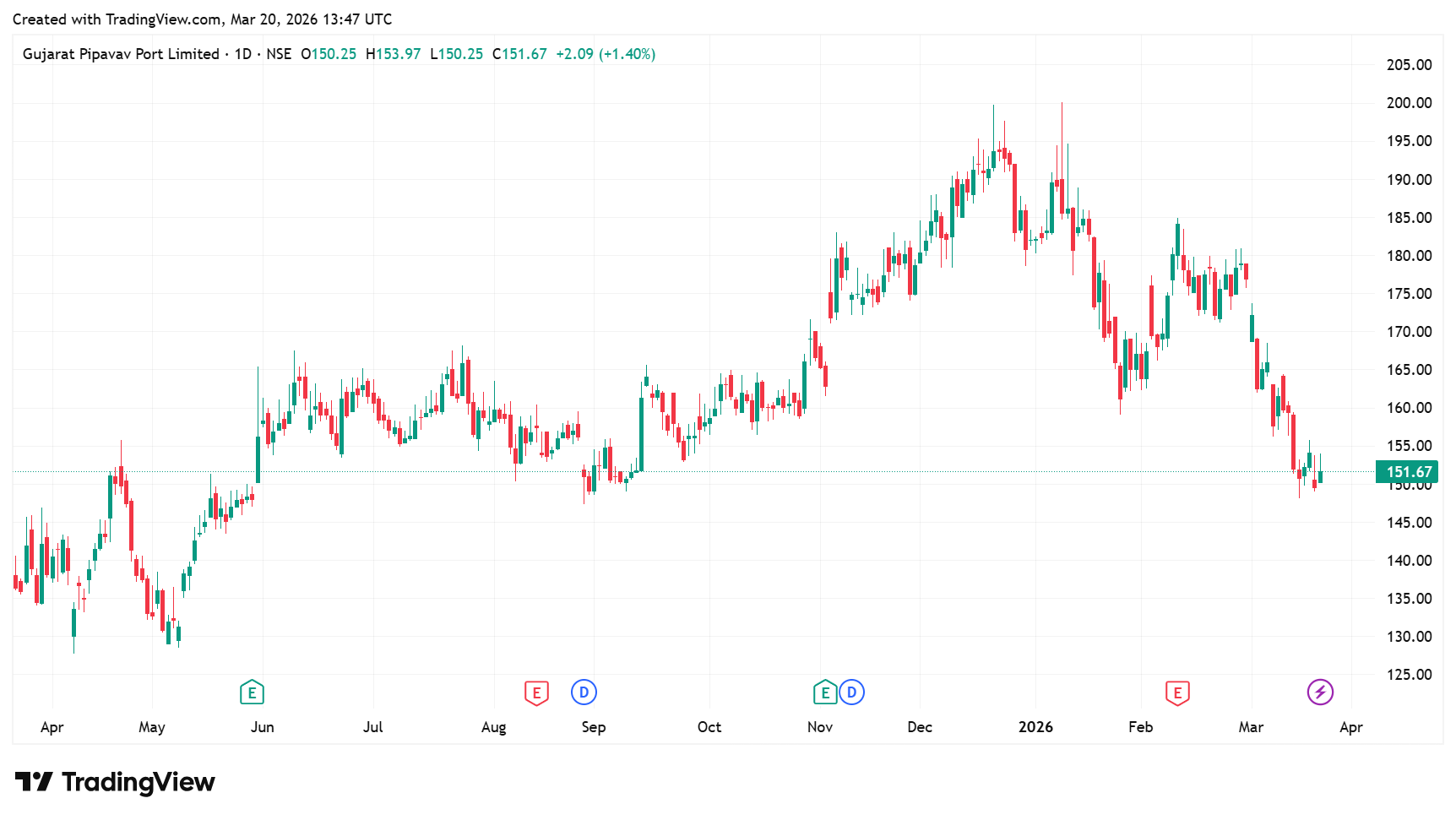
Gujarat Pipavav Share Price
Strategic Moat: How the Maersk Connection Shields the Top Line
Gujarat Pipavav is owned by APM Terminals (part of the A.P. Moller-Maersk group). APM Terminals operates a global network of 60 ports and terminals across 33 countries, leveraging its expertise to manage operations at Pipavav Port.
Gujarat Pipavav develops, manages, and operates the port. It operates India’s first private sector port under a 30-year Concession Agreement (on a Build-Own-Operate-Transfer basis) with the Gujarat Maritime Board and the Government of Gujarat.
Located in the Saurashtra region of Gujarat on the south-west coast of India (about 152 nautical miles north-west of Mumbai), it is an all-weather port that serves as a principal gateway on the West Coast. It provides crucial access to international maritime trade routes and vital inland connectivity to the cargo belt in the North and North-West regions of India.
It facilitates port operations for four primary types of cargo: containers, dry bulk, liquid cargo, and roll-on/roll-off. In addition to cargo handling, the company generates revenue by providing a comprehensive suite of port and marine services, including vessel berthing, cargo handling, storage operations, and other value-added services.
Furthermore, Gujarat Pipavav serves as a major offshore supply base for ONGC, providing jetty facilities, open yard space, and covered warehousing for ONGC’s offshore supply vessels and installations in the Arabian Sea.
The Unique Selling Proposition Moat
The port’s central Unique Selling Proposition is its superior rail infrastructure and efficient cargo evacuation capabilities. This is strongly supported by its 38.8% ownership stake in Pipavav Railway Corporation, an associate company that operates the railway line connecting the port to the national railway network (Surendranagar Junction).
This rail link provides cost-efficient, single-window transportation solutions for containers, LPG, and automotive cargo straight into the Indian hinterland.
Q3 FY26 Forensic: Volume Growth Meets the Strait of Hormuz Headwinds
The company’s market cap is ₹7,381 crore, as of 20 March 2026.
Over the last 3 years, net profit has grown at a 27% CAGR. Revenue from operations stayed flat at ₹988 crore in FY25. EBITDA (Earnings Before Interest, Tax, Depreciation and Amortisation) stood at ₹577.6 crore, with a 58.5% margin. Net profit surged 13% to ₹399 crore, driven by favourable cargo mix, cost control, and absence of exceptional items.
Further, the financials also grew strongly in Q3 FY26.
Revenue increased 11% year-on-year to ₹292 crore, due to increased activity in Bulk handling, RoRo, automotive cargo, and ONGC offshore supply base operations. EBITDA for the quarter grew 16% to ₹160.4 crore, with a 55% margin. Net profit surged 8% to ₹101 crore.
The company’s return ratios remain robust. Return on Capital Employed (ROCE) has risen to 23.5% (up from 21% in FY24), Return on Net Worth (RONW) stands at 19% (compared to 17% in FY24), and Return on Investment has increased to 20%, up from the previous 18%.
Debt-Free & Cash-Rich: Inside Gujarat Pipavav’s ₹1,069 Crore Balance Sheet
Gujarat Pipavav Port maintains a highly robust balance sheet. The company has no outstanding fund-based facilities or term loans and remains completely debt-free. The company’s liquidity position is remarkably strong, with total cash and bank balances of about ₹1,069 crore as of 31 March 2025.
The company funds its activities primarily through the cash generated from its operations. Net Cash Inflow from Operating Activities stood at ₹446 crore in FY25, compared to ₹485 crore in FY24. The company’s Capital Expenditure was ₹95 crore, up from ₹71 crore in FY24.
This gives a Free Cash Flow generation of roughly ₹351 crore in FY25, down from ₹414 crore in FY24. This strong free cash flow and zero-debt status are the exact factors that successfully support the company’s Dividend Distribution Policy.
Gujarat Pipavav’s Dividend Policy: Why Payouts Remain Sustainable
On the back of such cash flow, the company has already paid an interim dividend of ₹5.4 in FY26 Year-To-Date (YTD). This translates to a dividend yield of 3.5% YTD in FY26. Historically, Gujarat Pipavav has consistently paid dividends each year over the last five financial years.
Furthermore, the dividend has been increased every year during FY22-FY25, and given its track record of paying final dividends, it is likely to be raised again in FY26. It paid a dividend of ₹8.2 in FY25, translating into a dividend yield of 5.4% as per the current price of ₹153 per share.
In FY24, the dividend was ₹7.3 per share, ₹6.1 in FY23, ₹4 in FY22, and ₹4.5 in FY21. Collectively, in FY26 YTD, the company has already paid 90% of the last 5-year average dividend (₹6.0). The dividend payout has consistently been less than the 100% threshold required by our filter.
The ₹17,000 Crore Gambit: Growth vs. Dividend Sustainability
Gujarat Pipavav’s primary objective is to maintain a steady, consistent distribution of profits to its shareholders. But it may choose to retain earnings rather than distribute them under specific circumstances. But it maintains the flexibility to retain earnings rather than pay them out.
The payout ratio could be adjusted downward if funds are needed for business expansion, if the company faces weak trade growth, or if it needs to infuse equity into its joint venture, Pipavav Railway Corporation.
In this context, management declined to give forward-looking guidance on future payout ratios, given its proposed ₹17,000 crore investment plan. It noted that any shift in capital allocation and dividend payouts is strictly at the Board of Directors’ discretion, subject to final approval by shareholders at the Annual General Meeting.
Container Recovery & Suez Canal: What Management Says About the Turnaround
Looking ahead, management is cautiously optimistic about a turnaround in the container segment, noting early green shoots with a 7% sequential volume growth. Structural initiatives with Maersk have also yielded a 15% volume growth over the January to December period.
Despite these positive indicators, management prefers to wait for Q4 data for confirmation. However, note that the recent blockage of the Strait of Hormuz may slow down the probable turnaround.
Scaling to 5 MMT: The Liquid Cargo Expansion and the 3X Pumping Multiplier
To meet future demand in the liquid cargo and infrastructure sectors, large-scale infrastructure expansion is currently underway. The local LPG tank farm operator is commissioning new cryogenic tanks, which will improve the pumping rate by approximately 3X and free up valuable waterfront capacity.
The Kla Gorapur (KGP) pipeline is expected to connect to the port between March and June of the current year. The Board has approved a $90 million capital expenditure for a new liquid berth, targeted for commissioning by December 2026. This will increase the port’s overall liquid capacity from the current 1.6-1.75 million metric tons (MMT) to approximately 5-5.2 MMT.
Beyond Containers: The 450,000-Car Ambition and RoRo Dominance
Automotive exports have registered a 39% sequential increase in volume. To maintain this momentum, it is expanding its RoRo staging capacity by building a new 60,000-square-meter staging area. Of this, half is expected to be completed in Q4FY26 and the remainder in Q1FY27.
Once completed, the port’s car-handling capacity will grow from 250,000-300,000 cars to 400,000-450,000 cars. Furthermore, it has upgraded its rail yard infrastructure by adding an additional siding, enabling it to handle two-car trains simultaneously and improve evacuation efficiency.
Funding a ₹17,000 Crore Vision: Will Dividends Take a Backseat to Capex?
Its long-term outlook hinges on renewing its current port concession agreement, which is valid until September 2028. Management notes that engagements with the Gujarat Maritime Board are moving in the right direction, with no red flags. It has also proposed a capex of ₹17,000 crore to upgrade container-handling infrastructure and ensure long-term sustainability.
Valuation: Is Gujarat Pipavav Trading at a Discount to Peers?
Valuation-wise, Gujarat Pipavav trades at an EV/EBITDA multiple of 8.86x, at a discount to the 5-year historical median of 9.5X. The valuation is at a steep discount with market leaders like Adani Ports (15.2X) and JSW Infra (19.9X).
Is Gujarat Pipavav a stock that Dividend Hunters should track?
Undoubtedly, Gujarat Pipavav meets the key Dividend Hunter filters. It has a steady profit growth, strong cash flows, and a payout ratio within thresholds. Given a yield of 5.4%, higher profitability, a consistent historical record of dividend payments, and a dividend payout policy, it appears likely that the dividend payout trend will continue.
However, sustainability will depend on future profitability and capex momentum. Dividend hunters should add this stock to their watchlist and see if it continues to deliver a lucrative dividend yield.
Disclaimer:
Note: Throughout this article, we have relied on data from http://www.Screener.in and the company’s investor presentation. Only in cases where the data were unavailable have we used an alternative, widely accepted, and widely used source of information.
The purpose of this article is only to share interesting charts, data points, and thought-provoking opinions. It is NOT a recommendation. If you wish to consider an investment, you are strongly advised to consult your advisor. This article is strictly for educational purposes only.
About the Author: Madhvendra has been deeply immersed in the equity markets for over seven years, combining his passion for investing with his expertise in financial writing. With a knack for simplifying complex concepts, he enjoys sharing his honest perspectives on startups, listed Indian companies, and macroeconomic trends.
A dedicated reader and storyteller, Madhvendra thrives on uncovering insights that inspire his audience to deepen their understanding of the financial world.
Disclosure: The writer and his dependents do not hold the stocks discussed in this article.
The website managers, its employee(s), and contributors/writers/authors of articles have or may have an outstanding buy or sell position or holding in the securities, options on securities, or other related investments of issuers and/or companies discussed therein. The articles’ content and data interpretation are solely the personal views of the contributors/ writers/authors. Investors must make their own investment decisions based on their specific objectives, resources, and only after consulting such independent advisors as may be necessary.