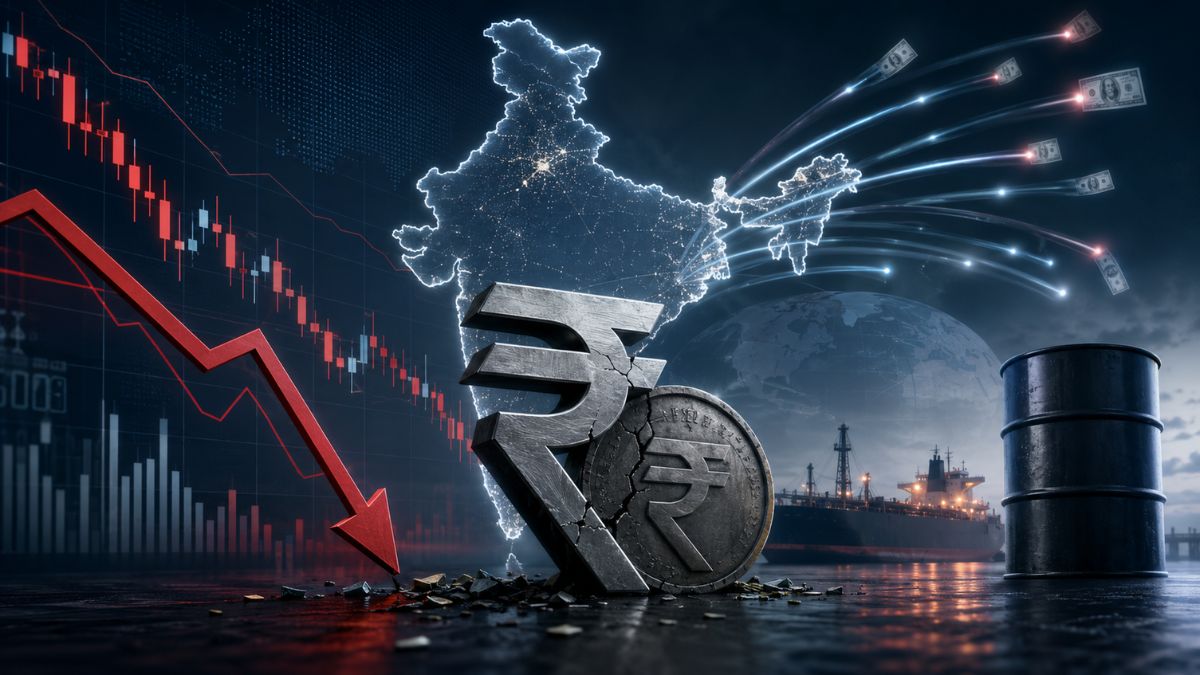
Foreign investors continued to cut exposure to Indian equities in May, pulling out Rs 32,963 crore during the month amid weak earnings growth, rupee depreciation and better opportunities in other global markets weighed on sentiment.
With this, Foreign Portfolio Investors’ net outflow from Indian equities in 2026 has reached Rs 2.25 lakh crore, higher than the Rs 1.66 lakh crore withdrawn during the whole of 2025, according to NSDL data.
The May number, though still large, marks a moderation from the heavy selling seen in March and April. FPIs had pulled out a record Rs 1.17 lakh crore in March and another Rs 60,847 crore in April. Since March, when the West Asia conflict and oil market disruption began to dominate macro risks, cumulative FPI equity outflows have stood at about Rs 2.11 lakh crore.
| Month | FPI equity flow |
| January 2026 | -Rs 35,962 crore |
| February 2026 | +Rs 22,615 crore |
| March 2026 | -Rs 1.17 lakh crore |
| April 2026 | -Rs 60,847 crore |
| May 2026 | -Rs 32,963 crore |
| Total 2026 so far | -Rs 2.25 lakh crore |
| Cumulative outflow since March | About -Rs 2.11 lakh crore |
Why FPIs are selling India
Market experts interviewed by PTI have previously stated that FPIs have been selling Indian equities because of a mix of domestic and global factors. Subdued earnings growth in India, a weaker rupee and strong performance in other markets have made foreign investors more selective.
In a conversation with PTI, Geojit Investments Chief Investment Strategist V K Vijayakumar said that weaker earnings growth in India, compared with stronger corporate performance in markets such as the US, Japan, South Korea and Taiwan, has pushed some foreign capital overseas.
He also pointed to the artificial intelligence-led rally in South Korea and Taiwan as one reason why foreign investors have found those markets attractive.
A weaker rupee has added another layer of concern. When the rupee falls, dollar-denominated returns for foreign investors take a hit even if Indian stock prices remain stable.
Reuters reported that the rupee recently weakened to around 95.68 against the dollar, with crude prices and uncertainty around a US-Iran peace deal weighing on Asian currencies.
Sachin Jasuja, Head of Equities and Founding Partner at Centricity WealthTech, said the rupee’s depreciation has become a key reason for continued FPI selling.
He told PTI that the rupee has weakened nearly 6% so far in 2026 and around 10% over the past year, falling from the mid-80s to about 95.5 against the US dollar despite RBI efforts to manage volatility.
Crude oil and the currency problem
India’s dependence on imported crude has made the current global situation more sensitive for markets. India imports more than 60% of its crude oil requirement, which means a sharp rise in global oil prices can quickly increase the import bill, widen the current account deficit and add pressure on the rupee.
Brent crude has moved sharply higher at different points during the West Asia crisis, with markets closely tracking developments around the Strait of Hormuz. Reuters reported that crude prices jumped as hopes of an early US-Iran peace deal faded, contributing to pressure on the rupee.
This is why the issue is no longer limited to stock market flows. It has become a broader macro concern involving fuel costs, raw material costs across critical industries, inflation and foreign exchange management.
Finance Minister Nirmala Sitharaman recently said India’s economy remains robust, but external pressures are being felt through the “3Fs” — fuel, fertiliser and forex. She also backed Prime Minister Narendra Modi’s call for conserving fuel and foreign exchange amid the global uncertainty.
Former Planning Commission Deputy Chairman Montek Singh Ahluwalia has also underlined the macro risk from oil prices and the rupee. In an Idea Exchange interaction with The Indian Express, he said India should prepare for crude oil prices above $100 per barrel if the West Asia conflict drags on, while warning that energy and fertiliser-related pressures could affect the economy.
On the rupee, Ahluwalia argued that some depreciation was “pretty much unavoidable” when external conditions turn adverse. He said allowing the exchange rate to reflect market conditions was not necessarily the wrong decision.
Selling has moderated, but reversal may take time
Notably, the pace of FPI selling eased in May compared with March and April, market analysts interviewed by PTI portray this development as an indicator that foreign investors may no longer be reducing India exposure as aggressively as they were earlier in the year.
Himanshu Srivastava, Principal – Manager Research at Morningstar Investment Research India, said the moderation in outflows indicates foreign investors have become less aggressive in cutting India exposure.
He said global risk sentiment has improved somewhat as concerns around trade tensions, tariffs and growth uncertainties have eased from the elevated levels seen a few months ago.
However, a sustained reversal may not be immediate. Analysts told PTI that FPIs may wait for clearer signs of earnings recovery, currency stability and cooling crude prices before increasing India allocation meaningfully.
As per experts interviewed by PTI, crude oil prices, rupee movement and rising cost of raw materials across critical industries remain key monitorables for India. They maintain that until these factors stabilise, FPI flows may remain choppy despite India’s longer-term growth story.