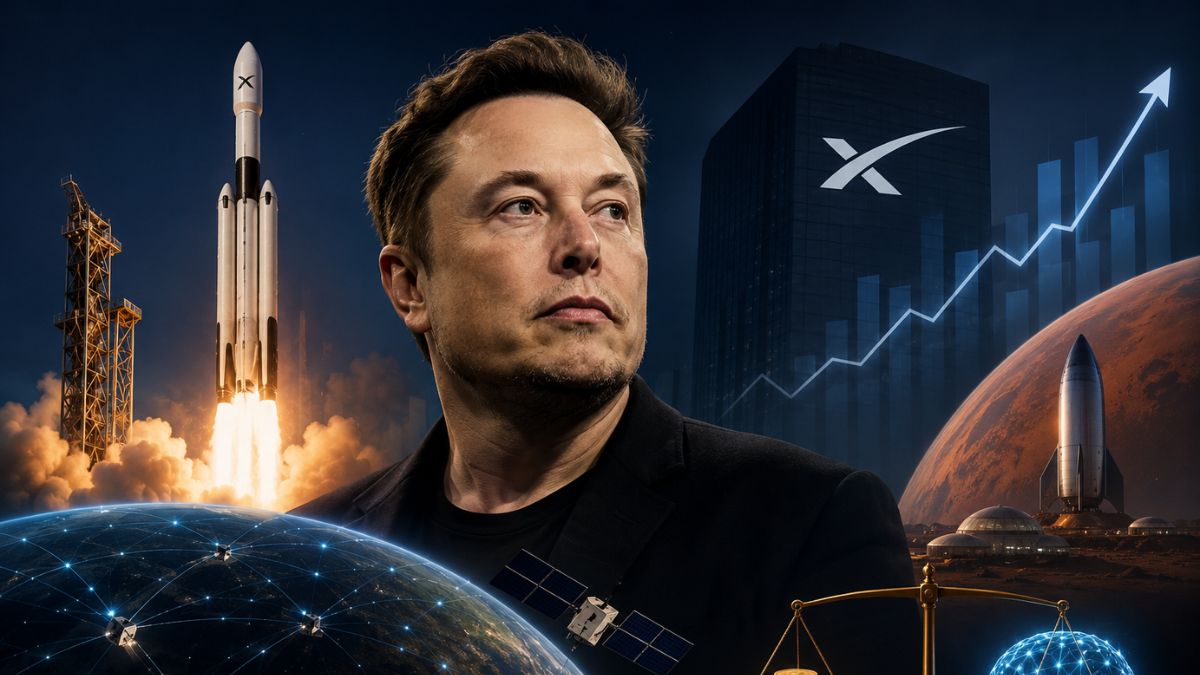
Just weeks ago, SpaceX appeared ready to chase one of the most ambitious public market debuts in history. Elon Musk-led rocket and artificial intelligence company had been targeting a valuation of more than $2 trillion for its long-awaited initial public offering (IPO), according to earlier reports. But as the company moves closer to listing on Nasdaq, that target has now come down.
SpaceX is now aiming for a valuation of at least $1.8 trillion, as reported by Bloomberg. However, the revised figure would still make it one of the most valuable companies in the world and potentially the largest IPO ever, the change shows a reality every company faces before going public. Hence, investor appetite ultimately determines the final price.
The reality check before listing
The reduction does not necessarily indicate weakening confidence in SpaceX. Instead, it shows the negotiation process that typically takes place before a major IPO. As bankers, advisers and large investors evaluate the offering, valuation expectations are often adjusted to match market demand. People familiar with the discussions said the target settled lower after consultations with advisers and investors. The company could still increase its valuation target if investor feedback during the formal marketing process proves stronger than expected. Details such as valuation and fundraising size are frequently revised in the days leading up to pricing.
A trillion-dollar story meets investor scrutiny
The company’s IPO filing paints a dramatically different picture of SpaceX than the one investors knew a decade ago. Earlier, the rocket company focused on reusable launch vehicles and satellite internet has evolved into a much technology story. Today, SpaceX is positioning itself as an artificial intelligence and infrastructure giant, with plans that stretch far beyond Earth’s atmosphere. Its filing talks about orbital data centres, AI infrastructure and a potential total addressable market of $28.5 trillion. A majority of that opportunity, according to the company, is linked to artificial intelligence.
But investors are also looking at current realities rather than future possibilities. SpaceX generated $18.7 billion in revenue in 2025, up from $14 billion a year earlier. However, the company also swung from a profit of $791 million in 2024 to a loss of $4.94 billion last year. This reversal has raised questions about how its newer AI-focused businesses can generate profits.
The xAI factor
A major reason for the changing financial picture is SpaceX’s growing connection to Musk’s artificial intelligence ambitions. In February, SpaceX acquired xAI, the company behind the Grok chatbot and social media platform X. The deal valued SpaceX at $1 trillion and xAI at $250 billion.
Though the acquisition strengthened Musk’s vision of combining space technology, AI and communications into a single ecosystem, it also brought a business that is still losing money. The IPO filing acknowledges that much of SpaceX’s future growth depends on AI-related ventures that remain unprofitable today. That creates a challenge for investors trying to value the company. They must weigh the strong cash-generating Starlink business against ambitious AI projects that have yet to prove their long-term economics.
Starlink remains the engine
Regardless of the excitement surrounding artificial intelligence, SpaceX’s current business remains heavily dependent on Starlink. The satellite internet network, built using roughly 10,000 satellites, generated most of the company’s $18.67 billion in revenue last year. The service provides broadband connectivity to consumers, governments and businesses around the world.
The strength of Starlink gives investors a profitable and growing core business to evaluate. At the same time, SpaceX continues to dominate the commercial launch market through its reusable rocket technology, which has dramatically lowered the cost of accessing space and helped the company pull ahead of rivals such as Blue Origin.
Betting on Elon Musk’s vision
For many investors, the challenge is that there is no true comparison for SpaceX. The company operates across rockets, satellite internet, AI infrastructure and future Mars colonisation projects. Traditional valuation models offer limited guidance. Analysts and academics have suggested that Musk’s reputation may influence investor sentiment as much as the company’s financial performance. The filing itself shows the scale of that vision.
The board has tied a significant portion of Musk’s compensation to extraordinary milestones, including establishing a permanent human colony on Mars and building space data centres powered by the equivalent of 100 terawatts of computing capacity. Such goals help explain why some investors see SpaceX as a company that could reshape multiple industries, while others view its valuation as difficult to justify using conventional metrics.
A record-breaking IPO still within reach
Even after lowering its target, SpaceX remains on track to attempt one of the largest public listings ever. The company is seeking to raise as much as $75 billion, which would surpass previous IPO records. At a valuation of around $1.8 trillion, SpaceX would immediately become one of the world’s most valuable publicly traded companies and the second Musk-led enterprise to cross the trillion-dollar mark after Tesla. The company is expected to begin formal marketing of the offering in early June, with pricing potentially taking place around June 11 and trading beginning shortly afterward under the ticker symbol “SPCX.”
Disclaimer: This article provides factual analysis only and is not, and should not be construed as, an offer, solicitation, or recommendation to buy or sell securities. Investors must conduct their own independent due diligence and seek advice from a registered financial advisor in the respective jurisdiction.