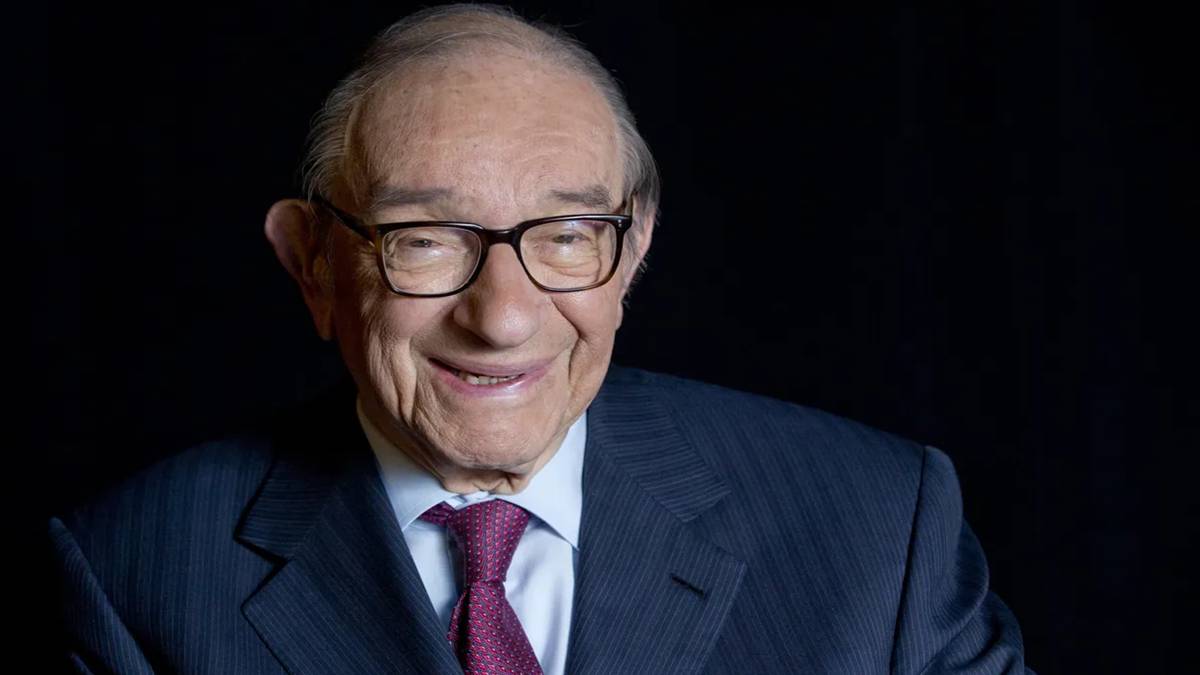
Alan Greenspan, the influential economist who steered U.S. monetary policy during his five terms as chairman of the Federal Reserve under four presidents, died at 100, NBC News reported on Monday.
His tenure was the second longest, four months short of that of William McChesney Martin, who presided over the central bank from 1951 to 1970.
Alan Greenspan chaired the Federal Reserve System’s Board of Governors for five terms. On August 11, 1987, he was appointed chairman to serve out his remaining term on the Board of Governors. January 31, 2006, marked the end of his previous term. Four different presidents appointed him chairman.
Irrational Exuberance
The word, ‘Irrational Exuberance’ that became a talking point in the equity markets for a long time was first coined by Greenspan. In a televised speech on December 5, 1996, his unusual frankness regarding the challenges of setting monetary policy triggered a brief market frenzy.
“How do we know when irrational exuberance has unduly escalated asset values, which then become subject to unexpected and prolonged contractions as they have in Japan over the past decade? … We should not underestimate or become complacent about the complexity of the interactions of asset markets and the economy,” had said Greenspan in the interview.
The phrase “irrational exuberance” suggested to many that Greenspan believed the market was overvalued, leading to a 3% decline in the Tokyo stock market and subsequent drops in other markets. Despite this initial reaction, markets rebounded and continued to rise until the dot-com bust in 2001.
Greenspan’s Timeline
Shortly after assuming office as chairman of the Board of Governors, Greenspan was faced with the October 1987 stock market crash and acted quickly to ensure liquidity in the markets.
During his tenure, he also led the Federal Reserve through several events with major economic repercussions, including two US recessions, the Asian financial crisis of 1997, and the September 11, 2001, terrorist attacks.
Greenspan, appointed by Ronald Reagan in 1987, oversaw an economy growing at 2.9% with 6.2% unemployment, although inflation was concerning at 3.1%. He increased interest rates from 6.7% in 1987 to 9.2% by 1989. While the economy initially grew, unemployment rose to 7.5% in 1992.
He had a reputation for being strongly anti-inflation, focusing more on controlling prices than on promoting full employment. Many credit Greenspan with facilitating the longest official economic expansion in US history. He was also known for his skill at building consensus among members of the Federal Open Market Committee on policy issues.
Disclaimer: This article is based on information available at the time of publication. While every effort has been made to ensure accuracy, some details — including dates, figures, and biographical facts — may be subject to verification. The views and assessments of Alan Greenspan’s legacy reflected herein represent widely reported historical accounts and do not constitute the editorial position of this publication. Alan Greenspan’s tenure, policies, and their long-term economic impact continue to be evaluated by economists and historians. Readers are encouraged to consult primary sources for further reference.