
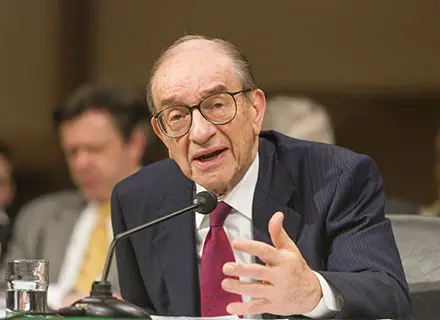
Greenspan served five consecutive terms as chairman of the Federal Reserve between 1987 and 2006 under four American presidents
Alan Greenspan, the influential economist who led the United States Federal Reserve through two decades of economic transformation and turbulence, died on 22nd June at the age of 100, his wife, veteran journalist Andrea Mitchell, said.
Greenspan, who served five consecutive terms as chairman of the Federal Reserve between 1987 and 2006 under four American presidents, was one of the most powerful economic policymakers of his era. He oversaw monetary policy during a period marked by the end of the Cold War, rapid globalisation, the rise of the internet economy and one of the longest expansions in US history.
“Alan passed away at our home this morning at the age of 100 from complications of Parkinson’s disease,” Mitchell said in a statement, describing him as “a giant of a man who helped shape the US economy for decades under presidents of both parties.”
Born in New York City in 1926, Greenspan initially studied music at the Juilliard School before turning to economics. After earning degrees from New York University, he built a successful economic consulting practice and became associated with novelist Ayn Rand, whose free-market philosophy influenced his economic thinking.
Rand’s “objectivist” philosophy of self-interest and laissez-faire capitalism not only inspired Greenspan but, along with him, a future generation of political libertarians and conservatives. Greenspan embraced some of her beliefs and paid tribute to her in his 2007 memoir titled “The Age of Turbulence: Adventures in a New World”.
He said, “Ayn Rand and I remained close until she died in 1982, and I’m grateful for the influence she had on my life. I was intellectually limited until I met her.”
Greenspan entered public service in the 1970s, serving as chairman of President Gerald Ford’s Council of Economic Advisers before returning to the private sector. In 1987, President Ronald Reagan appointed him chairman of the Federal Reserve, succeeding Paul Volcker.
His tenure began with the stock market crash of October 1987, during which he acted proactively by reassuring investors and injecting liquidity into financial markets. The Fed’s willingness to support markets during crises later became known as the “Greenspan Put”.
Greenspan won widespread acclaim for steering the world’s largest economy through the long expansion of the 1990s and navigating shocks, including the bursting of the dotcom bubble and the aftermath of the September 11 attacks. His influence extended well beyond financial circles, earning him nicknames such as “the maestri” and “America’s least-likely celebrity”.
However, his legacy became more contested after the 2007-08 global financial crisis. Critics argued that his support for financial deregulation and failure to curb risky lending practices helped create conditions that led to the collapse. A bipartisan US enquiry later cited deregulation and inadequate oversight as key contributors to the market downfall.
After leaving the Fed in 2006, Greenspan established a consulting firm, wrote several books and remained an influential voice on economic policy. He received numerous honours, including the Presidential Medal of Freedom in 2005.