
India’s semiconductor market is booming. The foundation of this growth was laid with the approval of India Semiconductor Mission 1.0 by the Union Cabinet in December 2021.
The Mission is supported by an incentive framework of ₹76,000 crore, offering fiscal support of up to 50% for silicon fabs, compound semiconductor facilities, assembly and testing units, and chip design. As of December 2025, 10 projects with a total investment of ₹1.60 lakh crore have been approved across 6 states.
According to the Press Information Bureau, India’s semiconductor market size is estimated to reach USD 100-110 billion (₹9-10 lakh crore) by 2030, up from about USD 38 billion (2023) and USD 45-$50 billion (2025). And this story is no longer confined to fabs and policy incentives.
By 2029, India is expected to achieve the capability to design and manufacture chips required for nearly 70-75% of domestic applications. The Budget FY27 further reinforced these ambitions with the announcement of India Semiconductor Mission 2.0. The mission allocates Rs 1,000 crore for research, training, and chip manufacturing capabilities.
But the semiconductor supply chain is vast, requiring raw materials, gases, and chemicals for manufacturing. This is where a few companies, beyond the big names like Tata and Murugappa Group, are establishing their footprint to capitalise on the semiconductor boom. Let’s take a look at these pick-and-shovel plays.
#1 Dominating the Micro-Niche: Acutaas and the Photoresist Monopoly
Acutaas Chemicals is evolving into a diversified specialty chemical company. It operates through two core traditional segments alongside two exciting emerging growth verticals: Advanced Pharmaceutical Intermediaries (API) and the chemicals segment.
The CDMO Engine: Scaling Toward a ₹1,000 Crore Revenue Milestone
API is the core engine, delivering a massive ₹1,174 crore in revenue for FY26, up 38% from ₹854 crore in FY25. This exceptional growth is heavily driven by their Contract Development and Manufacturing Organization (CDMO) business.
Management expects the CDMO business to contribute ₹1,000 crore by FY28. This is expected to be supported by a strong pipeline that includes four newly validated products, with revenue starting in FY27.
Semiconductor Pivot: High-Barrier Entry Into the Global Value Chain
Next is the Specialty Chemicals segment, which continues to provide a solid, steady foundation. This segment’s revenue grew by 8% year-on-year to ₹165 crore in FY26. This segment maintains stable pricing and high-volume growth in commodity chemicals. This has recently helped offset some slight sluggishness in its older semiconductor subsidiary, Baba Fine Chemicals.
Acutaas is India’s sole manufacturer of semiconductor-grade photoresist chemicals. These highly specialized chemicals require ultra-high purity, down to parts-per-billion levels, to meet the exacting standards of modern microchip fabrication. The company originally entered this high-barrier industry in FY23 by acquiring a 55% stake in Baba Fine Chemicals (BFC).
The Joint Venture with South Korea’s J& Materials
To expand its footprint internationally, Acutaas formed Indichem, a joint venture with South Korea’s J & Materials. Acutaas has already invested around ₹130 to ₹140 crores into this venture to supply value-added, advanced semiconductor chemicals to high-growth markets like South Korea, Japan, and Taiwan.
The capital expenditure for the Indichem plant is expected to finish by the end of calendar year 2026, with the venture beginning to contribute to revenue the following year. Management anticipates that this semiconductor business will be highly lucrative with higher margins than the traditional pharmaceutical business.
Management expects the semiconductor business to become an independent growth engine by FY28. To this end, the company is engaging with several clients in Japan, South Korea, and Taiwan.
Efficiency Gains: Analyzing the 122% Profit Surge and Margin Expansion
The company’s financial performance has been stellar, closing out FY26 with record-breaking numbers. For FY26, total revenue from operations rose by 33% year-on-year to ₹1,339 crore, driven solely by the API business.
Thanks to strong operating leverage, cost efficiencies, and an improved product mix, profitability soared. EBITDA more than doubled to ₹480 crore, and the EBITDA margin expanded to 35.9%, up from 23%. Ultimately, net profit more than doubled (up 122%) to ₹356 crore.
Acutaas Share Price
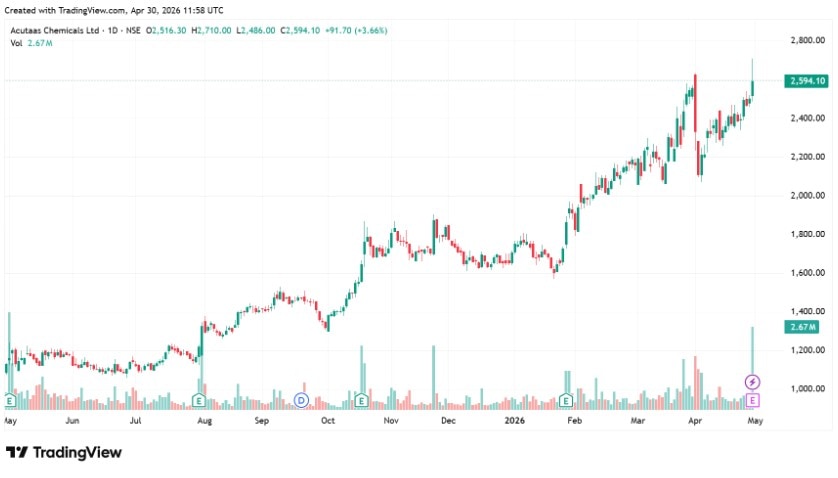
#2 The SiC Frontier: Archean’s High-Stakes Bet on Power Devices
Archean Chemicals is already India’s leading manufacturer of specialty marine chemicals. The company is now making a massive, high-growth pivot into advanced technology. At its core, Archean maintains a leadership position in India’s merchant bromine sales. It is the country’s largest exporter of both bromine and industrial salt.
In fact, exports accounted for 79% of revenue in 9MFY26. They supply critical bromine to the pharmaceuticals, agrochemicals, and flame-retardant industries. Its 100% export-focused industrial salt business serves the chloralkali and textile sectors.
Furthermore, Archean is India’s sole manufacturer of high-value, chloride-free Sulphate of Potash fertilizer directly from natural sea brine. But the biggest story for Archean right now is its bold entry into the semiconductor space.
Silicon Carbide Pivot: Securing India’s Semiconductor Sovereignty
Archean is actively building India’s first commercial compound semiconductor fabrication facility in Odisha through its subsidiary, SiCSem Private. This facility will specialize in manufacturing Silicon Carbide (SiC) power devices and MOSFETs.
These devices are the backbone of green technology and are essential for electric vehicles, defence, railways, data centers, fast chargers, consumer appliances, and solar power inverters. The project is highly prestigious, being one of only 10 projects approved by the Union Cabinet under the Indian Semiconductor Mission.
Archean is currently in the final stages of signing a fiscal support agreement with the ISM to lock in their funding framework. The groundbreaking ceremony was conducted on 1 November 2025, with completion expected within 30 months.
Strategic Synergies: Leveraging UK Tech and Zinc-Bromide Patents
To ensure world-class capabilities, Archean made a strategic investment to secure a 22.2% stake in UK-based Clas-SiC Wafer Fab. This is a massive competitive advantage, as it provides Archean with exclusive access to advanced SiC technology in India, including process modules and design kits.
Once operational, the facility is designed to handle both fabrication and packaging, boasting an annual capacity of 60,000 wafers and 9.6 crore packaging units. In addition, Archean is tapping into the booming stationary energy storage market. They are acquiring a 21% stake in Offgrid Energy Labs, a company with over 50 patents in zinc-bromide battery technology.
Financial Check: Salt Growth vs. Bromine Headwinds in 9MFY26
On the financial front, total revenue increased by 11% year-on-year to ₹802 crore in 9MFY26, driven mainly by 29% growth in revenue from the industrial salt business. EBITDA fell 15% to ₹217 crore, with margins at 27%. Net profit fell 13.9% to ₹93 crore. Negative revenue growth in the bromine business impacted its financials.
Archean Share Price
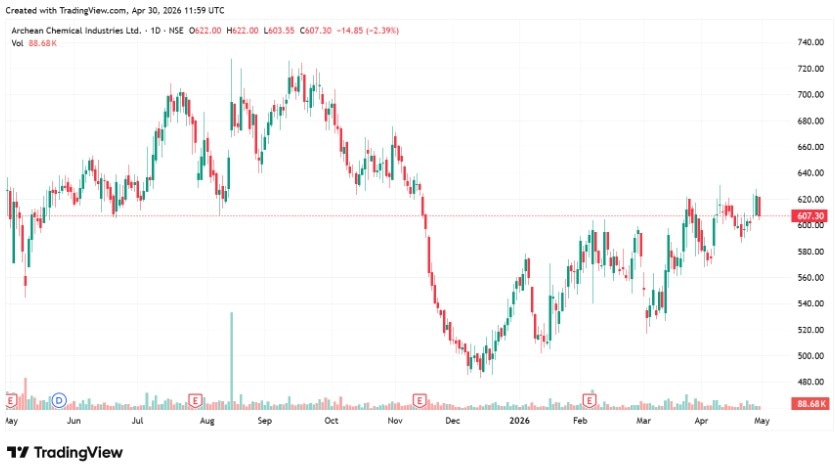
#3 Fueling the Fabs: Stallion’s Quest for 6N Helium Purity
Stallion India manufactures refrigerants and industrial gases. It focuses on the debulking, blending, and processing of both refrigerant and non-refrigerant gases. It serves a wide range of applications, supporting over 15 industries and catering to more than 200 satisfied customers.
Market Positioning: Leveraging the High-Margin Industrial Aftermarket Ecosystem
Its diverse product portfolio includes more than 40 different gases and custom blends. Stallion holds approximately 10% of the market share in India. It specifically focuses on the aftermarket segment, which is a highly lucrative business. Aftermarket offers higher margins compared to supplying Original Equipment Manufacturers (OEMs).
Stallion is strategically entering the semiconductor and high-purity gas markets. This is a core pillar of its roadmap for forward integration. This is perfectly timed to address India’s rapidly emerging technology needs in electronics, solar cells, and fiber optics.
To achieve this, the company is actively expanding its Khalapur facility to cement its position in the high-purity semiconductor gases and liquid helium. Following this, the upcoming Mambattu facility in Andhra Pradesh will also feature a dedicated semiconductor and helium-processing unit to tap into the high-growth markets in South India.
Semiconductor Integration: Engineering a 1,200 MT Helium Supply Chain
A major part of Stallion’s semiconductor strategy revolves around liquid helium, targeting an annual processing capacity of 1,200 metric tons. It will make it one of India’s leading suppliers.
To create a globally connected supply chain for these complex gases, it recently entered into a strategic technology tie-up with Portugal’s SYS Advanced for helium recovery and liquefaction systems. Additionally, it has signed a long-term partnership with Sharjah Oxygen in Dubai to source liquid helium directly from Qatar’s Ras Gas and Oil fields.
Supply Resilience: Upgrading Infrastructure to Mitigate Geopolitical Risks
To handle these highly sensitive gases, Stallion recently completely re-engineered its Khalapur helium plant, upgrading it from a 200-bar to a 300-bar pressure system to meet the latest industry standards, with operations expected to commence by March 2026. The company is currently exposed to supply shortage risk due to gas undersupply amid geopolitical tensions.
Financial Trajectory: Modeling the Transition to 24% Operating Margins
Thanks to its expansions, Stallion’s financial performance is accelerating. Revenue rose by 42% year-on-year to ₹321 crore in 9MFY26. A better product mix and higher contributions from value-added gases drove the growth. Profitability is also seeing a massive boost.
EBITDA grew by 49% to ₹44 crore, with a margin at 13.7%. Net profit surged by 63% to ₹31 crore. Its current net profit margin is around 10%. However, these new high-purity products offer higher margins, ranging from 16% to 24%. Therefore, as revenue from semiconductor gases and liquid helium grows, profits could also increase.
Stallion Share Price
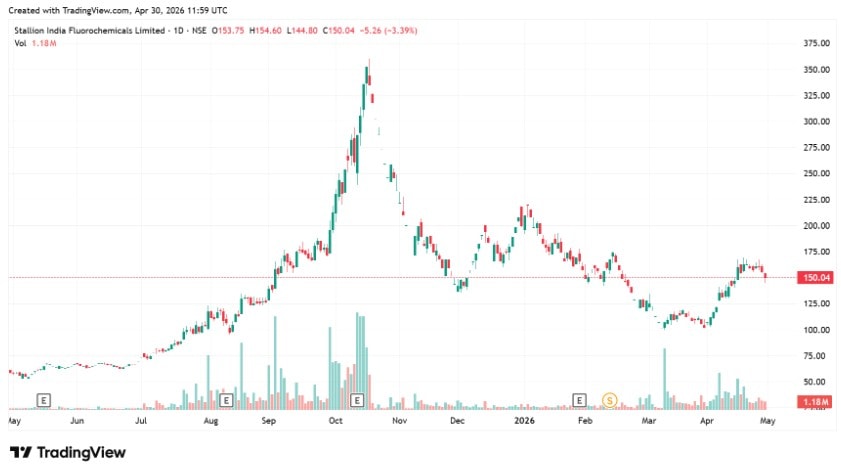
The Bottom Line: Growth-at-a-Price?
Accutas, with its strong growth, has a return on capital employed (RoCE) of 31.6% and a return on equity (RoE) of 24%, followed by Stallion. Archean’s volatile financials mean its return ratios aren’t that great.
| Valuation Assessment (X) | |||||
| Price-to-Earnings Multiple | Return Ratios | ||||
| Company | Company | 3-Year Median | Industry Median | RoCE (%) | RoE (%) |
| Acutaas | 73.0 | 61.6 | 29.8 | 31.6 | 24.0 |
| Archean | 51.0 | 32.0 | 28.7 | 12.8 | 9.8 |
| Stallion | 37.8 | 37.1 | 38.4 | 19.7 | 15.2 |
| source: screener.in (As of 30th April, 2026) | |||||
In terms of valuation, Acutaas and Archean are trading at a premium to the 3-year historical median multiple and the industry median. However, Stallion has a shorter trading history, yet trades almost in line with industry valuations.
India’s ₹10 lakh crore semiconductor story is no longer just a policy tailwind. It is taking shape across the supply chain. Early movers in niche inputs are building scalable, high-margin businesses. However, much of the optimism is priced in. This makes execution, client traction, and timely capacity addition crucial.
Nonetheless, keep track of them by keeping them in your watchlist.
Disclaimer:
Note: Throughout this article, we have relied on data from http://www.Screener.in and the company’s investor presentation. Only in cases where the data were unavailable have we used an alternative, widely accepted, and widely used source of information.
The purpose of this article is only to share interesting charts, data points, and thought-provoking opinions. It is NOT a recommendation. If you wish to consider an investment, you are strongly advised to consult your advisor. This article is strictly for educational purposes only.
About the Author: Madhvendra has been deeply immersed in the equity markets for over seven years, combining his passion for investing with his expertise in financial writing. With a knack for simplifying complex concepts, he enjoys sharing his honest perspectives on startups, listed Indian companies, and macroeconomic trends.
A dedicated reader and storyteller, Madhvendra thrives on uncovering insights that inspire his audience to deepen their understanding of the financial world.
Disclosure: The writer and his dependents do not hold the stocks discussed in this article.
The website managers, its employee(s), and contributors/writers/authors of articles have or may have an outstanding buy or sell position or holding in the securities, options on securities, or other related investments of issuers and/or companies discussed therein. The articles’ content and data interpretation are solely the personal views of the contributors/ writers/authors. Investors must make their own investment decisions based on their specific objectives, resources, and only after consulting such independent advisors as may be necessary.