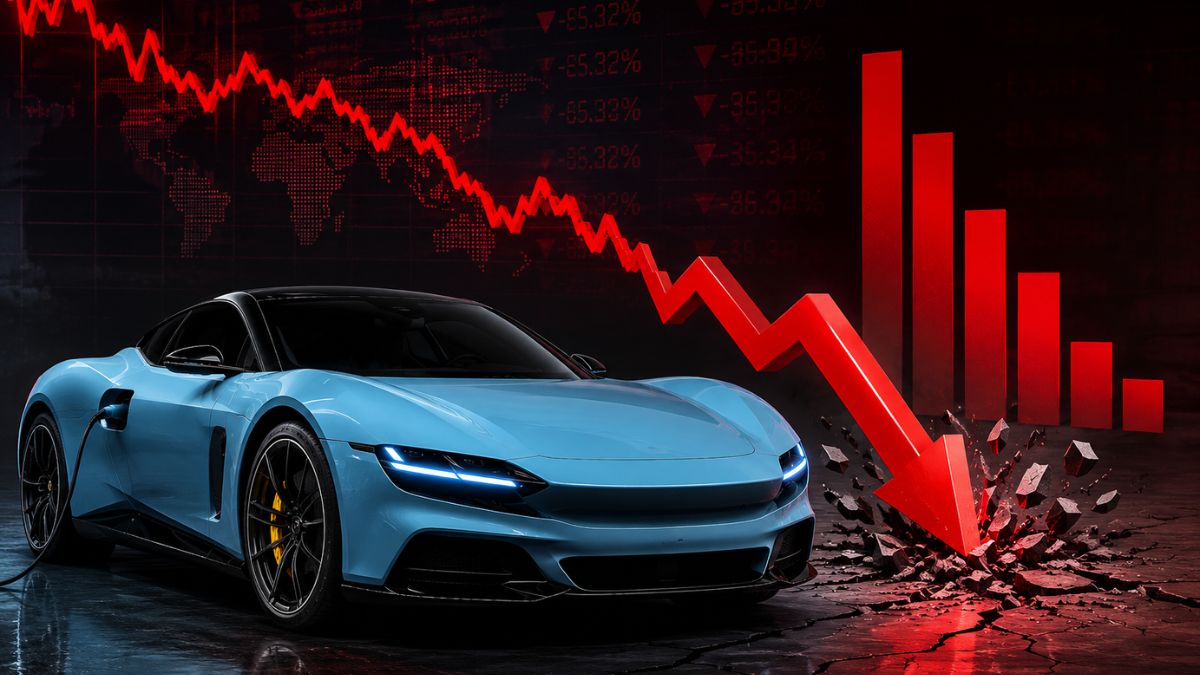
The debut of Ferrari’s first electric vehicle, Luce was meant to mark the company’s grand entry into the future. But sadly it erased nearly $4.3 billion from Ferrari’s market value within hours, as fans questioned whether the iconic supercar maker had moved too far away from the brand identity that made it legendary. For decades, the roar of a Ferrari engine was linked to speed, luxury and classic supercars. But the Italian carmaker’s move into electric vehicles has not gone down well with investors.
Ferrari’s shares fell more than 6% on the Italian Stock Exchange in Milan, Borsa Italiana, sliding to around €291 ($338) from the previous close of €310 ($360). The selloff came immediately after the company unveiled the Luce, its first fully electric vehicle, priced at $640,000 (£545,000).
Investors question Ferrari’s new direction
The launch was highly anticipated, however, the Luce’s design divided opinion among investors and car enthusiasts. Unlike Ferrari’s classic low-slung sports cars, the Luce has a more minimalist and saloon-like appearance created by former Apple design chief Jony Ive.
The car is also the first Ferrari with five seats and only the second Ferrari to feature four doors, indicating the company’s move towards wealthy families rather than traditional supercar buyers. Ferrari’s only other four-door vehicle is the Purosangue SUV launched in 2022.
Analysts said the new look may have unsettled investors who strongly associate Ferrari with aggressive styling and roaring combustion engines. According to CNBC, Pierre-Olivier Essig, head of research at AIR Capital, reportedly described the car as looking like a “mix between a Honda Accord EV and Tesla 3,” adding: “We are lost in translation with Ferrari’s new strategy. Anthony Dick, an auto analyst at Oddo BHF, told CNBC, the market reaction was “by far the sharpest reaction we’ve seen for a car design — the market has spoken.”
‘Design hate’ and fear of brand dilution
According to CNBC, analysts linked the selloff to both disappointment over the design and concerns that Ferrari’s push into electric vehicles could weaken the exclusivity of the brand.
“Ultimately many fans are disappointed that Ferrari is embracing the EV concept, believing it dilutes the supercar brand, which has modelled itself around classic design and raw, combustion-engine power,” Michael Field, chief equity strategist at Morningstar, told CNBC. Field also said investors have long worried that electric vehicles could become an expensive gamble for Ferrari because of high research and development costs.
“From an investment perspective, many investors had feared the development of an EV model, on the basis that the research and development costs are materially high, putting a lot of pressure on the brand to recoup these, and potentially diluting investment returns for the business,” he said.
Some analysts also pointed to the classic market phrase “travel and arrive,” meaning Ferrari’s shares had already climbed strongly ahead of the launch and investors used the event as an opportunity to book profits.
The reaction also comes as Ferrari has already softened its long-term electric ambitions. The company last year reduced its EV targets for 2030. Ferrari now plans for 40% of its lineup by 2030 to remain traditional internal combustion engine models, 40% hybrids and only 20% fully electric vehicles. Earlier plans had projected 40% EVs by the end of the decade.
Chief executive Benedetto Vigna defended the company’s move into electrification, saying Ferrari wanted to show leadership by embracing new technology. “We are convinced that a company demonstrates its leadership when it has the courage to dare and to take on the challenge of new technologies. Ferrari Luce was born precisely from this challenge, offering our unprecedented vision of electrification,” Vigna said in a press note
Disclaimer: This article provides factual analysis only and is not, and should not be construed as, an offer, solicitation, or recommendation to buy or sell securities. Investors must conduct their own independent due diligence and seek advice from a registered financial advisor in the respective jurisdiction.