
The brokerage house Macquarie Equity has outlined its view on India’s energy landscape. As per the brokerage house, the sector is seeing a broad transformation across power generation, transmission and distribution.
Macquarie noted that this is largely driven by regulatory changes, infrastructure investments and changing energy consumption patterns.
Meanwhile, renewable energy is seeing a significant surge in momentum, Macquarie believes conventional power sources still have a key role to play in ensuring energy security and grid stability. Let’s take a look –
NTPC leads Macquarie’s preferred utility picks
As per the brokerage report, NTPC remains Macquarie’s most preferred stock within the utility space.
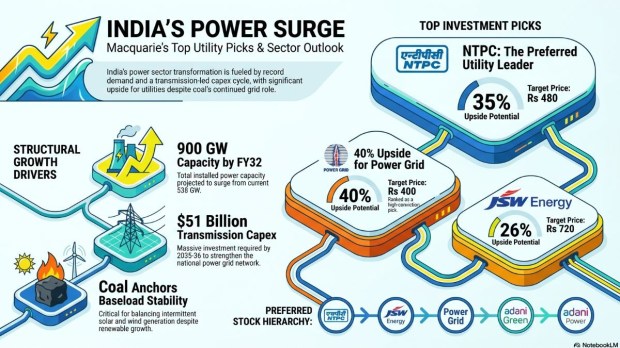
The brokerage’s pecking order places NTPC at the forefront, “NTPC > JSW Energy > Power Grid > Adani Green > Adani Power > Adani Energy Solutions.”
According to Macquarie, India’s electricity demand outlook remains strong. This is creating opportunities for companies involved across the energy value chain.
The brokerage has assigned a target price of Rs 480 for NTPC, implying an upside potential of around 35%.
JSW Energy is another preferred name, with Macquarie assigning a target price of Rs 720 and an estimated upside of about 26%.
Power Grid Corporation of India follows closely with a target price of Rs 400. This indicates an upside potential of nearly 40%.
Other stocks in the brokerage’s preferred list include Adani Group stock such as Adani Green Energy, Adani Power, and Adani Energy Solutions
Macquarie’s preferred utility stocks
| Company | Target Price (Rs) | Upside / Downside |
| NTPC | 480 | +35% |
| Power Grid | 400 | +40% |
| JSW Energy | 720 | +26% |
| Adani Green Energy | 1,700 | +11% |
| Adani Power | 230 | +2% |
| Adani Energy Solutions | 1,450 | -8% |
Why India needs more power than ever
One of the biggest themes highlighted by the brokerage is the sharp rise in electricity demand.
As per the brokerage house report, India’s installed power capacity could increase from around 538 Gigawatts (GW) currently to nearly 900 GW by FY32.
The report noted that “peak power demand has touched record highs (271GW in May 2026).”
As per the brokerage house, the surge is being driven by multiple factors. For instance, industrial activity continues to account for a large share of electricity consumption. Apart from this, increasing air-conditioning usage is adding to power demand during summer months.
Macquarie highlighted that the Central Electricity Authority (CEA) expects a “6% power demand CAGR through 2030.”
The brokerage believes emerging sectors such as data centres and electric mobility could become additional demand drivers over the coming years.
Renewables are growing, but coal remains important
While renewable energy is expanding rapidly, Macquarie believes the transition will not be straightforward.
Macquarie pointed out that one of the key trends in focus is, “coal continuing to anchor baseload stability.”
The report argues that renewable energy additions alone may not be sufficient because solar and wind generation are intermittent in nature.
As per the brokerage house, India may require nearly 74 GW of energy storage capacity to balance renewable energy generation and support evening power demand.
Furthermore, the brokerage house also pointed to instances of grid stress. It noted that renewable energy curtailment remains a challenge when generation exceeds transmission capacity.
Transmission emerges as the next big investment cycle
Another major theme in the report is transmission infrastructure.
According to Macquarie, India is entering a “transmission-led capex cycle.”
The brokerage estimates that nearly US$51 billion of investment could be required by 2035-36 to strengthen the country’s power transmission network.
The need arises because many renewable energy projects are located far from major consumption centres. Building transmission corridors is therefore becoming increasingly important to move power efficiently across regions.
In addition, the report also highlighted that there is a significant time gap between setting up generation projects and building transmission infrastructure.
Distribution companies showing signs of recovery
Macquarie also sees improvement in the financial health of electricity distribution companies, commonly known as discoms.
“India’s discoms are on a clear recovery path,” added Macquarie in its report.
The report attributes this improvement to reforms under the Revamped Distribution Sector Scheme (RDSS), wider adoption of smart meters and better billing efficiency.
Macquarie noted that Aggregate Technical and Commercial (AT&C) losses have fallen significantly compared with previous years, while overdue payments across the sector have reduced substantially.
What investors need to watch
Despite its positive long-term outlook, Macquarie cautions that risks remain.
Macquarie added, “execution bottlenecks in land, clearances and supply chains” could affect project timelines. The brokerage also flagged fuel supply volatility, grid reliability challenges and geopolitical developments as factors that investors should monitor.
For now, Macquarie believes India’s power sector is entering a period of structural change. The surging electricity demand, transmission investments, renewable energy expansion and improving distribution economics are expected to shape the sector’s next growth phase.
Disclaimer: Investment targets and stock rankings presented reflect the views and analysis of external brokerage firm Macquarie Equity and do not constitute independent research or financial advice by this publication. Equity investments are subject to market risks, and target prices or projected upside percentages are speculative estimates that may vary over time. Readers must consult a SEBI-registered investment advisor or qualified financial professional before executing buy, sell, or hold positions based on these institutional research opinions. This disclaimer has been generated using AI to support user well-being and responsible content consumption.