Three straight months of falling luxury card spending, stubborn inflation and a hawkish Fed suggest the affluent shoppers are finally feeling the squeeze
While middle and lower-income families trimmed grocery lists and put off buying cars, the affluent kept booking business-class flights, buying handbags and filling restaurant tables. That cushion is now thinning.
Fresh card data, cooling luxury sales and a sharp turn in the interest rate cycle all point the same way, with the country’s richest shoppers beginning to behave like everyone else, just weeks before the 3 November midterm elections.
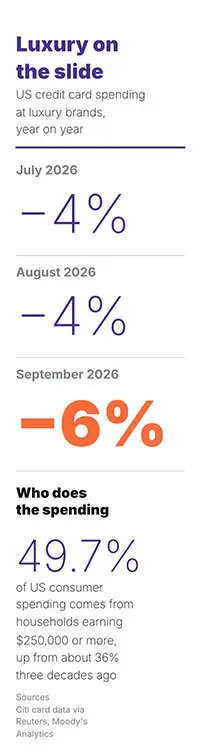
US credit card spending on luxury brands fell 6% year on year in September, according to Citi data reported by Reuters.
It followed 4% declines in both July and August, making it the third straight monthly drop and the steepest of the three. Citi noted that the run-up to an election often brings caution from consumers and businesses alike.
The deeper causes, however, lie in prices, borrowing costs and a fading sense of financial security.
Why the top of the market matters
 The pullback carries weight far beyond Fifth Avenue. Moody’s Analytics estimates that households earning roughly USD 250,000 or more now account for 49.7% of US consumer spending, up from about 36% three decades ago.
Bank of America economists reported in July that the top 10% of earners spend as much on discretionary items as the bottom 70% combined.
With consumer spending making up around 69% of GDP, any lasting retreat by the affluent would ripple through the wider economy.
Brands had counted on American buyers, including a new cohort of AI millionaires, to offset prolonged weakness in China and the disruption caused by the Iran war.
What the luxury makers’ numbers reveal
The third-quarter results from Europe’s luxury houses show a market splitting in two rather than collapsing outright.
LVMH, the sector’s bellwether, reported third-quarter revenue of 18.5 billion euro on October 12, with organic growth slowing to 1% from 3% in the second quarter.
Its fashion and leather goods division, home to Louis Vuitton and Dior, saw organic sales fall 5%. The group said the US, Europe and Japan delivered good growth while China weighed on results, but investors remain unconvinced.
LVMH has shed more than USD 167 billion in market value this year amid doubts over when meaningful growth will return.
Hermes, whose clients sit at the very top of the wealth pyramid, reported third-quarter revenue of 4.1 billion euro on October 22, up 5.5%.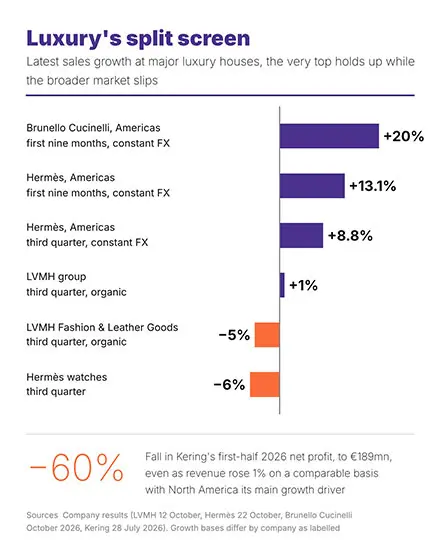
Sales in the Americas rose 8.8% at constant exchange rates in the quarter, a clear step down from the 13.1% pace recorded across the first nine months.
Even the most resilient name in luxury is seeing American momentum ease, and its shares fell in early trading.
Brunello Cucinelli, which sells cashmere to the ultra-wealthy, is the exception that proves the rule.
Its Americas revenue climbed 20% at constant exchange rates in the first nine months, and the company raised its full-year guidance.
The very richest, cushioned by stock market gains, are still spending.
Citi itself expects brands that serve the highest-end consumers to stay relatively resilient, thanks to rising equity wealth.
 Profit figures show the strain lower down the ladder.
Kering, owner of Gucci, saw first-half net profit drop 60% to 189 million euro, even as revenue edged up 1% on a comparable basis and North America remained its main growth driver.
Its third-quarter figures are due after the Paris close on October 22.
The weakness is also uneven across categories. Citi found that spending on leather goods and ready-to-wear improved slightly from August, while luxury watches and jewellery deteriorated further in September.
That is significant, because jewellery had been the sector’s bright spot for more than a year. Hermès saw a similar pattern, with watch sales falling 6% in the third quarter even as leather goods grew by more than 12%.
What links these trends is the so-called aspirational shopper, the professional on a comfortable six-figure salary who buys one designer bag a year rather than ten.
Years of steep price increases have already stretched that buyer’s budget. Higher mortgage rates, fuel bills and borrowing costs are now squeezing it further.
Data from US specialist jewellers tells the same story, with average spending per item up 11% in September while demand for lower-priced pieces weakened.
Is the tariff war to blame?
Partly, though not in the way many expected.
Washington’s trade war has changed course repeatedly.
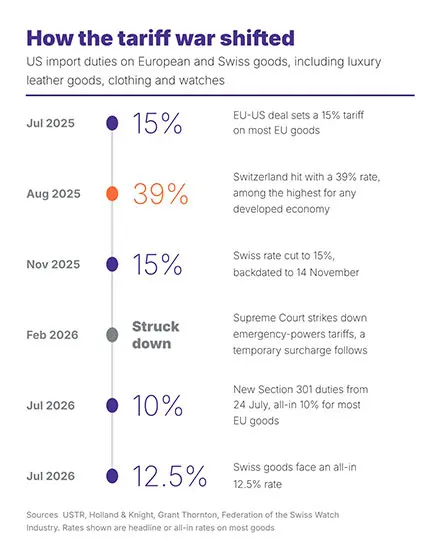 In 2025, the Trump administration agreed a 15% tariff on EU goods and imposed a 39% rate on Swiss imports, later cut to 15%. In February 2026, the Supreme Court struck down the emergency powers used to levy those duties.
A temporary global surcharge followed, and since July 24 most EU goods have faced an all-in rate of 10% under new Section 301 tariffs, with Swiss products at 12.5%.
The damage lies in what came before. Brands passed tariff costs on to customers through repeated price rises, and those increases have not been reversed.
Citi noted that apparel, footwear and leather goods brands lifted prices by low single digits this year, while watch and jewellery companies pushed through bigger increases.
It is no coincidence that watches and jewellery are now the weakest categories.
Swiss watch data shows how distorted the picture has become.
Exports to the US fell 19.4% in August, then jumped 86% in September.
That rebound was largely a base effect, since September 2025 was the first full month of the 39% tariff, when shipments collapsed.
For American-owned brands that manufacture in Asia, the costs remain direct.
Tapestry, owner of Coach, said tariffs reduced its gross margin by about 130 basis points in fiscal 2026, and its outlook for the coming year assumes a tariff rate in the mid-20% range on US inventory.
Citi named Tapestry, LVMH and Ferragamo as the companies most exposed to US spending.
Tariffs, in short, have helped push luxury prices beyond what many shoppers are willing to pay. But they are an accelerant rather than the root cause. The bigger forces are at work across the whole economy.
What the trend says about America’s economic health
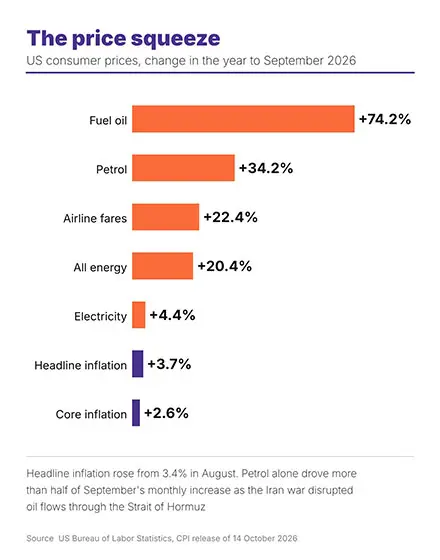
The most immediate pressure is inflation. Consumer prices rose 3.7% in the year to September, up from 3.4% in August, according to the Bureau of Labor Statistics.
Energy drove most of the jump.
Energy prices are up 20.4% on the year, with petrol up 34.2% and fuel oil up 74.2%, largely because the Iran war has disrupted oil shipments through the Strait of Hormuz.
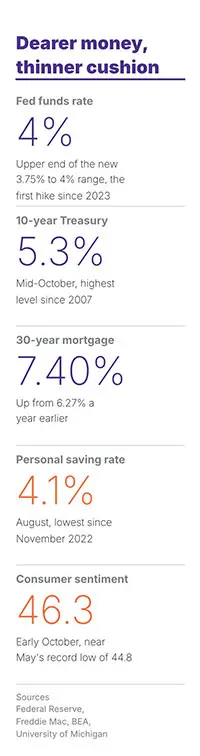
The Federal Reserve has responded by tightening. On 16 September, it raised its benchmark rate by a quarter point to a range of 3.75% to 4%, its first increase since 2023. Officials’ median projection points to a rate of 4.1% by the end of the year, implying another hike is possible.
Rates on credit cards and car loans tend to follow.
Bond markets have moved even faster. The 10-year Treasury yield climbed back above 5.3% in mid-October after the hot inflation report, a level not seen since 2007.
The average 30-year mortgage rate reached 7.40% in mid-October, according to Freddie Mac, up from 6.27% a year earlier.
For affluent households, whose wealth is often tied up in property and shares, higher yields mean costlier mortgages, softer home values and more volatile portfolios.
It would be wrong, however, to read the pullback as a sudden burst of thrift. The personal saving rate fell to 4.1% in August, its lowest since November 2022, as spending outpaced income.
Real disposable income did not grow that month. In other words, many households are dipping into their buffers simply to keep up with higher prices.
The wealthy are trimming their indulgences, while the rest of America has little left to trim.
Confidence reflects that strain. The University of Michigan’s consumer sentiment index fell to 46.3 in early October, close to May’s all-time low of 44.8, while year-ahead inflation expectations rose to 4.7%.
The labour market is cooling too, with employers adding just 29,000 jobs in September and unemployment at 4.2%.
Economists have spent two years describing a K-shaped economy, in which wealthier households kept rising while poorer ones struggled.
The luxury slowdown suggests the upper arm of that K is beginning to bend.
What comes next
 The coming fortnight will be decisive. The Fed meets on October 27 and 28, and the following morning brings the first estimate of third-quarter GDP alongside September income and spending data.
A further fall in the saving rate would confirm that consumption is running on a shrinking cushion.
Then come the midterms, where affordability has become a central campaign issue.
A result that brings policy clarity could release some pent-up demand before the holiday season.
For now, the message from the tills is clear.
When even America’s wealthiest shoppers start counting the cost, the rest of the economy should take note.