The FIFA World Cup isn’t just a sporting spectacle; it’s one of the world’s biggest consumption moments. For brands, it is a high-stakes battle for visibility, engagement, and most importantly, demand spikes.
And for PepsiCo, this is one such moment. Its snacks brand, Lay’s, is an official sponsor of the FIFA World Cup 2026. It gives the company a global stage to amplify marketing, launch new products, and drive incremental demand during the tournament.
In India, the spotlight shifts to Varun Beverages Ltd., PepsiCo’s largest franchisee outside the US. The company is responsible for manufacturing and distributing Pepsi products across India. This positions it to capture much of the incremental demand from both event-led consumption and peak summer.
Now, the real question is, can such event-driven demand translate into sustained growth for Varun Beverages?
Varun Beverages’ Growth Story Is Already Playing Out
Recent performance suggests that the momentum is already in place at Varun Beverages.
Between 2020 and 2025, Varun Beverages reported a sales volume CAGR* of 23.3%. What stands out is the pace of growth in its international business. It is growing faster than its India business. Over the same period, international business reported a sales volume CAGR of 41.5%.
Note: Varun Beverages follows the calendar year as its financial year.
*CAGR: Compounded Annual Growth Rate
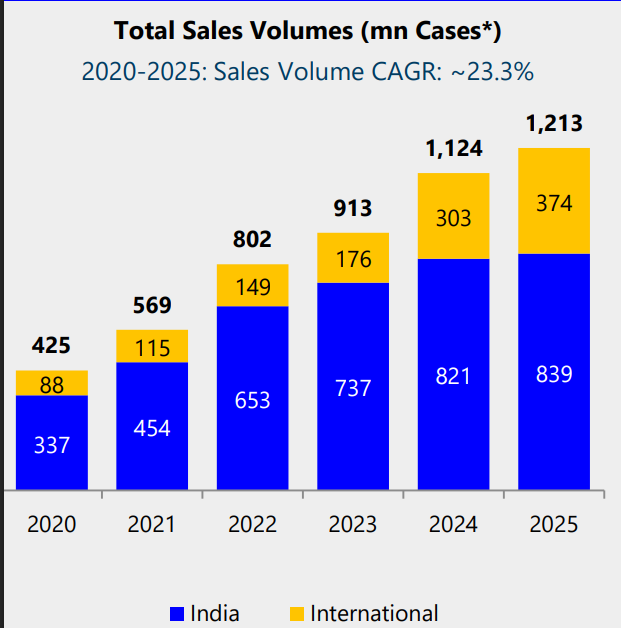
The momentum has carried into 2026. Varun Beverages has reported 16.3% year-on-year sales volume growth in the January to March period, despite being a seasonally weak period.
Varun Beverage’s Earnings Trajectory
| Year | 2020 | 2021 | 2022 | 2023 | 2024 | 2025 |
| Revenue (₹) | 6,450 | 8,823 | 13,173 | 16,043 | 20,008 | 21,685 |
| Net Profit (₹) | 357 | 746 | 1,550 | 2,102 | 2,634 | 3,062 |
Financials are impressive as well. The 5-year compounded annual sales growth is 27.4%, and net profit growth is 53.7%.
Put together, this steady performance over five years points to a deeper structural growth story rather than a cyclical uptrend.
Structural Tailwinds and Scale: Inside Varun Beverages’ Growth Engine
Varun Beverages is benefiting from a long-term structural opportunity. Despite being the world’s most populous country, India continues to have among the lowest per capita consumption of non-alcoholic beverages.

The chart above shows how India’s production of non-alcoholic beverages is just a fraction of China’s and the US’s. This gap leaves ample room for growth.
Domestic Expansion: Varun Beverages has steadily scaled up its manufacturing footprint to meet the growing demand and expand to new markets. The company currently has 53 production facilities, including 15 in international territories, compared to a total of 38 facilities five years ago.
Alongside manufacturing, Varun Beverages has scaled its distributors’ network as well, increasing from 1,500 in 2020 to more than 2,300.
International Growth: Outside India, Varun Beverages is expanding rapidly into Africa. Through multiple acquisitions, the company has established its presence in nine countries on the continent. These markets are less developed, providing plenty of growth opportunities.
Diversification into Snacks: Varun Beverages’ India business primarily consists of PepsiCo’s beverage portfolio, but not snacks. In several African nations, including Zimbabwe, Zambia, and Morocco, the company has secured rights to make and sell PepsiCo’s snack brands, such as Lay’s, Cheetos, and Doritos. This has enabled Varun Beverages to access a wider range of products and increase its profits.
While Varun Beverages is benefiting from the structural tailwinds, there are also near-term tailwinds in play.
Heat and Hype: Twin Demand Trigger For Varun Beverages
Summer Intensity and El Niño Conditions
The sale of carbonated soft drinks in India is highly temperature-sensitive. The peak summer months make up most of the annual sales. With a forecast of El Niño predicting a hot summer, the management is expecting stronger growth in the second quarter (April to June).
The numbers clearly show how the business is sensitive to temperatures. Historically, Varun Beverages has made up to 40% of its sales in the April-June quarter. However, this concentration also means that even a small variation in weather can materially impact annual growth outcomes.
Global Consumption Trigger: FIFA World Cup 2026
Large sporting events usually lead to consumption spikes over shorter periods. With Lay’s as an official sponsor, the tournament is likely to see strong marketing activities from PepsiCo worldwide across its product range.
For Varun Beverages, this could translate to higher beverage sales during the period. The effect of major sporting events on consumption is not just theoretical. During the 2025 IPL final match day, food delivery platforms reported a double-digit rise in orders. Restaurants in both major cities and smaller towns experienced higher customer traffic during the match.
Adidas, a long-time FIFA sponsor, reported a 14% increase in sales in the first quarter, primarily driven by strong demand for football merchandise. The company’s World Cup-related sales during the quarter reached around €250 million, and it is expecting similar numbers in the current quarter as well.
Beyond the Event: Can Growth Sustain?
While events like the FIFA World Cup often lead to short-term consumption spikes, the real upside comes if companies convert that demand into lasting growth.
Such big events help brands expand into new areas, secure better shelf space, and improve visibility with retailers. For example, on quick commerce platforms, brands can place their products in prime spots or run ads to boost sales.
This improves distribution stickiness even after the event. One often overlooked benefit is that such events create new consumption occasions if some of those habits persist.
Strong Triggers, but Risks Remain
Events like FIFA or extreme heat waves can trigger strong short-term consumption spikes, but that doesn’t mean they come without risks.
Execution Risk in Distribution Expansion
To meet perceived demand, aggressive pre-event stocking and distribution are necessary. If demand falls short, the company risks having excess inventory and may need to reduce stock levels after the season. This can affect profitability in the following quarters.
Rising Input Costs Can Offset Volume Gains
Even with strong demand, profit margins are vulnerable to sugar prices, packaging, and logistics costs.
The shortage of aluminum cans, higher costs of PET bottles due to increased crude prices, and rising shipping expenses are major negatives. These factors could impact margins.
Valuations Have Cooled, But Not Cheap Yet
Varun Beverages Ltd is currently trading at a price-to-earnings (P/E) multiple of 54.6x, below its five-year median of 61.3x. The valuations have declined, even as earnings continue to grow.
At its peak, the stock traded at over 100 times earnings in 2024, indicating a significant correction in multiples. While this makes the stock appear cheaper compared to past levels, it is not inexpensive in absolute terms.
Varun Beverages P/E Trend: Moderating Valuations
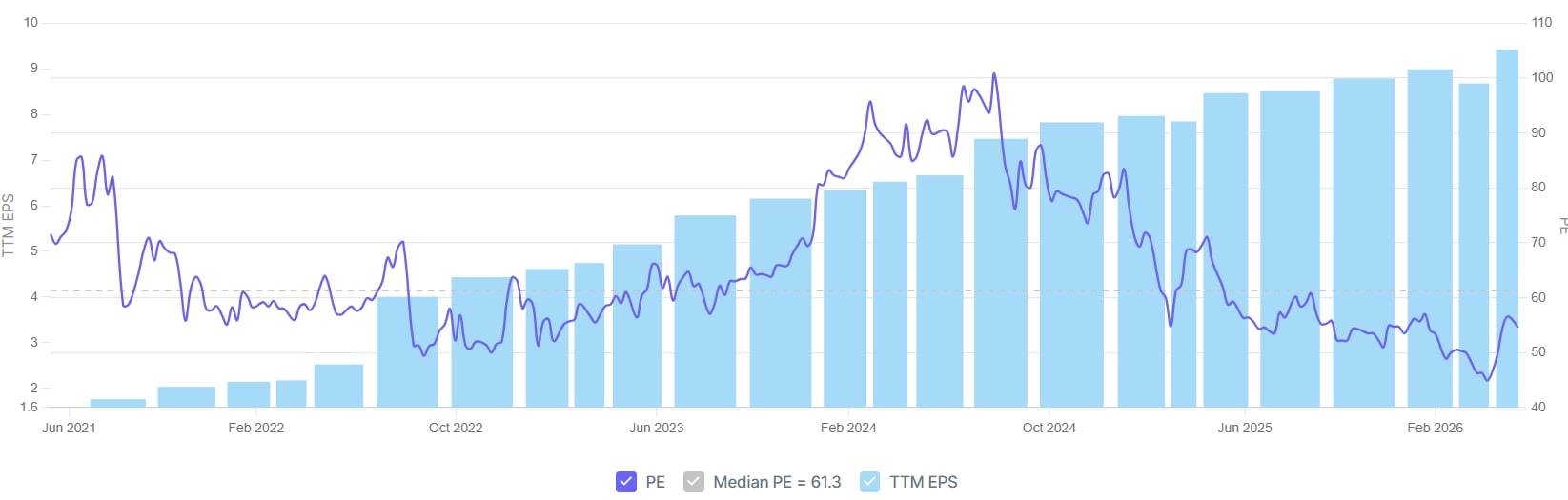
The re-rating suggests earnings are catching up with the stock price, not that fundamentals are weakening. However, valuations remain high compared to the overall market, with the BSE FMCG Index trading at a P/E of about 35.
If near-term tailwinds such as summer demand or event-led consumption fail to play out, chances of valuation correction cannot be ruled out.
More than a World Cup boost: What Will Sustain Varun Beverages’s Growth
The FIFA World Cup 2026 may provide a near-term boost to volumes for Varun Beverages Ltd. However, the company’s five-year growth path indicates a business that is steadily growing and is not dependent on one-time events.
A key factor to watch is the pace of its international expansion, where demand has been significantly stronger and is increasingly driving overall growth. Sustained execution here will determine whether this momentum can justify valuations and deliver long-term compounding.
Disclaimer:
Note: We have relied on data from www.Screener.in throughout this article. Only in cases where the data was not available, have we used an alternate, but widely used and accepted source of information.
The purpose of this article is only to share interesting charts, data points and thought-provoking opinions. It is NOT a recommendation. If you wish to consider an investment, you are strongly advised to consult your advisor. This article is strictly for educative purposes only.
Deepan Datta has spent over a decade studying stocks and mutual funds. His passion is to uncover interesting stories in the financial markets and share them through his writings with investors at large. He is focused on delivering clear, easy to understand and research-backed insights. Deepan began his career as a Research Associate at S&P Global, where he developed a strong foundation in financial research and data analysis.
Disclosure: The writer and his dependents do not hold the stocks discussed in this article.
The website managers, their employees (s), and contributors/writers/authors of articles have or may have an outstanding buy or sell position or holding in the securities, options on securities or other related investments of issuers and/or companies discussed therein. The content of the articles and the interpretation of data are solely the personal views of the contributors/ writers/authors. Investors must make their own investment decisions based on their specific objectives, resources and only after consulting such independent advisors as may be necessary.