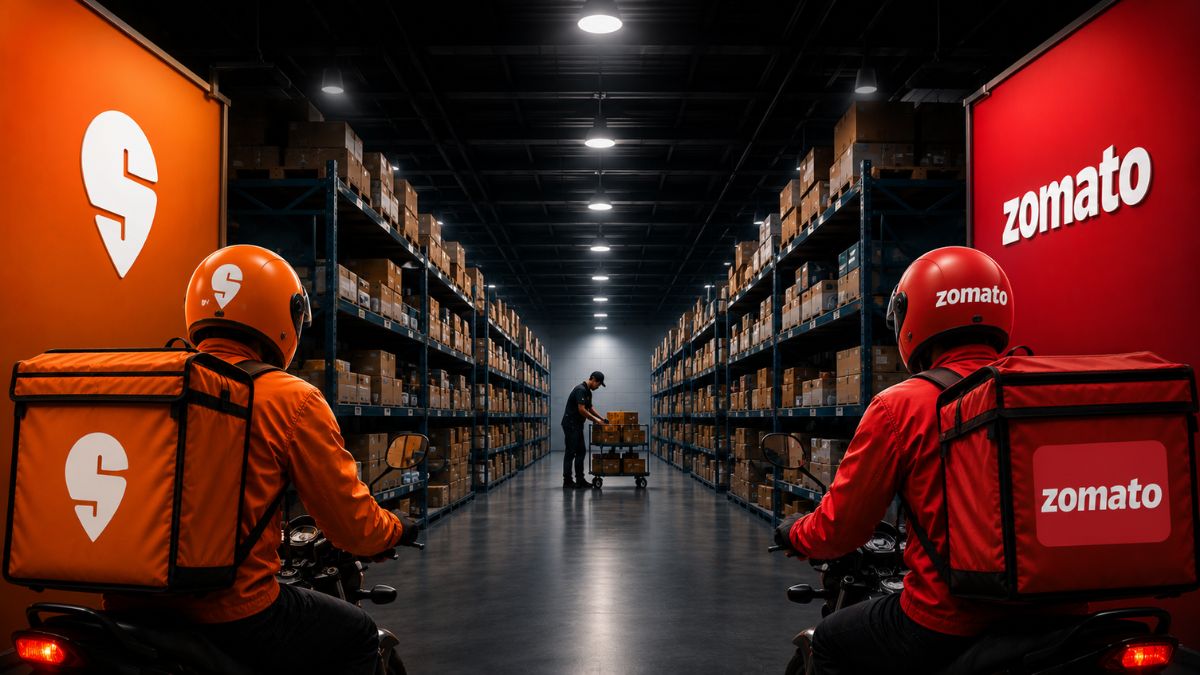
India’s two listed consumer internet platforms closed FY26 with a common message for the Street. Food delivery demand remained resilient despite concerns around urban consumption, while quick commerce continued to grow rapidly even as competition intensified across categories, cities and customer cohorts.
Yet the Q4FY26 earnings commentary from Swiggy Ltd. and Eternal Ltd. showed a widening gap in profitability, operating leverage and near-term visibility.
Eternal entered FY27 with Blinkit reporting adjusted earnings before interest, taxes, depreciation and amortisation profitability of Rs 37 crore. Swiggy’s Instamart, despite improving contribution margins, still reported an adjusted EBITDA loss of Rs 858 crore during the same period.
Swiggy vs Eternal: Divergent business dynamics
Eternal also sharpened its medium-term ambitions, targeting an annual net order value of $20 billion by FY28 and adjusted EBITDA of$1 billion by FY29. Swiggy, meanwhile, focused more on defending unit economics and preserving balance sheet flexibility while competition in quick commerce remained elevated.
Food delivery emerged as the earnings stabiliser for both companies in Q4FY26. Eternal’s food delivery net order value increased to Rs 9,757 crore in Q4FY26 from Rs 8,214 crore in Q4FY25, while adjusted EBITDA margin improved to 5.5% of net order value from 5.2% a year earlier.
Swiggy’s food delivery gross order value rose to Rs 9,005 crore in Q4FY26 from Rs 7,347 crore in Q4FY25, while adjusted EBITDA margin improved to 3.3% of gross order value from 2.9% a year earlier. Both management teams repeatedly pointed to affordability, retention and order frequency as the next drivers of growth instead of aggressive discount-led expansion.
Neither company announced any dividend payout for FY26. Both continued to deploy capital toward dark store additions, supply-chain investments, customer acquisition and category expansion, reinforcing that profitability improvement remained secondary to scaling consumer ecosystems.
Swiggy vs Eternal: Food delivery core profitability engine
Food delivery remained the most stable and profitable segment for both companies in Q4FY26, with management commentary indicating that demand recovery strengthened further during the quarter.
Eternal Ltd. reported food delivery net order value of Rs 9,757 crore in Q4FY26, increasing 18.8% year-on-year from Rs 8,214 crore in Q4FY25. Adjusted EBITDA increased to Rs 532 crore from Rs 428 crore a year earlier, while adjusted EBITDA margin improved to 5.5% of net order value from 5.2% in Q4FY25. The company reiterated its long-term expectation of more than 20% annual net order value growth with margins remaining in the 5-6% range.
Swiggy’s food delivery gross order value rose to Rs 9,005 crore in Q4FY26 from Rs 7,347 crore in Q4FY25, marking 22.6% year-on-year growth. Adjusted EBITDA increased to Rs 297 crore from Rs 212 crore a year earlier, while adjusted EBITDA margin improved to 3.3% of gross order value from 2.9% in Q4FY25. Monthly transacting users rose to 18.3 million in Q4FY26 from 15.1 million in Q4FY25.
Sriharsha Majety, Co-founder, Managing Director and Group Chief Executive Officer at Swiggy, said in the shareholder letter, “Food GOV grew 22.6% YoY, which is the highest since demand normalised in the post-COVID period. While this acceleration is definitely exciting, we are particularly pleased to see this being driven by a sharper increase in order and user volumes as opposed to AOVs.”
Rohit Kapoor, Chief Executive Officer of Food Marketplace at Swiggy, said during the earnings call, “The food delivery is a 10-year-old phenomenon. We know the business, we know the category. It caters to X% of India’s population, which is roughly like 10% of India’s total population on a very transactional basis. The contours of that are more predictable. We have continued to guide two things there. One is a medium-term growth of 18%-20% and a EBITDA margin of steady-state 5%.”
Eternal also suggested that food delivery demand recovery was becoming more broad-based after multiple muted quarters. In the shareholder letter, Akshant Goyal, Chief Financial Officer at Eternal, said food delivery net order value growth “continues to improve for the third quarter in a row, inching closer to our long-term expectation of 20%+ YoY.”
Swiggy vs Eternal: Blinkit widens profitability gap in quick commerce
The sharpest divergence between the two companies appeared inside quick commerce, where Eternal’s Blinkit crossed into adjusted EBITDA profitability while Swiggy’s Instamart continued to report heavy operating losses despite better contribution margins.
Eternal reported quick commerce net order value of Rs 14,386 crore in Q4FY26, increasing 95% year-on-year from Rs 7,377 crore in Q4FY25. Adjusted EBITDA improved to a profit of Rs 37 crore from a loss of Rs 178 crore a year earlier. Blinkit’s adjusted EBITDA margin stood at 0.3% of net order value in Q4FY26. The company operated 2,243 dark stores by March 2026 and reiterated its target of nearly 3,000 stores by March 2027.
Swiggy’s Instamart business reported gross order value of Rs 7,881 crore in Q4FY26, increasing 68.8% year-on-year from Rs 4,670 crore in Q4FY25. Net order value increased 60.3% year-on-year to Rs 5,675 crore. Contribution margin improved to negative 1.8% in Q4FY26 from negative 5.6% in Q4FY25, but adjusted EBITDA loss still stood at Rs 858 crore against a loss of Rs 840 crore a year earlier. Active dark stores increased to 1,143 in Q4FY26 from 1,021 in Q4FY25.
Akshant Goyal, Chief Financial Officer at Eternal, said during the earnings call, “We are fairly comfortable and confident that over a period of three years, we should be able to deliver this CAGR of growth.” He added that the growth guidance would be driven by “assortment expansion, geographical expansion as well as more demand densification in the cities where we are present today.”
Swiggy management repeatedly stressed differentiation instead of pure market-share aggression. Sriharsha Majety said during the earnings call, “With quick deliveries increasingly becoming a commoditised market, every participant in the category has to choose between being a differentiated platform or a value-led/price-led one.”
Rahul Bothra, Chief Financial Officer at Swiggy, said, “We think the consumer proposition is very strong. At least early signs that we have seen in some of the labels that we have launched.”
Bothra also said, “Over the medium term, Swiggy is aiming for INR1tn GOV in the Instamart business with a 3-4% adj EBITDA margin.”
Swiggy vs Eternal: Margin discipline replaces aggressive expansion
The Q4FY26 earnings calls from both companies repeatedly returned to contribution margins, adjusted EBITDA progression and customer retention instead of headline order growth.
Eternal’s management acknowledged that contribution margin in quick commerce moderated slightly in Q4FY26 because of lower average order value and supply-chain costs, but maintained confidence around medium-term profitability. Anand Rathi said Blinkit’s operating leverage remained strong enough to support long-term adjusted EBITDA margins of 5-6%.
Akshant Goyal said during Eternal’s earnings call, “Broadly the math is fine. We’re not giving any specific guidance, and therefore the numbers could move a little bit depending on how things pan out.” He was responding to analyst calculations that implied medium-term quick commerce margins of around 3-3.5%.
Swiggy also indicated that preserving unit economics now mattered more than maximising customer acquisition at any cost. Amitesh Jha, Chief Executive Officer of Instamart at Swiggy, said during the earnings call, “There are multiple ways in which we will be reaching our CM number. One is the repurpose of the incentives that we give to the end consumer on the wallet. We don’t reduce it. In the way that it happens is that it allows for better retention for the end consumer as well.”
Jha further said, “The marketing spends, what we are doing is commensurate to the growth that we are essentially looking for.”
Swiggy’s contribution margin in quick commerce improved to negative 1.8% in Q4FY26 from negative 2.5% in Q3FY26 and negative 5.6% in Q4FY25. Eternal’s Blinkit contribution margin stood at 5.4% in Q4FY26 compared with 5.5% in Q3FY26, according to Motilal Oswal estimates.
Swiggy vs Eternal: No dividend payouts
Neither company indicated any near-term intention to begin dividend distribution, with both management teams continuing to prioritise reinvestment into infrastructure, technology and category expansion.
Swiggy closed FY26 with cash balances of around Rs 15,500 crore, according to Nomura estimates, while Eternal continued to prioritise Blinkit network expansion, Hyperpure warehousing and technology investments.
Nomura said Swiggy’s food delivery business could generate free cash flow between Rs 1,400 crore and Rs 2,200 crore during FY27 and FY28, helping absorb continuing quick commerce losses. The brokerage said Swiggy remained “well-funded to weather the competition in the QC business.”
Eternal founder Deepinder Goyal framed the company’s capital allocation strategy around long-cycle execution instead of near-term shareholder returns. In the shareholder letter, Goyal wrote, “You spend years building track before the first train runs.” He added that Eternal expected to reach “US$1 billion of Adjusted EBITDA, hopefully by FY29.”
The absence of dividend payouts from both companies also reflected the intensity of the current quick commerce expansion cycle. Eternal planned to increase Blinkit dark stores to around 3,000 by March 2027 from 2,243 stores in March 2026, while Swiggy continued selective expansion in Instamart with greater emphasis on utilisation efficiency.
Swiggy vs Eternal Q4FY26 operational comparison
| Metric | Eternal | Swiggy |
| Food delivery gross/net order value | Rs 9,757 crore | Rs 9,005 crore |
| Food delivery growth | 18.8% YoY from Rs 8,214 crore in Q4FY25 | 22.6% YoY from Rs 7,347 crore in Q4FY25 |
| Food delivery adjusted EBITDA margin | 5.5% of net order value from 5.2% in Q4FY25 | 3.3% of gross order value from 2.9% in Q4FY25 |
| Quick commerce gross/net order value | Rs 14,386 crore | Rs 7,881 crore gross order value / Rs 5,675 crore net order value |
| Quick commerce growth | 95% YoY from Rs 7,377 crore in Q4FY25 | 68.8% YoY from Rs 4,670 crore in Q4FY25 |
| Quick commerce adjusted EBITDA | Profit of Rs 37 crore | Loss of Rs 858 crore |
| Quick commerce contribution margin | 5.40% | Negative 1.8% |
| Dark stores | 2,243 | 1,143 |
| Dividend payout for FY26 | None | None |
Swiggy vs Eternal: Brokerage focus on earnings visibility
Brokerage commentary after the earnings cycle showed stronger confidence around Eternal’s profitability trajectory, while views on Swiggy remained tied more closely to valuation comfort and execution improvement.
Anand Rathi retained a ‘Buy’ rating on Eternal with a target price of Rs 400. The brokerage said Eternal was “structurally well-positioned to handle the heat on the back of clear scale advantage especially in Blinkit with strong customer retention without relying on heavy discounts.”
Motilal Oswal also maintained a ‘Buy’ rating on Eternal with a target price of Rs 340. The brokerage said Eternal’s “long-term ramp intact despite near-term volatility” and added that Blinkit’s medium-term adjusted EBITDA margin could gradually move toward 5-6%.
Nomura retained a ‘Buy’ recommendation on Swiggy while reducing its target price to Rs 473 from Rs 546. However, the brokerage lowered growth assumptions for Instamart and said Swiggy “needs to improve its execution toward profitability for the stock to do well from here.”
Jefferies retained a ‘Buy’ recommendation on Swiggy with a target price of Rs 415, but also said the stock was likely to remain “range-bound until clarity emerges on industry structure & Q/C profitability trend.”
Conclusion
The Q4FY26 results showed that India’s quick commerce battle is no longer only about adding dark stores, chasing users or pushing order volumes higher. The sharper divide between Swiggy and Eternal is now emerging in profitability, visibility and how quickly each company can convert scale into earnings.
Eternal entered FY27 with Blinkit already reporting adjusted EBITDA profitabilitySwiggy, on the other hand, showed that demand across food delivery remains strong and margins are improving steadily, but Instamart is still consuming large amounts of capital even after better contribution margins. What also stood out through the quarter was the absence of dividend payouts from both companies.The next few quarters are likely to matter less for topline expansion alone and more for whether bottomline improvement continues without growth slowing materially.
Disclaimer: The following analysis of Swiggy and Eternal’s financial performance is provided for informational purposes only. This report covers corporate earnings, sector-wide trends, and analyst outlooks; it does not constitute investment advice, a recommendation to buy or sell securities, or an offer of solicitation.
While the article references specific brokerage ratings and price targets, these are third-party views and have not been independently verified. Investing in consumer internet and quick commerce platforms involves significant market risk and volatility. Readers should consult with a SEBI-registered investment advisor or a qualified financial professional before making any decisions based on this data.
This disclaimer has been generated using AI to support user well-being and responsible content consumption.