Technology companies are gaining an even bigger grip on global financial markets, with their influence now stretching far beyond stock markets and increasingly into corporate debt as well.
The rise has been driven largely by the artificial intelligence boom, with companies pouring billions of dollars into data centres, semiconductors, cloud computing and other infrastructure needed to support the next wave of AI growth.
New data from MSCI shows just how much the balance of power has shifted in recent years.
Tech now makes up nearly 40% of a major US stock index
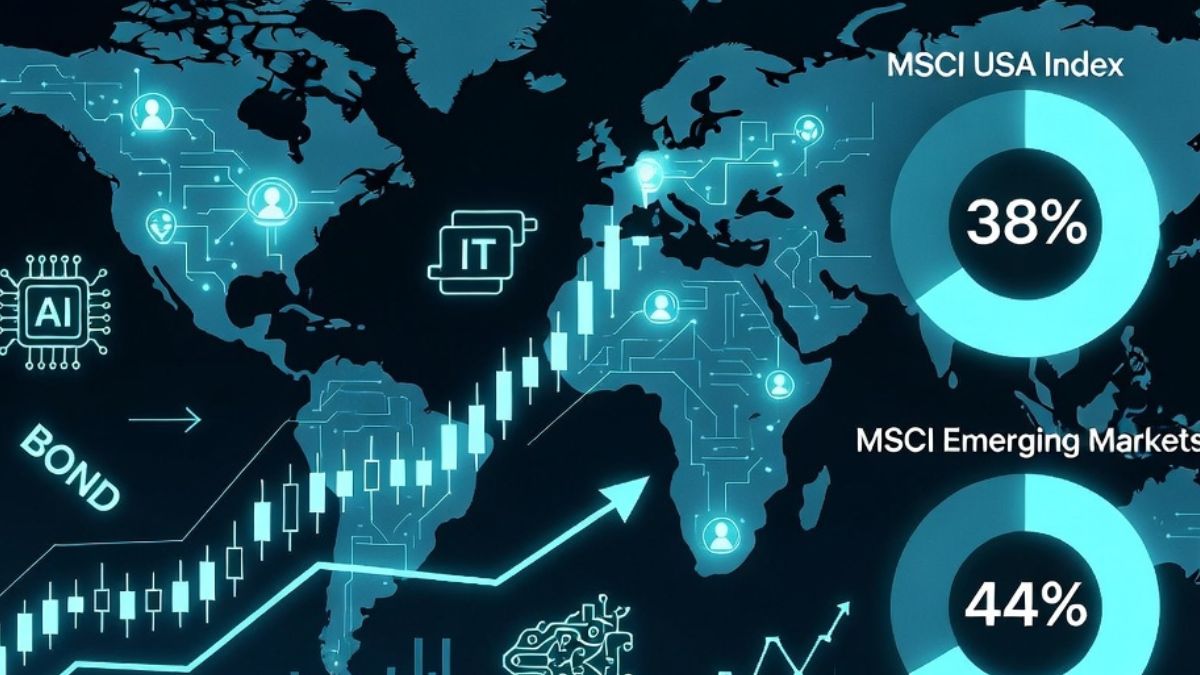
The Information Technology sector currently accounts for 38.33% of the MSCI USA Index, one of the most-followed measures of the American stock market. The index tracks large and medium-sized US companies and represents about 85% of the country’s stock market value.
That figure has risen by more than 15 percentage points over the past four years. Much of that rise has been driven by a handful of giant technology companies. Nvidia alone accounts for around 7.79% of the MSCI USA Index, while Apple makes up about 6.96%.
Investors have poured money into companies involved in semiconductors, software, cloud services and computer hardware, pushing their market values sharply higher. As a result, a small group of technology firms now has an outsized impact on major indexes such as the S&P 500. Their strong performance has helped lift the broader market, but it has also sparked concerns about whether too much depends on a single sector.
Technology firms are reshaping the global investment landscape:
The IT sector now accounts for ~38% of the MSCI USA Index, which tracks large and mid-cap stocks of the US equity market, covering ~85% of the US market cap.
This percentage has surged +15 points over the last 4… pic.twitter.com/ccN6atSTvD
— The Kobeissi Letter (@KobeissiLetter) June 20, 2026
Emerging markets are even more dependent on tech
Technology companies now account for about 43.2% of the MSCI Emerging Markets Index, which tracks large and medium-sized companies across 24 developing economies. Just a few years ago, the sector’s share was much smaller. Since 2022, its weight in the index has more than doubled.
Much of that growth has been driven by semiconductor companies in Taiwan, major technology firms in South Korea and the expansion of digital businesses across China and other emerging economies.
MSCI noted that Taiwan became the largest country in the emerging markets index, representing 24.8% of the benchmark as of April 2026.
Tech’s influence is spreading to bond markets
The technology sector’s growing dominance is not limited to stocks. Tech companies are also becoming some of the biggest borrowers in the corporate bond market.
The share of US investment-grade bond issuance coming from technology firms has more than tripled in recent years, reaching record levels of around 18% to 20% in 2026. Some of the world’s largest companies, including Amazon, Meta, Alphabet, Microsoft and Oracle, have raised tens of billions of dollars through bond sales this year.
The money is being used to fund expensive AI projects, build new data centres and expand cloud infrastructure. Despite the heavy borrowing, analysts say most of these companies remain financially strong, with healthy balance sheets and high credit ratings.
Why investors are paying close attention
The AI investment cycle continues to drive huge spending across the industry. At the same time, many tech firms are reporting strong profits, helping justify their high market valuations.
Another factor behind the boom is the return of the IPO market. After years of subdued activity, investors are gearing up for a wave of highly anticipated listings from AI and technology giants such as OpenAI, Anthropic and SpaceX. The excitement around these offerings is drawing fresh money into the sector, strengthening confidence in high valuations and adding further fuel to the rally.
The structure of major stock indexes is also helping drive gains. Most indexes are weighted by market capitalization, meaning companies with the highest valuations carry the most influence. As their share prices climb, their weight in the index increases as well, creating a cycle in which the biggest winners play an even larger role in pushing the market higher.
But such concentration also comes with risks. A regulatory crackdown, geopolitical tensions affecting semiconductor supply chains, changing interest rates or slower-than-expected growth in AI could all hurt the sector.
Some market observers have drawn comparisons with previous periods when a small group of companies dominated financial markets, including the technology boom of the late 1990s and the dominance of financial stocks before the 2008 financial crisis.
There is one important difference, however. Today’s technology giants are generally far more profitable and generate more revenue than many companies that led earlier market booms.
For now, the AI boom shows little sign of slowing. As long as companies continue spending heavily on chips, data centres and digital infrastructure, technology is likely to remain at the centre of global markets.