During February 2026, mutual funds were net buyers in the Indian equity market. They bought equities worth ₹11,421.7 crore during the month (net).
Amidst this buying, one particular capital market stock saw several funds load up on it.
It was Angel One Ltd.The stock witnessed a 14.86% point rise in its mutual fund holdings during the month of February.
Among the buyers were HDFC Banking & Financial Services Regular (Growth) fund which invested 1.09% of its assets under management (AUM) in Angel One.
Then there was Kotak Small Cap Regular (Growth) Fund, which invested around 0.44% of its AUM, followed by ICICI Pru Balanced Advantage Growth Fund which put in 0.1% of its AUM in the capital market giant.
These three funds were among the biggest buyers of the stock during the month. Incidentally, this was a new purchase for these funds.
So, what made Angel One top the priority list of these mutual fund houses?
Let’s explore.
Angel One: Managing Assets Worth Over ₹1.5 Trillion
Angel One is one of the largest capital market players in the country, with a total clientele of around 36.9 million (as of February 2026).
It offers a range of services and products including investing and trading in stocks, commodities, currencies, initial public offerings, mutual funds, margin trading facility and institutional broking.
While Angel One, earlier known as Angel Broking, is primarily engaged in the stock broking business, it also offers client funding for trading and investment via a margin trading facility and also engages in third-party distribution business of personal loans, insurance, and other financial and investment instruments.
During Q3FY26, the total assets under custody (AUC) of the brokerage house grew to ₹1.5 trillion, growing 5.6% QoQ. Also, gross clients acquired during the quarter was 1.7 million.
Broking Giant: Leading with a Market share of 20.4%
Angel One has one of the largest client bases in the industry. As of 31 December 2025, it held a market share of 16.5% in demat accounts..
On the basis of retail equity turnover, Angel One holds around 20.4% of the market share.
The average client funding book stood at ₹5,900 crore, which was a growth of 10.4% QoQ.
Emerging Businesses: Credit Disbursement Jumped 55.7%
Angel One’s distribution network is growing steadily. During the October-December quarter, credit disbursement rose to ₹710 crore, growing 55.7% QoQ. The capital market giant crossed the 100,000 clients mark for its credit business as well during the period.
Angel One also distributes mutual funds. At the end of the quarter, there were 2.3 million unique SIPs registered with the company, rising 2.6% QoQ. The total number of mutual fund clients registered with the brokerage house was around 3.3 million.
Apart from third-party financial product distribution, Angel One has two other business segments, which are wealth management and asset management.
During Q3FY26, AUM of the wealth management business grew by 33.7% QoQ to ₹8,220 crore, while AUM of the asset management business grew by 16.7% QoQ to ₹470 crore.
Trading Activity Skyrockets Logging 88% Growth
Average daily turnover of Angel One surged by a whopping 88.4% YoY from around ₹29,59,100 crore in February 2025 to ₹55,74,300 crore in February 2026.
This is mainly owing to trades in futures and options (F&O) segment, which grew by 87.4% during the period, contributing to around 97% of the overall daily turnover.
Mixed Financial Growth
Revenue grew marginally by 5.8% YoY during the quarter from ₹1,262 crore to ₹1,335 crore. However, net profit dropped during the period by 5% YoY from ₹281 crore to ₹269 crore.
Having said that, revenue growth was positive during this quarter, though marginally, after being negative for the past three quarters. This turnaround in the business could be a reason for mutual fund houses to buy this capital market stock aggressively during the last month after Q3 earnings were announced.
Thriving in a Highly Competitive Market
Angel One, like all other brokerage houses, faces cutthroat competition where even a slight change in the brokerage charges could lead to a significant change in the revenue and profits.
As Angel One derives most of its revenue from the broking business, growth is highly sensitive to market conditions and regulatory changes as well.
This is why Angel One is expanding its other business segments as per its diversification strategy. Though most of the insurance, loans, and mutual fund products are third-party products, the company launched its own mutual fund as well in February 2025.
Then there is the regulatory risk to contend with. Over the last many months, the regulator has taken action to discourage trading by retail investors. In the long term, if the regulations take hold, there’s a risk that growth in the broking business of the company may be throttled.
Valuation: Does Angel One Command a Premium?
The stock is currently trading at a price/earnings (PE) of 27.9x, which is higher than the industry median of 16.9x, indicating a premium valuation. The price-to-book value (PBV) is also higher than 3.7x, compared to the industry median of 1.9x.
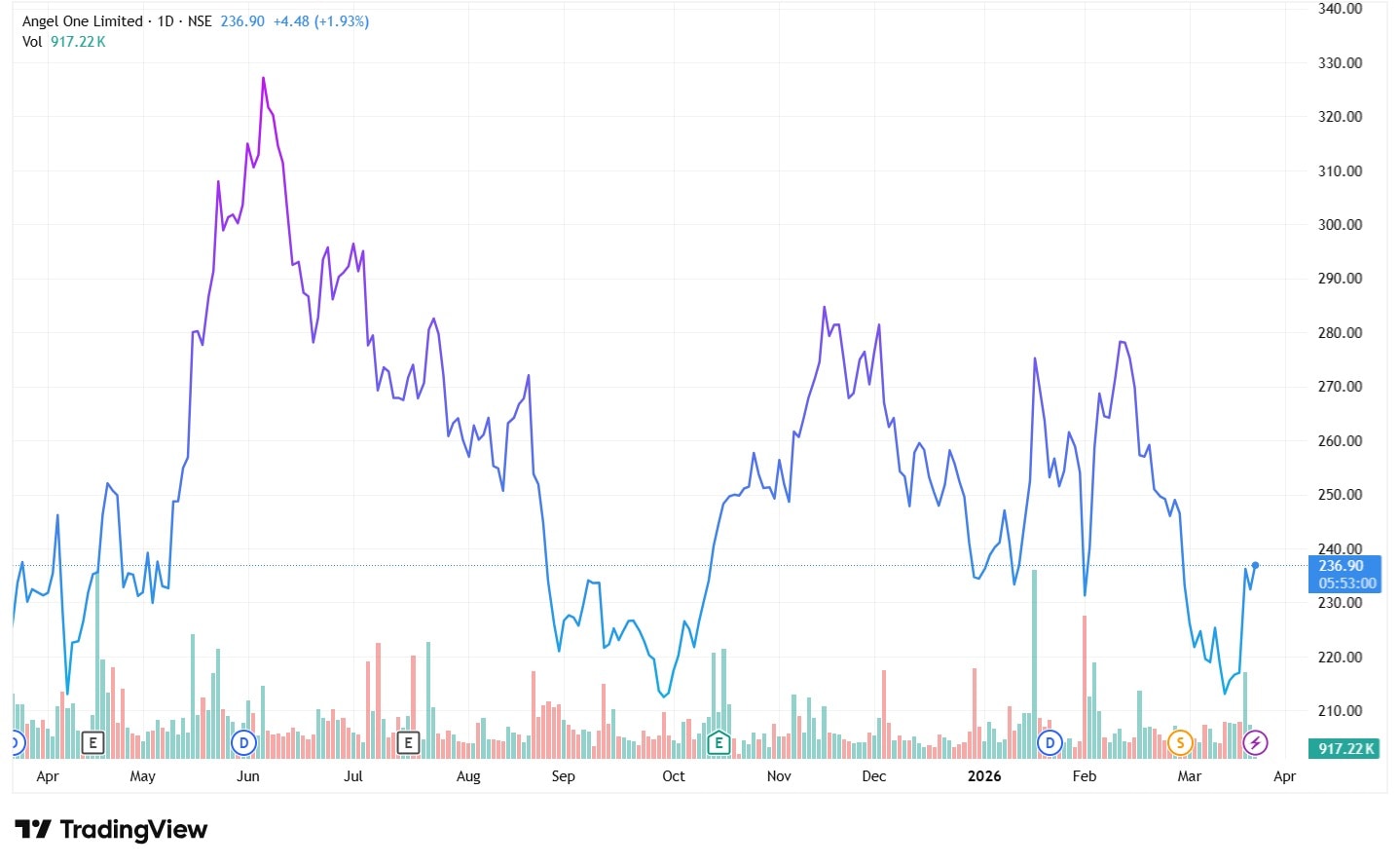
1-Year Share Price Chart of Angel One Ltd.
Final Thoughts
Mutual funds buying this capital market stock for the first time, and also the existing stakeholders raising their stake, even amidst a sluggish revenue and profit growth trajectory, perhaps indicate the future potential of the business, especially the way it is diversifying.
While Angel One walks a tight rope due to excessive competition, it has an edge over others in the industry. Having said that, to keep a track of whether mutual funds continue to invest in the stock or they hold or exit their position, and monitor how the diversification strategy is working for the company, you can add this stock to the watchlist for now.
Disclaimer:
We have relied on data from www.Screener.in throughout this article. Only in cases where the data was not available have we used an alternate, but widely used and accepted source of information.
The purpose of this article is only to share interesting charts, data points, and thought-provoking opinions. It is NOT a recommendation. If you wish to consider an investment, you are strongly advised to consult your advisor. This article is strictly for educational purposes only.
Maumita Mitra is a seasoned writer specializing in demystifying the world of investment for a broad audience. She has a keen eye for detail and a knack for explaining complex financial concepts in the simplest manner possible.
Disclosure: The writer and her dependents do not hold the stocks discussed in this article.
The website managers, their employees (s), and contributors/writers/authors of articles have or may have an outstanding buy or sell position or holding in the securities, options on securities, or other related investments of issuers and/or companies discussed therein. The content of the articles and the interpretation of data are solely the personal views of the contributors/ writers/authors. Investors must make their own investment decisions based on their specific objectives, resources, and only after consulting such independent advisors as may be necessary.