A tea stall outside a busy office may sell the same tea as many others. But if people still go there every day, it has an edge. It could be location, trust, taste, or habit. In investing, this edge is called a moat. It helps a company protect its market, margins, and profits.
A monopoly is when one company dominates a market with little real competition. A moat monopoly is broader. It may not be a legal monopoly, but it has a strong hold over its core business. This can come from regulation, scarce assets, licences, scale, technology, or strategic importance.
Such stocks become interesting when the economy also supports their business. India’s spending on infrastructure, defence, energy security, and public capacity creation can help companies with strong market positions. These companies may enjoy stable demand, pricing power, or long-term visibility.
The companies selected here are not just large names. Their dominance is backed by clear business advantages. Some control scarce resources. Some operate in regulated or strategic sectors. Others have deep execution history and government linkages. We have avoided businesses where dominance is weak, easily challenged, or shared closely with a strong rival.
#1 Indian Railway Catering and Tourism Corporation (IRCTC): Transitioning Beyond a Pure Ticketing Monopoly
Incorporated in 1999, IRCTC is a Navratna (Category 1, Central Public Sector Enterprises) and the only company authorized by the Indian government to provide online railway tickets, catering services, and packaged drinking water at railway stations and trains in India.
IRCTC remains one of the clearest monopoly-like plays in India’s listed market. Its moat comes from its exclusive role in railway ticketing, catering, packaged drinking water for rail passengers, and railway tourism. This is not a private-sector moat built only on brand. It is backed by railway access, scale, regulation, and deep integration with Indian Railways.
For Q3 FY26, the company reported revenue from operations of Rs 1,449 crore. This was up 18.2% year-on-year (YoY). Net profit stood at Rs 394 crore, up 15.5% YoY. Earnings before interest, tax, depreciation, and amortisation (EBITDA) came in at Rs 465 crore, up 11.5%, with an EBITDA margin of 32.1%. Management said this was the company’s highest-ever revenue and profitability quarter. The company is yet to declare its Q4 results.
The core strength remains internet ticketing. IRCTC said nearly 89% of reserved railway tickets in India are now booked through its online platform. The segment reported revenue of Rs 401 crore, up 13.2% YoY. It also delivered an EBITDA margin of 85%. Daily ticket bookings rose to 14.6 lakh from 13.5 lakh in December 2024. UPI’s share increased to 50.1% from 46.8%.
Scaling Non-Convenience Fees and Vande Bharat Triggers
Catering was the largest revenue contributor. Revenue rose 19.1% YoY to Rs 661 crore. Growth was helped by the addition of 40 trains, including 19 Vande Bharat trains. Management said Vande Bharat billing increased by about Rs 70 crore on a year-on-year basis. The railway ministry’s plan to introduce 260 Vande Bharat train sets over the coming years is a key growth trigger for IRCTC.
Rail Neer revenue stood at Rs 98 crore, up 6.5% YoY. The company is expanding capacity at Danapur and Ambernath. Its board has also approved four new plants at Mysore, Prayagraj, Bhagalpur, and Ranchi. These projects may add around 25-30% capacity over about 1.5 years.
Tourism also had a strong quarter. Segment revenue rose 29% YoY to Rs 289 crore. Maharaja Express revenue grew 39% to Rs 53.1 crore. State Tirth and Bharat Gaurav train revenue grew 51% to Rs 118.9 crore. Management is also working on a unified portal to cross-sell travel services to its large base of rail passengers.
IRCTC is also exploring newer digital opportunities. Its RBI document submission deadline for the payment aggregator licence has been extended till August 2026. Until then, management said the payment business will grow gradually. The company is focusing more on non-convenience fee revenue, which grew 26% during the quarter.
Assessing Regulatory Risks and EV/EBITDA Valuation Compression
In valuation terms, IRCTC trades at an EV/EBITDA of 20.6 times, against its five-year median EV/EBITDA of 38.6 times. Its return ratios remain strong, with Return on Capital Employed (ROCE) at 49% and Return on Equity (ROE) at 37.2%. The stock’s investment case now depends on whether catering, Rail Neer, tourism, and non-convenience revenue can offset the maturity in online ticketing.
At current levels, IRCTC is no longer just a ticketing story. The next leg depends on catering growth, Rail Neer capacity addition, tourism packages, and higher non-convenience revenue. Its valuation has also moderated compared with its five-year average.
But the business still depends heavily on railway policy, pricing approvals, and regulatory timelines. That keeps the stock in a strong moat category, but not without policy-linked risks.
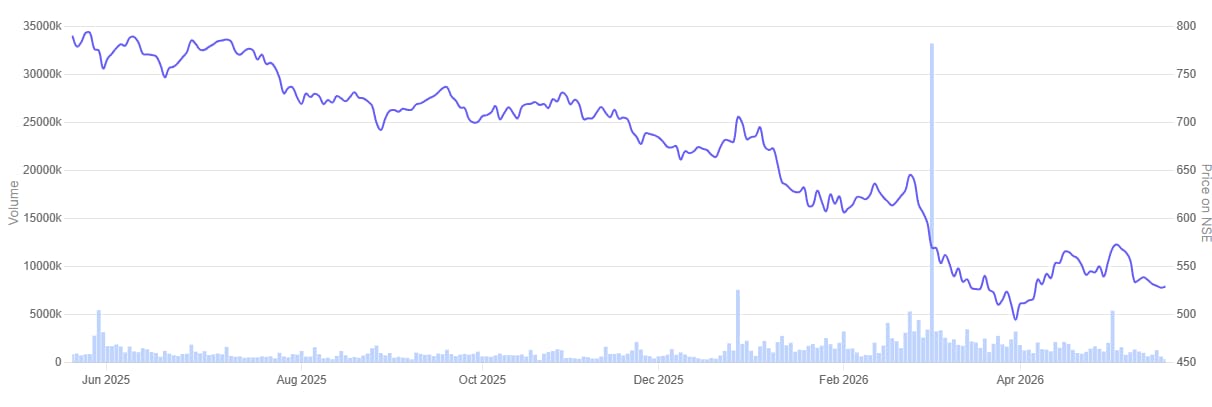
In the past year, the share price of IRCTC tumbled 33%.
IRCTC 1 Year Share Price Chart
#2 Hindustan Zinc: Cost Leadership Backed by Captive Assets
Incorporated in 1966, Hindustan Zinc operates across the zinc, lead and silver businesses. It is the world’s second-largest integrated zinc producer and the third-largest silver producer globally, with an annual silver capacity of 800 MT.
The company has a market share of approximately 75% of the growing zinc market in India with its headquarters at zinc city, Udaipur along with zinc-lead mines and smelting complexes spread across the state of Rajasthan.
Hindustan Zinc qualifies as a moat stock because its dominance is backed by reserves, integration, and scale. It is India’s leading zinc producer and has a large presence in silver as well. Its strength does not come only from market share. It comes from captive mines, smelters, cost control, and a long operating history in a resource-heavy business.
The company reported a strong March quarter. In Q4 FY26, revenue stood at Rs 13,544 crore, up 49% YoY. Net profit rose 68% YoY to Rs 5,033 crore. For FY26, Hindustan Zinc reported record revenue of Rs 40,844 crore, up 20%. Net profit rose 34% to Rs 13,832 crore. Annual EBITDA stood at Rs 22,162 crore. The year was helped by better metal prices, higher operating efficiency, and a stronger contribution from silver. Silver accounted for 45% of overall profitability during the year.
Examining Silver-Driven Margins and the Rs 12,000 Crore Rajasthan Complex
Operationally, the company ended FY26 with record mined and refined metal production. Q4 mined metal production stood at 315 kilotonnes. Refined metal production was 282 kilotonnes. Silver production stood at 176 tonnes in the quarter and rose 11% sequentially. Zinc cost of production also fell to one of its lowest levels, which supported margins.
The expansion story is also important. Hindustan Zinc has approved a Rs 12,000 crore project to add a 250 kilotonne metals complex in Rajasthan. The project is expected to be completed in 36 months. This will add to its existing production base and support its broader plan to expand capacity over time.
The company is also trying to position itself beyond a plain zinc cycle. Its silver business has become a larger earnings driver. It also remains linked to sectors such as infrastructure, renewable energy, batteries, galvanisation, and industrial metals. This makes the stock relevant in a moat-monopoly article, especially because its resource base and integrated model are difficult to replicate.
Navigating Commodity Cycle Exposure and Historical Valuation Premiums
In valuation terms, Hindustan Zinc trades at an EV/EBITDA of 12 times, against its five-year EV/EBITDA of 9.3 times. Its return ratios remain among the strongest in the sector, with ROCE at 69.3% and ROE at 76.6%. These numbers show the strength of the business. But the valuation is not cheap compared with its own history.
The investment case now depends on three factors. Metal prices must remain supportive. The expansion project must stay on track. Silver should continue to add meaningful profit support. Hindustan Zinc’s moat remains strong, but earnings can still move with the commodity cycle. That makes it a high-quality monopoly-like business, but not a risk-free one.
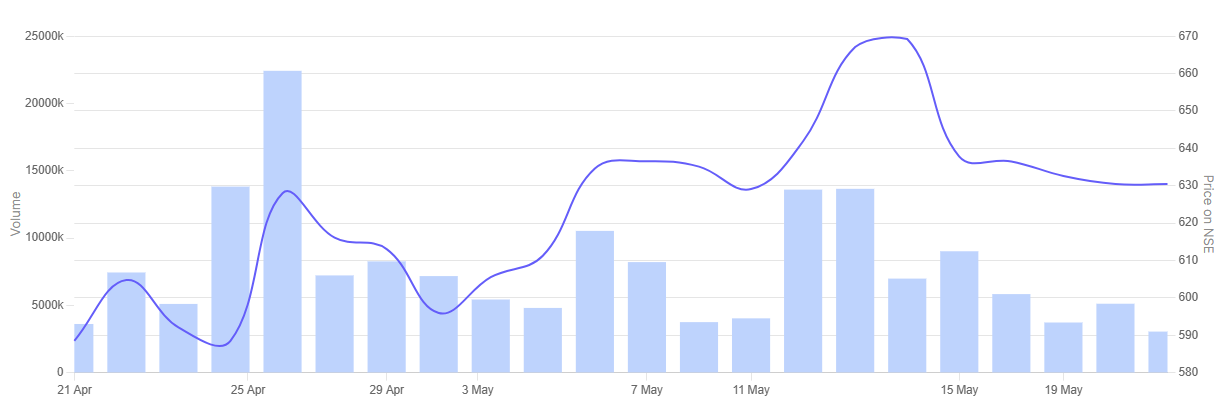
In the past year, the share price of Hindustan Zinc rallied 42.1%.
Hindustan Zinc 1 Year Share Price Chart
#3 Hindustan Aeronautics (HAL): Order Book Execution is the Ultimate Moat
Hindustan Aeronautics is engaged in the business of manufacture of aircraft and helicopters and repair, maintenance of aircraft and helicopters.
Hindustan Aeronautics qualifies as a moat stock because its position is built on strategic capability, not just market share. It sits at the centre of India’s aerospace and defence manufacturing chain. In a sector where approvals, technology, trust and execution history matter, HAL has a monopoly-like position in its core market.
For FY26, HAL reported revenue from operations of Rs 33,050 crore. This was up 7%. Profit before tax rose 12% YoY to Rs 12,112 crore. EBITDA increased 11% to Rs 13,472 crore. Operating EBITDA margin was maintained at around 30%.
The March quarter also showed strong growth. Consolidated Q4 revenue from operations stood at Rs 13,942 crore, against Rs 13,699 crore a year ago. Net profit for the quarter stood at Rs 4,196 crore. This reflects around 17% YoY growth.
Manufacturing revenue rose to Rs 9,227 crore from Rs 7,057 crore. This was supported by deliveries of ALH helicopters, AL-31FP engines and RD-33 engines. Repair and overhaul revenue stood at Rs 20,524 crore. HAL expects manufacturing revenue to rise further once LCA Mk1A and HCT-40 deliveries begin.
Analyzing the Rs 2.54 Lakh Crore Order Backlog and Fighter Jet Timelines
HAL’s order book rose to Rs 2,54,538 crore which is 34.5% higher than it was at the start of FY26. Fresh orders stood at Rs 97,028 crore. Major orders included 97 LCA Mk1A aircraft for the Indian Air Force, ALH helicopters, DO-228 aircraft, Hindustan 228 aircraft for Guyana, and other defence platforms.
The company is also expanding capacity. It established annual production capacity of eight LCA Mk1A aircraft at Nashik. It plans to invest around Rs 12,000 crore by 2030 in LCA, HCT-40, LCA Mk-II, GE-414 engines, IMRH engines, SSLV infrastructure and aero-engine indigenisation.
Monitoring Supply-Chain Bottlenecks and Global Aerospace Joint Ventures
Several projects moved ahead in FY26. ALH Dhruv-NG took its maiden flight in December 2025. The first series-production HCT-40 completed its maiden sortie in October 2025. HAL also received DGCA certification for indigenous manufacturing of the Shakti civil engine. LCA Mk1A deliveries are expected to start around August-September, subject to testing and refinements.
HAL is also widening its global and non-defence presence. It signed an SSLV technology transfer agreement with ISRO, IN-SPACe and NSIL. It also signed an MoU with Russia’s United Aircraft Corporation for SJ-100 aircraft production in India. It entered into an agreement with Safran Aircraft Engines for LEAP engine parts.
In valuation terms, HAL trades at an EV/EBITDA of 18.2 times, against its five-year EV/EBITDA of 14 times. Its return ratios remain strong, with ROCE at 32% and ROE at 24%. The stock trades above its historical valuation average.
The investment case depends on timely execution. HAL has a large order book, strategic relevance and deep technical capability. But delays in LCA Mk1A, engine supplies and global supply-chain issues remain key risks. The next phase will depend on how quickly that moat converts into deliveries and revenue growth.
Conclusion
These companies have strong positions in their core markets. But that alone is not enough. A moat can protect a business, but it cannot remove every risk.
For investors, the key is to look beyond the word monopoly. Some of these companies depend on government orders. Some depend on commodity prices. Some need large projects to be completed on time. So the business may be strong, but the stock can still go through weak phases.
A better way is to treat this list as a starting point. Check the growth, valuation, balance sheet and execution record before deciding. A good moat helps a company stay ahead. But returns finally depend on the price paid and the growth delivered.
You can track how these are progressing by adding stocks to your watchlist.
Disclaimer:
Note: We have relied on data from www.Screener.in throughout this article. Only in cases where the data was not available, have we used an alternate, but widely used and accepted source of information.
The purpose of this article is only to share interesting charts, data points and thought-provoking opinions. It is NOT a recommendation. If you wish to consider an investment, you are strongly advised to consult your advisor. This article is strictly for educative purposes only.
Ekta Sonecha Desai has a passion for writing and a deep interest in the equity markets. Combined with an analytical approach, she likes to deep dive into the world of companies, studying their performance, and uncovering insights that bring value to her readers.
Disclosure: The writer and her dependents do not hold the stocks discussed in this article.
The website managers, its employee(s), and contributors/writers/authors of articles have or may have an outstanding buy or sell position or holding in the securities, options on securities or other related investments of issuers and/or companies discussed therein. The content of the articles and the interpretation of data are solely the personal views of the contributors/ writers/authors. Investors must make their own investment decisions based on their specific objectives, resources and only after consulting such independent advisors as may be necessary.