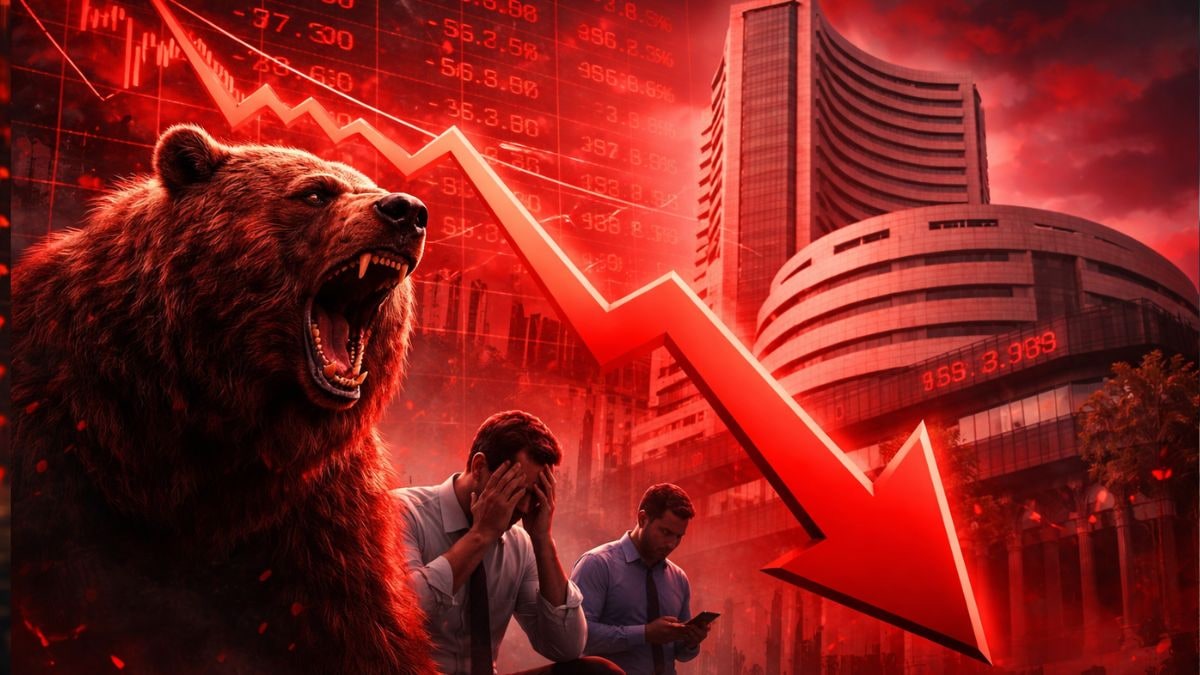
The Indian stock market saw a broad-based selling in the afternoon trade as rising geopolitical tension in the Middle East rattled investor sentiment. Benchmark indices extended losses through the afternoon session, with weakness spreading across large-cap, mid-cap and small-cap stocks.
At the time of writing, the Sensex was down over 1,600 points, or 2%, to below 76,600, while the Nifty slipped over 500 points, or nearly 2%, to below 23,700.
The sell-off was not limited to frontline indices. The Nifty Midcap 100 fell 1.5%, the Nifty Smallcap 100 declined 2%, while the BSE Midcap and BSE Smallcap indices dropped 1.56% and 2.19%, respectively.
Here are the seven key reasons behind today’s sharp fall in the market.
Trump declares ceasefire ‘over’: US-Iran conflict weighs on investor sentiment
The biggest trigger behind the sell-off is the fresh escalation in tension between the United States and Iran. According to Reuters, US President Donald Trump stated that the memorandum of understanding signed with Iran to end the conflict was “over”, adding he didn’t want to engage with Tehran.
The interim ceasefire agreement signed between Washington and Tehran — under the mediation of Pakistan — was intended to provide a 60-day window for negotiations on a permanent agreement, but indirect talks in Qatar ended last week.
Reports of fresh strikes by both countries have increased uncertainty in the Middle East, prompting investors to reduce exposure to riskier assets.
Global equity markets have turned cautious, and Indian equities have also come under pressure.
Crude oil prices surge
Another major reason behind the weakness is the sharp rise in crude oil prices. India imports a large part of its crude oil requirement, making higher oil prices a concern for the economy.
Commenting on the development, Dr. VK Vijayakumar, Chief Investment Strategist, Geojit Investments, said, “With the renewed U.S.-Iran tensions and the consequent spike in Brent crude to $76, the market is again back to uncertain territory. How long this would last and what would be its consequences are now in the realm of uncertainty.”
Uncertainty over foreign investor flows
The geopolitical situation has also raised concerns over the sustainability of foreign institutional investor inflows.
Vijayakumar said, “The market was slowly gaining strength on positive FII activity and improving macro fundamentals. The renewed U.S.- Iran tensions have put a temporary question mark on this positive development. Therefore, investors have to wait and watch the developments.”
He added, “The weakening of the chip trade globally and FIIs turning buyers in India are clear positives for the Indian market. During the last three days FIIs have been consistent buyers in Indian market having bought equity for Rs 1991 crores. Even though the amount is small, this marks a significant trend in FII activity.”
According to him, India could continue attracting foreign investments if geopolitical tensions do not worsen. However, a further rise in crude oil prices could change that outlook.
Technical indicators remain weak
Market experts also believe that technical indicators suggest caution in the near term.
Sudeep Shah, Head of Technical and Derivatives Research at SBI Securities, said, “The frontline indices started the day with a notable downwards gap on the back of reports of geopolitical tension between US and Iran resulting in a spike in Brent crude prices however Nifty stabilized as the day matured, remaining in a 0.34% range.”
He further said, “Coming to Nifty, the zone of 24120-24140 will act as a crucial support for the index while the resistance lies in the zone of 24370-24390. On the downside, if the index slips below the level of 24120 then the next support is placed in the zone of 23970-23990.”
According to Shah, “In an event of a surge above 24390, the index can experience an extension of the rally towards 24590.”
Selling pressure across sectors
The weakness was visible across several sectors. Financial services, fast-moving consumer goods, automobiles and healthcare stocks were among the biggest drags on the benchmark indices.
Heavyweights drag benchmark indices
Several heavyweight stocks also came under pressure, adding to the decline in benchmark indices.
Maruti Suzuki was the biggest loser among the frontline stocks, falling over 3%, followed by IndiGo, Hindustan Unilever, UltraTech Cement and Bharat Electronics.
India VIX jumps sharply
Investor nervousness was also reflected in the volatility index. The India VIX, often referred to as the market’s fear gauge, jumped more than 23% to 14.33 in the intraday trade. A sharp rise in the VIX generally indicates increasing uncertainty and expectations of higher market volatility over the short term.