
India’s agri-tech story is picking up pace. Technology is entering the farm. From Artificial Intelligence, or AI, to precision farming and drone usage, the shift is becoming visible. The government is also backing this move. Schemes like Rashtriya Krishi Vikas Yojana, (RKVY), are supporting innovation and adoption. The direction is clear. Farming is moving towards efficiency, not just expansion.
This shift matters because productivity has remained a weak link. Water usage is still inefficient. Mechanisation is uneven. Input application is often not precise. Crop outcomes still depend heavily on monsoon patterns. Agri-tech is trying to fix these gaps. It is helping farmers use fewer resources and get better output. The change is gradual, but it is spreading across the value chain.
For investors, this opens up a different way to look at agriculture. The opportunity is not just in traditional input players anymore. It is in businesses that improve how farming is done. As adoption improves and policy support continues, companies linked to productivity could see stronger and more stable growth over time. This makes the space worth tracking now.
The companies selected for this list reflect that shift from different angles. Together, they offer exposure to some of the most important building blocks of farm productivity. These include better water management, stronger seed-led output, crop science-led efficiency and improved on-field farm solutions.
They also represent different risk-reward profiles. Some are stronger on fundamentals. Some are more cyclical. One is still seen as a turnaround story. But each has a credible link to the larger theme of technology improving the economics of Indian farming.
#1 PI Industries: Navigating the Global Agri-Chem Cycle with Technology
PI Industries is a leading player in the agro-chemicals space having strong presence in both domestic and export markets. It has state-of-art facilities in Gujarat having integrated process development teams and in-house engineering capabilities.
PI Industries reported a muted performance in the December quarter, reflecting ongoing weakness in the global agri-chemicals cycle. The company reported Q3 FY26 revenue of Rs 1,376 crore which is significantly lower compared to Rs 1,901 crore reported in Q3 FY25. Growth remained under pressure due to lower demand and delayed customer off-take.
Profit performance was supported by operational discipline and product mix. Margins declined at a slower pace compared to topline due to despite a weak demand environment. During Q3 FY26 the company’s net profit declined to Rs 311 crore from Rs 373 crore reported a year ago. The company also reported 50% increase in its income from its pharma business, which supported net profit during the period.
The core agri-chem export business saw moderation, largely due to weak global demand, destocking and lower crop prices. Domestic demand also remained subdued, impacted by high channel inventory and lower farmer spending on premium products.
The Export Conundrum: Can New Molecules Offset Global Destocking?
Despite near-term pressure, the company continues to focus on technology-led growth. It has already commercialised five new molecules, with more in the pipeline, supporting long-term growth visibility.
PI is expanding its play in biologicals and digital agriculture. It is investing in peptide-based technologies and scaling its presence across markets such as the U.S., Brazil, Mexico and Europe. Early traction remains encouraging.
The company plans to invest Rs 500–600 crore in FY27 towards new technology platforms and capacity expansion. It remains debt-free with a strong cash position, although working capital has increased and is expected to normalise with demand recovery.
The FY27 Outlook: Normalizing Demand and Digital Platforms
Looking ahead, the company expects gradual recovery starting from the fourth quarter. Growth is likely to pick up more meaningfully from FY27 as industry conditions stabilise. The focus remains on innovation, new product development and building scalable agri-tech platforms.
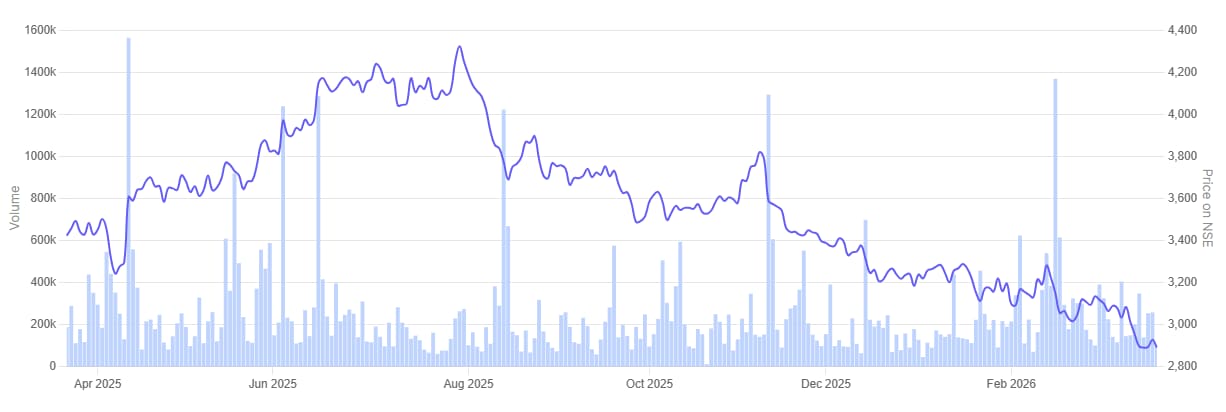
In the past year, share price of PI Industries declined 15.3%.
PI Industries 1 Year Share Price Chart
#2 Kaveri Seed Company: Scaling the Seed-Tech Frontier Amid Seasonal Volatility
Incorporated in 1976, Kaveri Seed Company is in the business of research, production, processing and marketing of various high quality hybrid seeds.
Kaveri Seed Company reported steady growth in the December quarter, supported by strong traction in key crop segments. Revenue for Q3 FY26 stood at Rs 210 crore, up 20.7% year-on-year (YoY). Net profit came in at Rs 13 crore lower compared to Rs 15 crore reported a year ago. Profit growth remained modest despite higher revenue, reflecting pressure on margins during the quarter.
The company’s financial performance has remained uneven across quarters. This is typical of the seeds business, which is heavily dependent on crop cycles and seasonal demand. Revenues tend to be concentrated in specific quarters, leading to volatility in earnings and margins through the year.
The performance was driven by continued demand for non-cotton seeds. Maize, rice and vegetable segments contributed to growth. Volume expansion in these crops supported revenue momentum. However, profitability was impacted by higher cost of production. The company was not able to fully pass on these costs to farmers, which weighed on margins.
Seed-Tech Edge: Research-Led Growth in a Seasonal Market
The broader trend highlights the role of seed technology in improving farm productivity. Hybrid seeds and research-led varieties remain key to increasing yields. The company continues to invest in breeding and product development. Research & development (R&D) spend remains in the range of 5% to 10% of revenue, supporting a steady pipeline of new hybrids across crops.
Kaveri is also seeing growth in export markets. Overseas revenue grew sharply during the quarter, supported by increased registrations and expansion into new geographies. The company has been working on widening its global footprint over the last few years, and this is now beginning to reflect in numbers.
On the domestic front, crop trends continue to shape demand. Acreage expansion in maize and rice is supporting volume growth. At the same time, pricing volatility in crops such as maize has created short-term uncertainty for farmers. This has had some impact on realisations and margins in the current season.
The company has also invested in capacity expansion and inventory build-up to support future growth. Cash levels declined during the quarter as funds were deployed towards inventory and operations. Management expects this to normalise as the season progresses and sales pick up.
Looking ahead, the outlook remains stable. Demand for hybrid seeds is expected to remain strong, supported by rising acreage and the need for higher productivity. The company expects growth in key segments such as maize and rice to continue. However, margins will depend on input costs and the ability to pass on price increases.
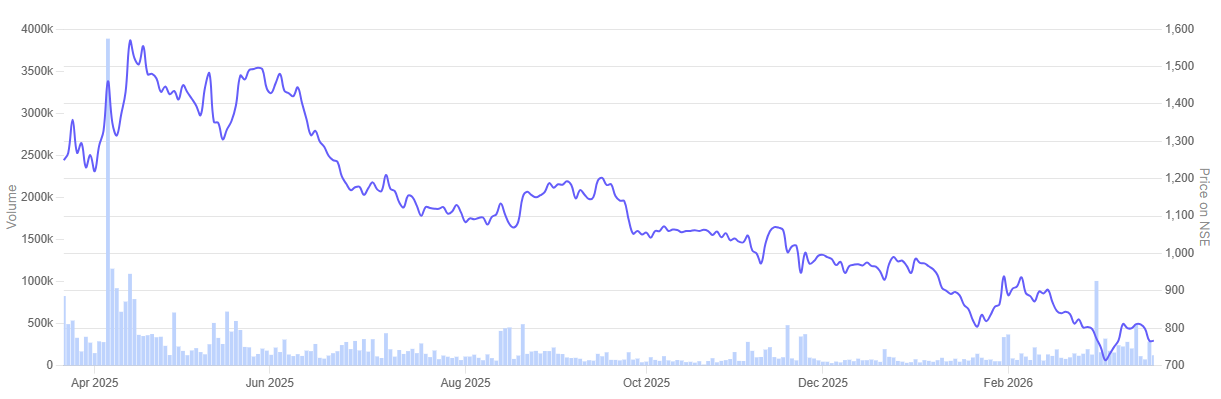
In the past year, share price of Kaveri Seed Company slumped 38.4%.
Kaveri Seed Company 1 Year Share Price Chart
#3 Jain Irrigation Systems: From Government Projects to a Retail-Led Water Efficiency Play
Jain Irrigation Systems is engaged in providing solutions in agriculture, piping and infrastructure through manufacturing of micro irrigation systems, PVC pipes, HDPE pipes, plastic sheets, agro processed products, renewable energy solutions, tissue culture plants, financial services and other agricultural inputs.
Jain Irrigation Systems reported steady growth in the December quarter, with revenue rising 17.4% YoY to around Rs 1,600 crore. Growth was broad-based across segments, led by the hi-tech division, which includes micro-irrigation and tissue culture. This reflects increasing adoption of water-efficient farming solutions in India.
The company saw strong traction in retail-led sales, which grew about 24% during the quarter. This shift towards retail is a key structural change, as it reduces reliance on government projects and improves working capital efficiency.
Growth was also supported by recovery in the plastics segment and stable performance in agro-processing. However, profitability remained under pressure. Net Loss for Q3 FY26 widened significantly to Rs 47 crore from Rs 1 crore a year ago, primarily due to non-cash goodwill write-offs.
Profitability has remained volatile in recent quarters. While revenues have been relatively stable, net profit has swung between profits and losses. Operating margins have held in a narrow range, but high interest costs and one-off items have impacted earnings. Overall, the company is seeing operational improvement, but this has not yet translated into consistent profitability.
From an agritech lens, the focus remains on improving farm productivity through micro-irrigation and allied solutions. Growth in drip irrigation and solar pump segments highlights rising demand for water management technologies. The company is also investing in new growth areas. Its beverage manufacturing facility has started operations, and a tomato processing joint venture is expected to contribute from FY27.
De-leveraging the Future: The Pivot from Government Tenders to Retail Growth
The balance sheet continues to improve gradually. Working capital cycle has reduced, supported by lower inventory and better receivables management. The share of government business has declined sharply and is expected to remain minimal going forward.
Looking ahead, management expects growth to remain steady, supported by better monsoon conditions and improving demand. While quarterly performance may remain uneven due to seasonality, the company is targeting mid-teen revenue growth for the year, with a stronger earnings profile likely from FY27 onwards.
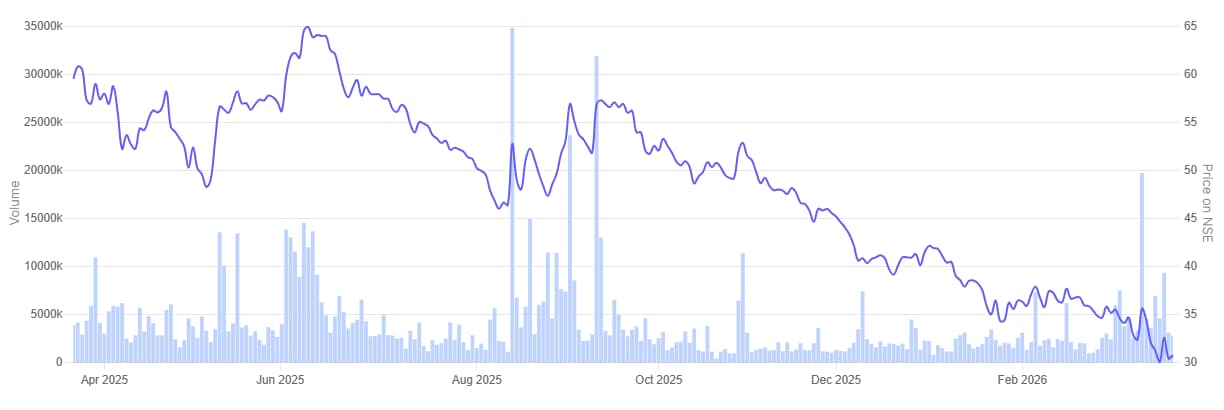
In the past year, share price of Jain Irrigation Systems nose-dived 47.8%.
Jain Irrigation Systems 1 Year Share Price Chart
#4 UPL: Riding the Global Agri-Input Recovery via Value-Added Biologicals
UPL is principally engaged in the business of agrochemicals, industrial chemicals, chemical intermediates, speciality chemicals and production and sale of field crops and vegetable seeds.
UPL reported a strong performance in Q3 FY26, indicating a gradual recovery in the agri-input cycle. Revenue stood at Rs 12,269 crore, up 12% YoY. The growth was largely volume-led, with volumes rising around 8%. Pricing remained under pressure, but higher volumes and favourable mix supported the topline.
Growth was broad-based across regions. Europe delivered strong growth, while Latin America remained resilient. India saw steady performance, supported by seeds and crop protection. The Rest of the World segment also reported sharp growth, driven by Africa and Asia.
Profitability improved on a sequential basis, but remains volatile on a yearly view. Net profit for the quarter came in at Rs 490 crore, compared to Rs 853 crore in the same period last year. However, earnings recovered from losses seen in earlier quarters of FY24 and FY25. Operating profit rose to Rs 2,236 crore, with margins improving to 18%, indicating better cost control and operating leverage despite pricing pressure.
The quarter highlights UPL’s shift towards an agritech-led model. The seeds business, Advanta, delivered strong growth of over 20%. Sustainable solutions and biologicals also saw good traction. New product launches are gaining acceptance across markets. These segments are becoming key growth drivers.
The company continues to benefit from its global presence. Strong demand in Europe and Latin America helped offset challenges in North America. The US business remained impacted by tariffs. UPL is adjusting its supply chain to manage these costs. Local manufacturing and formulation shifts are being scaled up.
Value Unlocking: How the Advanta IPO Signals a Structural Shift
On the strategic front, UPL is moving towards value unlocking. The DRHP filing for Advanta is a key step. It signals a focus on restructuring and balance sheet improvement. Debt levels have reduced, and leverage ratios have improved during the year.
The industry environment remains mixed. Demand is stable, but pricing pressure continues due to global oversupply. The company expects a volume-led Q4, supported by seasonal demand and new launches.
Overall, UPL’s performance shows improving execution. The focus on agritech, portfolio mix, and financial discipline is visible. However, a sustained recovery will depend on pricing stability and continued growth in high-value segments.
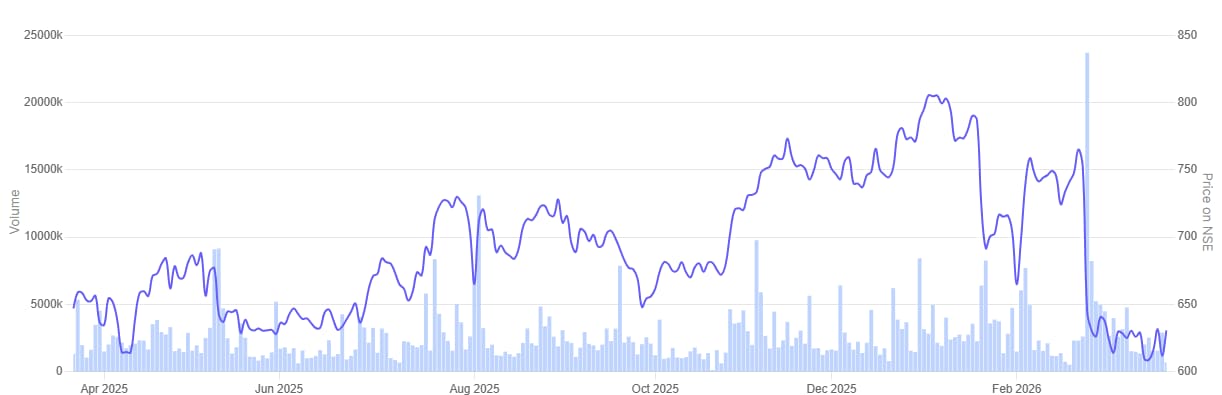
In the past year, share price of UPL is down 2.8%.
UPL 1 Year Share Price Chart
The Efficiency Gap: Comparing ROCE and Valuations Across the Agri-Tech Spectrum
Let’s now turn to the valuations of the companies in focus, using the Enterprise Value to EBITDA multiple as a yardstick.
Valuations of Companies in focus
| Sr No | Company | EV/EBITDA Ratio | 5-Year Average EV/EBITDA | Industry Median | ROCE | ROE |
| 1 | PI Industries | 19.4 | 28.1 | 10.1 | 22.9% | 17.6% |
| 2 | Kaveri Seed Company | 11.2 | 12.3 | 11.8 | 20.1% | 19.0% |
| 3 | Jain Irrigation System | 7.8 | 11.6 | 14.0 | 4.9% | 0.6% |
| 4 | UPL | 8.4 | 9.4 | 10.5 | 7.7% | 3.3% |
If you look at return ratios, PI Industries is clearly ahead. It has a Return on Capital Employed (ROCE) of 22.9% and Return on Equity (ROE) of 17.6%. Kaveri Seed is also strong, with ROCE at 20.1% and ROE at 19%. The other two are much lower. Jain Irrigation has ROCE of 4.9% and ROE of just 0.6%. UPL is slightly better but still weak, with ROCE at 7.7% and ROE at 3.3%.
Valuations also follow the same trend. PI Industries is trading at 19.4x EV/EBITDA. This is lower than its 5-year average of 28.1x, but still much higher than the industry median of 10.1x. Kaveri Seed is at 11.2x, almost in line with both its past average of 12.3x and the industry median of 11.8x. Jain Irrigation is at 7.8x, well below its own average of 11.6x and the industry median of 14x. UPL is at 8.4x, also below its 5-year average of 9.4x and the industry median of 10.5x.
The sector itself is changing. The focus is moving from just selling products to improving farm output. Seeds, crop protection, and specialty solutions are becoming more important. Companies are also trying to grow outside India.
PI Industries is doing well because of its specialty business. Kaveri Seed is steady and focused on the domestic market. Jain Irrigation is still trying to recover. UPL is improving, but margins and returns are still not strong.
So the opportunity is there, but not everyone is in the same position. Some are already performing well. Others still need to improve. These companies are worth tracking to see who executes better from here.
Execution vs. Theme: Identifying the Long-Term Winners in India’s Farm Push
The agritech story is playing out, but it is not the same for all companies. The gap is quite visible. Some are delivering strong returns and steady performance. Others are still struggling with low margins and weak profitability.
This is also visible in valuations. Companies with better numbers are still getting higher multiples. The ones with lower returns are cheaper, but that comes with uncertainty. The market is clearly rewarding consistency.
Going ahead, the opportunity in this space remains strong. Demand for better seeds, crop protection and efficient farming solutions is not going away. But growth alone is not enough. Margins and returns will matter just as much.
So from here, it is less about the theme and more about execution. Some players are already in a good position. Others still have work to do. This is a space to track, but with a clear focus on who is actually delivering.
You can track how these companies progress with the advent of agritech by adding these stocks to your watchlist.
Disclaimer:
Note: We have relied on data from www.Screener.in throughout this article. Only in cases where the data was not available, have we used an alternate, but widely used and accepted source of information.
The purpose of this article is only to share interesting charts, data points and thought-provoking opinions. It is NOT a recommendation. If you wish to consider an investment, you are strongly advised to consult your advisor. This article is strictly for educative purposes only.
Ekta Sonecha Desai has a passion for writing and a deep interest in the equity markets. Combined with an analytical approach, she likes to deep dive into the world of companies, studying their performance, and uncovering insights that bring value to her readers.
Disclosure: The writer and her dependents do not hold the stocks discussed in this article.
The website managers, its employee(s), and contributors/writers/authors of articles have or may have an outstanding buy or sell position or holding in the securities, options on securities or other related investments of issuers and/or companies discussed therein. The content of the articles and the interpretation of data are solely the personal views of the contributors/ writers/authors. Investors must make their own investment decisions based on their specific objectives, resources and only after consulting such independent advisors as may be necessary.