India’s testing, inspection, and certification (TIC) market is steadily expanding. According to a report by IMARC Group, the market stood at around US $ 7.9 billion in 2025 and is expected to reach nearly USD 10.9 billion by 2034, growing at a CAGR of 3.63%. This reflects a gradual but consistent rise in demand for quality and standardisation across industries.
This growth is being driven by multiple factors. Regulatory standards are becoming stricter. Export-oriented industries must meet global quality benchmarks. Sectors like pharmaceuticals, automotive, electronics, and food processing are under constant compliance pressure. At the same time, technology is changing how testing is done, with automation and digital tools improving accuracy and speed.
For investors, this creates an interesting opportunity. This is not a cyclical theme. It is structural. Once regulations tighten, they rarely reverse. Companies are forced to spend on testing, validation, and compliance year after year. This leads to stable demand visibility and recurring revenue streams for players operating in this ecosystem.
The selected companies reflect this trend across different layers of the value chain. Some directly benefit from rising demand for lab testing and certification services. Others are linked to regulatory-driven research and validation in high-compliance sectors. There are also players enabling product validation through technology and simulation. Finally, infrastructure providers supporting testing facilities complete the ecosystem. Together, they capture the full spectrum of this growing compliance-driven opportunity.
#1 Vimta Labs: The 39% Export Powerhouse
Incorporated in 1990, Vimta Labs is a contract research and testing services provider.
Vimta Labs Q3 Results: 10% Revenue Growth Amid Rising TIC Demand
Vimta Labs reported a steady performance in Q3 FY26, supported by rising demand for quality testing across industries. Revenue for the quarter stood at Rs 100.5 crore, marking a 10.2% year-on-year (YoY) growth. However, profitability remained largely flat. Net profit came in at Rs 17.6 crore, up just 0.4% YoY. The muted profit growth was partly due to operational challenges and delays in certain analytical services, which pushed some revenues into the next quarter.
The company continues to benefit from structural tailwinds in the testing and certification space. Management highlighted that stricter quality norms, expanding wellness trends, and increasing focus on product safety are driving demand across segments. Pharmaceutical testing and research services remained the largest contributor to revenue. Food testing also saw good traction during the quarter, with seasonal tailwinds expected to support growth ahead.
The Q1 Catalyst: Biologics Launch
On the expansion front, Vimta is investing in new capabilities to capture emerging opportunities. Its biologics contract research and development facility is on track and is expected to be commercialised by Q1 of the next fiscal. In electronics testing, capacity expansion is underway with additional infrastructure being added to meet rising demand, particularly in specialised testing areas. The company is also increasing its overseas presence, with exports contributing around 39% of revenue in Q3, indicating improving global traction.
The broader industry environment remains favourable. Management noted strong demand across pharma, food, and electronics testing, driven by continuous regulatory updates and higher compliance requirements. This reinforces the core theme that quality control is becoming non-negotiable, leading to sustained demand visibility for testing players.
Going ahead, the company expects a stronger Q4, supported by seasonal demand and execution of deferred orders. While near-term growth may remain uneven due to ongoing investments and capacity additions, the long-term outlook remains positive, backed by a growing compliance-driven market and expanding service capabilities.
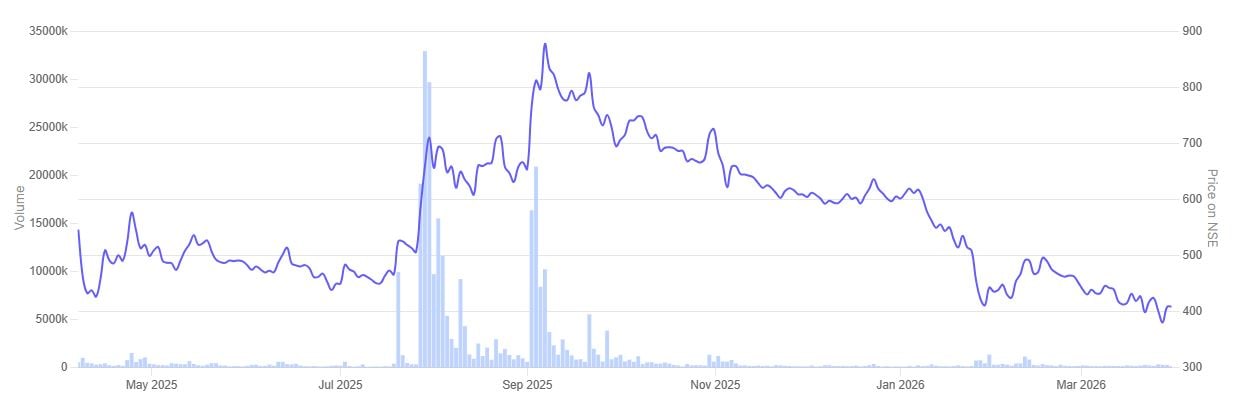
In the past year, the share price of Vimta Labs tumbled 24.8%.
Vimta Labs 1 Year Share Price Chart
#2 Syngene International: A Rs 917 Cr Bet on Discovery
Syngene (established in 1993) as a Biocon subsidiary is India’s first Contract Research Organization (CRO) which expanded later to be an integrated service provider offering end-to-end drug discovery, development, and manufacturing services on a single platform (CRAMS). Total research & manufacturing infrastructure for the company is spread across 1.9 million square feet across locations.
Navigating the 44% Profit Slump
Syngene International reported a muted performance in Q3 FY26, weighed down by issues in its biologics segment. Revenue from operations declined 3% YoY to Rs 917 crore. Profit before exceptional items stood at Rs 73 crore, down 44% YoY. The sharp drop in profit reflects operating pressure and lower contribution from a key product.
The weakness was largely driven by a single commercial-stage biologics product from its largest customer. This product continued to face headwinds during the quarter. However, the underlying business remained steady. Excluding this impact, the company indicated growth across both research services and manufacturing segments. Demand continues to be supported by global outsourcing trends in pharma and biotech.
Across its core segments, the company is seeing improving activity. Research services are gaining traction with new client additions across chemistry, biology, and clinical platforms. In manufacturing, capacity utilisation is gradually improving in both small and large molecule businesses. The base business is growing at high single-digit to low double-digit levels, indicating stable demand despite near-term disruptions.
Syngene continues to invest in expanding capabilities to meet rising quality and compliance requirements in drug development. During the quarter, it expanded its advanced chemistry infrastructure in Hyderabad. It also commissioned a commercial-scale facility for liquid-filled oral formulations. In the US, the Bayview biologics facility has completed validation and is preparing to start operations. These investments strengthen its position as an integrated research and manufacturing partner.
The 2035 Visibility Advantage
The company also strengthened its long-term client relationships. Its collaboration with Bristol Myers Squibb has been extended till 2035. This provides long-term visibility and supports its research services business. At the same time, the company is focusing on diversifying its revenue base. Reducing dependence on single large products has become a priority after the current disruption.
The broader industry environment remains supportive. Regulatory requirements are increasing across global pharma markets. This is driving demand for testing, validation, and contract research services. As quality control becomes more critical in drug development, companies like Syngene are seeing sustained long-term opportunities despite short-term volatility.
Looking ahead, the near-term outlook remains cautious. The impact of the biologics product is expected to continue over the next few quarters. However, improving biotech funding and steady outsourcing demand offer support. While growth may remain uneven in the short term, the company remains positioned to benefit from the rising importance of quality and compliance in global healthcare.
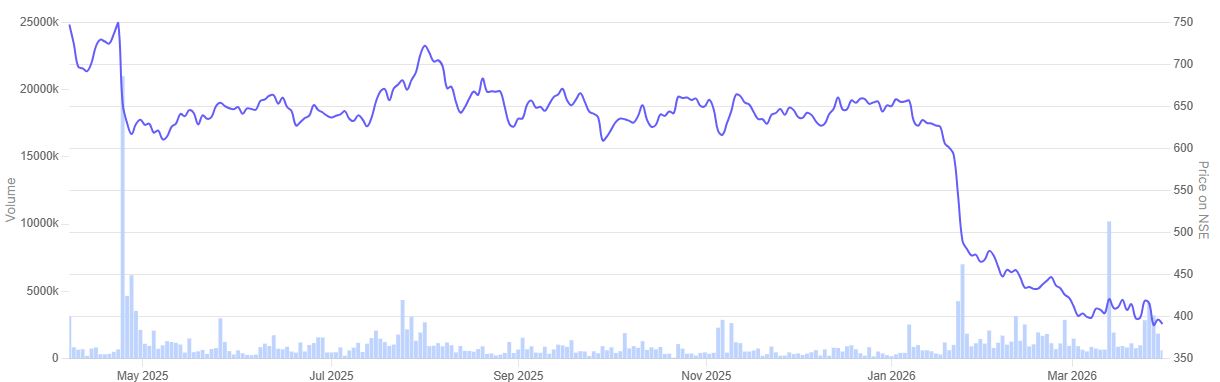
In the past year, share price of Syngene International tumbled 47.4%.
Syngene International 1 Year Share Price Chart
#3 Tata Elxsi: The 36% ROCE Compounder
Tata Elxsi is amongst the world’s leading providers of design and technology services across industries including Automotive, Media, Communications and Healthcare.
This Tata group company provides integrated services from research and strategy, to electronics and mechanical design, software development, validation and deployment, and is supported by a network of design studios, global development centers and offices worldwide.
Tata Elxsi reported a mixed performance in Q3 FY26 on a year-on-year basis. It saw modest growth in revenue but a sharp decline in profitability. Sales rose to Rs 953 crore from Rs 939 crore. This reflects a growth of about 1.5% YoY. Net profit fell significantly to Rs 109 crore from Rs 199 crore reported in the same quarter last year. The drop in profit indicates pressure on margins and cost structures. This is despite stable top-line growth.
On a sequential basis, the company showed signs of recovery during the quarter. Growth was supported by better execution of ongoing projects. It was also supported by improved utilisation across teams. EBITDA margins saw an improvement. This was aided by operating leverage and tighter cost control measures implemented over recent quarters.
Transport: The 55% Revenue Driver
The transportation segment continued to be the main growth driver. It contributes over 55% of total revenue. It delivered strong growth during the quarter. This was led by ramp-up of previously won deals. It was also supported by normalisation of client programs that were impacted earlier. The company is seeing strong traction in areas such as software-defined vehicles, electrification, and advance driver assistance systems (ADAS). These are complex systems. Here testing, validation, and compliance have become critical before deployment.
Other segments remained relatively weak. The media and communication business saw a marginal decline. This was due to seasonal furloughs and delays in deal closures. The healthcare and life sciences segment appears to have stabilised. Management has indicated a possible recovery starting Q4. The company is also investing in AI-led regulatory workflows and automation tools. These are increasingly being used to improve accuracy. They also reduce manual effort and help meet evolving compliance standards.
Demand conditions remain cautious across global markets. Clients are taking longer to make decisions. They are also more selective in spending. However, investments continue in areas linked to safety, software validation, and regulatory compliance. This reflects a broader shift. Quality control is becoming essential, especially in industries like automotive and electronics. In these industries, system failures carry high risk.
Looking ahead, the company expects gradual improvement. This will be supported by deal ramp-ups and recovery in underperforming segments. While near-term growth may remain measured due to macro uncertainties, improving utilisation and a steady deal pipeline provide support. Over the longer term, Tata Elxsi’s focus on design-led engineering and validation capabilities positions it well. It is likely to benefit from the increasing importance of quality and compliance across industries.
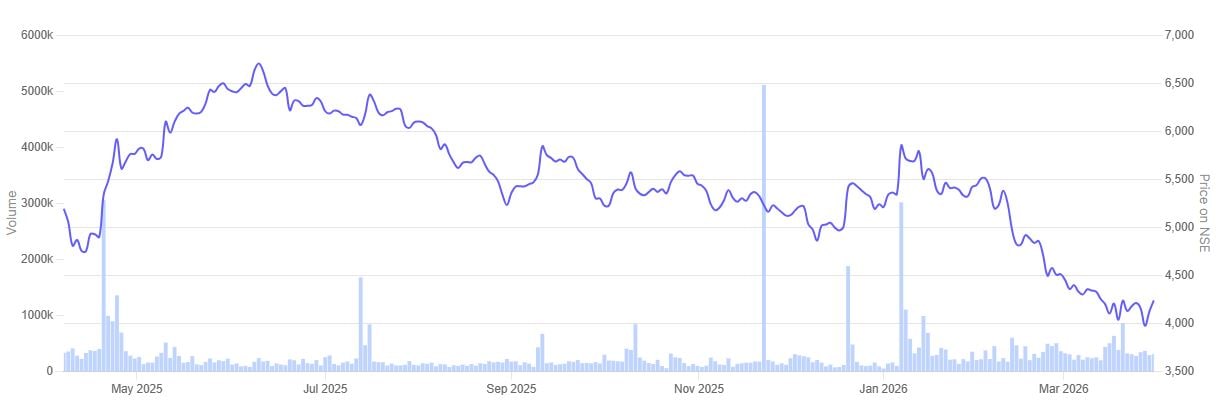
In the past year, share price of Tata Elxsi is down 18.7%.
Tata Elxsi 1 Year Share Price Chart
Decoding the Value Chain: From Lab Testing to Product Validation
Let’s now turn to the valuations of the companies in focus, using the Enterprise Value to EBITDA multiple as a yardstick.
Valuations of Companies in focus
| Sr No | Company | EV/EBITDA Ratio | 5-Year Average EV/EBITDA | Industry Median | ROCE | ROE |
| 1 | Vimta Labs | 12.4 | 11.5 | 15.4 | 25.2% | 19.4% |
| 2 | Syngene International | 15.4 | 27.3 | 15.4 | 13.5% | 10.5% |
| 3 | Tata Elxsi | 25.7 | 40.6 | 12.0 | 36.3% | 29.3% |
Tata Elxsi leads the pack on return ratios. Its return on capital employed (ROCE) stands at 36.3% and return on equity (ROE) at 29.3%. Vimta Labs also shows solid numbers with ROCE of 25.2% and ROE of 19.4%. Syngene International is lower on this front, with ROCE at 13.5% and ROE at 10.5%, as the business is still going through a phase of investment and adjustment.
Valuations tell a slightly different story. Tata Elxsi is trading at 25.7 times EV/EBITDA. This is lower than its 5-year average of 40.6, but still above the industry median of 12.0. Syngene is at 15.4, which is in line with the industry, but well below its 5-year average of 27.3. Vimta Labs is at 12.4. This is close to its 5-year average of 11.5 and below the industry median of 15.4, which makes it relatively better placed on valuation.
What ties all three together is the same underlying shift. Companies today cannot take quality lightly. There are more checks, more standards, and more accountability. This is visible across pharma, auto, and electronics.
Vimta Labs is directly into testing work. Syngene is linked to research and compliance in pharma. Tata Elxsi comes in through validation and system-level testing, especially in newer areas like EVs and ADAS. Different roles, but part of the same broader change. That is why these names remain relevant to watch.
Conclusion
Quality is no longer an option for companies. It has become part of the basic process. In sectors like pharma, auto and electronics, testing and checks are now routine. Companies have to spend on it, whether they like it or not.
But the numbers are not the same for all. Return ratios, growth and valuations vary a lot. One is showing strong profitability. Another is still going through a weak phase. So it is better to look at them one by one, not as a single group.
From here, the opportunity looks steady, but nothing will move fast. Execution will matter more. How these companies grow, control costs and improve profits is what needs to be watched. These are not quick bets. They are names to keep an eye on as this space slowly grows.
You can track how these progress by adding stocks to your watchlist.
Disclaimer:
Note: We have relied on data from www.Screener.in throughout this article. Only in cases where the data was not available, have we used an alternate, but widely used and accepted source of information.
The purpose of this article is only to share interesting charts, data points and thought-provoking opinions. It is NOT a recommendation. If you wish to consider an investment, you are strongly advised to consult your advisor. This article is strictly for educative purposes only.
Ekta Sonecha Desai has a passion for writing and a deep interest in the equity markets. Combined with an analytical approach, she likes to deep dive into the world of companies, studying their performance, and uncovering insights that bring value to her readers.
Disclosure: The writer and her dependents do not hold the stocks discussed in this article.
The website managers, its employee(s), and contributors/writers/authors of articles have or may have an outstanding buy or sell position or holding in the securities, options on securities or other related investments of issuers and/or companies discussed therein. The content of the articles and the interpretation of data are solely the personal views of the contributors/ writers/authors. Investors must make their own investment decisions based on their specific objectives, resources and only after consulting such independent advisors as may be necessary.