The shipping industry is one of the few industries that has benefited from the current crisis in the Middle East. Spot shipping freight rates have skyrocketed in the key tanker segment between 2 and 4 times on a y-o-y basis in the March 2026 quarter, depending on the type of vessel.
Tanker vessels are used to transport a range of petroleum and allied products.
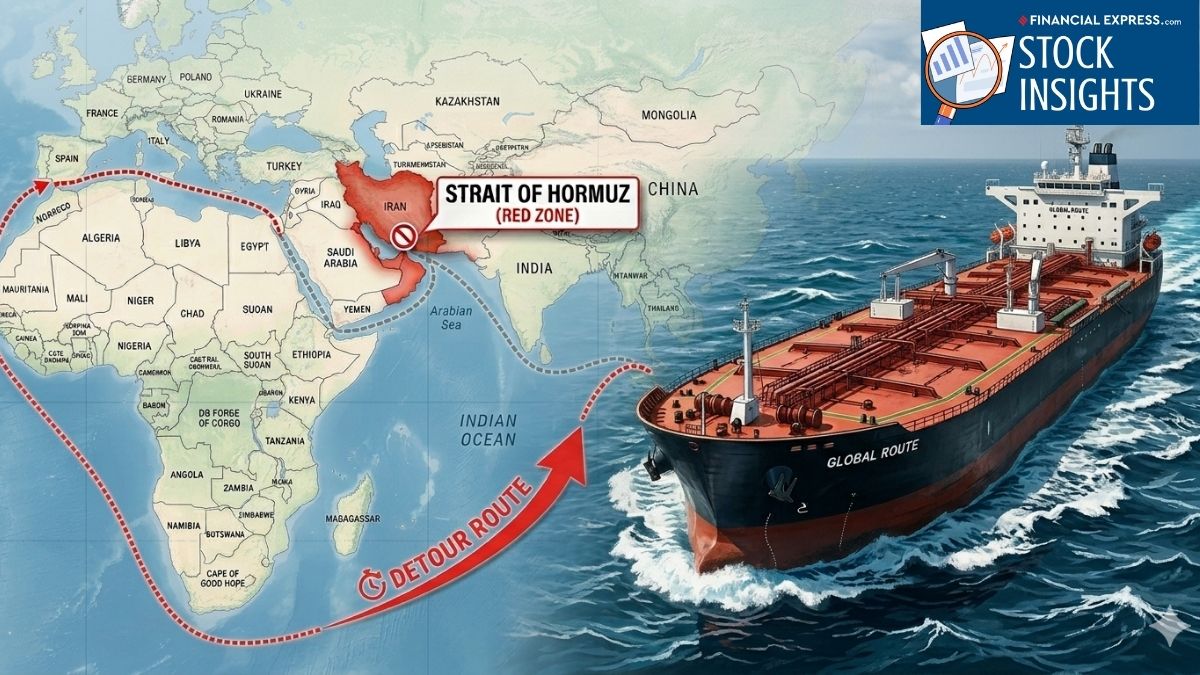
The current stand-off in the key shipping route, Strait of Hormuz, between USA and Iran has led to ships taking a longer route to complete their journey. Also, in the current crisis, global insurance companies are either staying away or charging exorbitant insurance premiums to cover the risks related to the ship and crew, and this has also led to higher shipping freight rates for the different tanker vessels.
For instance, in tanker segments like VLCC (very large crude carriers) the average spot freight rate was $ 165,162 per day in the March 2026 quarter as compared to $40,144 per day a year ago, according to industry data from a leading shipping company.
Leading Indian shipping companies like Great Eastern Shipping Company and the government-controlled Shipping Corporation of India typically utilise 70-75% of their fleet capacity for transporting petroleum products via tanker vessels. In addition, shipping companies utilise a combination of short-term and long-term contracts with customers to maximise their freight earnings.
To understand the ‘super upcycle’ in the shipping industry we compared the two leading players, G E Shipping Company and Shipping Corporation of India on various parameters in the March 2026 quarter – growth in net sales and net profit along with operating profit margins.
GE Shipping reports stronger growth than nearest local rival in Q4FY26
G E Shipping has highlighted that its total revenue days were 3,525 in the March 2026 quarter and broadly flat y-o-y. Also, its total owned tonnage was 3.2 million dead weight tonne (dwt) in Q4FY26 as compared to 3.04 million dwt a year earlier.
The company has pointed out for crude carriers the average freight rate was $ 61,424 per day in Q4FY26, nearly double from a year earlier. In other tanker segments, like LPG carriers, the company has highlighted freight earnings that grew barely 4% y-o-y to $45,216 per day in the March 2026 quarter.
Also, in the smaller dry bulk segment, the average of the Baltic Dry Index was 1,955 in the March 2026 quarter as compared to 1,118 a year earlier.
Super cycle of earnings and performance in the March 2026 quarter
| Great Eastern Shipping (Consolidated) | Shipping Corporation of India (Consolidated) | |
| Growth in revenue from operations (% change y-o-y) | 23.5% y-o-y | 14.2% y-o-y |
| Operating profit margin (in %) | 51.9% | 40.5% |
| Net profit (% change y-o-y) | 187.6% y-o-y | 118.4% y-o-y |
Strong freight rates resulted in its consolidated revenue from operations rising 23.5% y-o-y to Rs 1,511 crore in the March 2026, and its operating profit margin jumped 730 basis points y-o-y to 51.9% in the quarter under review.
GE Shipping had a profit of sale of ships and other assets of Rs 281.2 crore in Q4FY26, a jump of 940% y-o-y. Strong freight earnings and higher other income helped the company’s consolidated net profit rise 187.6 % y-o-y to Rs 1,044.1 crore in the March 2026 quarter.
The company’s fleet capacity at the time of declaring fourth quarter of FY26 results was 3.19 million dwt.
Shipping Corporation of India – Q4FY26 performance
The government-controlled Shipping Corporation has highlighted a fleet capacity of 58 vessels with 5.26 million dwt, as per its investor presentation for fourth quarter of FY26.
Strong freight rates helped its revenue from operations rise 14.2% y-o-y to Rs 1,513.2 crore in Q4FY26, and its operating profit margin jumped 1300 basis points y-o-y to 40.5% in the quarter under review.
Its consolidated net profit also jumped 118.4% yo-y to Rs 404.6 crore in the March 2026 quarter.
Return on Equity (RoE) – making efficient use of capital
G E Shipping Company had a Return on Equity (RoE) of 18.8% for FY26, according to data from the company and Screener.
Shipping Corporation of India had a RoE of 15.5%, according to Screener.in.
Return on Equity
| Company | ROE (%) |
| Great Eastern Shipping | 18.8 % (consolidated basis) for FY26 |
| Shipping Corporation of India | 15.5% |
Growth outlook and valuations
Spot freight rates in the key tanker segment have continued to remain strong – the average of the VLCC segment was $ 201,300 per day, as per data from a leading industry player.
GE Shipping results were declared after the close of Thursday trade, and on Friday, the stock hit a 52-week high of Rs 1,642.8, and ended the day’s trade 4.7% higher at Rs 1,554.
The stock trades at a consolidated P/E of 7.4 times, according to Screener.in, and over the past 5 years it has traded between 3.8 times and 32.9 times.
Shipping Corporation of India trades at a consolidated P/E of 11.5 times, and over the past 5 years it has traded between 4 times and 23.7 times.
G E Shipping v/s Shipping Corporation of India valuations
| Name of company | Consolidated P/E |
| Great Eastern Shipping | 7.4 |
| Shipping Corporation of India | 11.5 |
Spot shipping freight rates tend to be quite volatile, and readers need to take into consideration that a low P/E in the shipping industry does not necessarily mean a ‘value’ buy. The shipping industry reacts almost instantly to big / significant changes in the global economy.
Readers can add the two shipping stocks on their watch list for 2026, and see if performance matches expectations.
Disclaimer:
Amriteshwar Mathur is a financial journalist with over 20 years of experience.
Disclosure: The writer and his family have no shareholding in any of the stocks mentioned in the article.
The website managers, its employee(s), and contributors/writers/authors of articles have or may have an outstanding buy or sell position or holding in the securities, options on securities or other related investments of issuers and/or companies discussed therein. The content of the articles and the interpretation of data are solely the personal views of the contributors/ writers/authors. Investors must make their own investment decisions based on their specific objectives, resources and only after consulting such independent advisors as may be necessary.