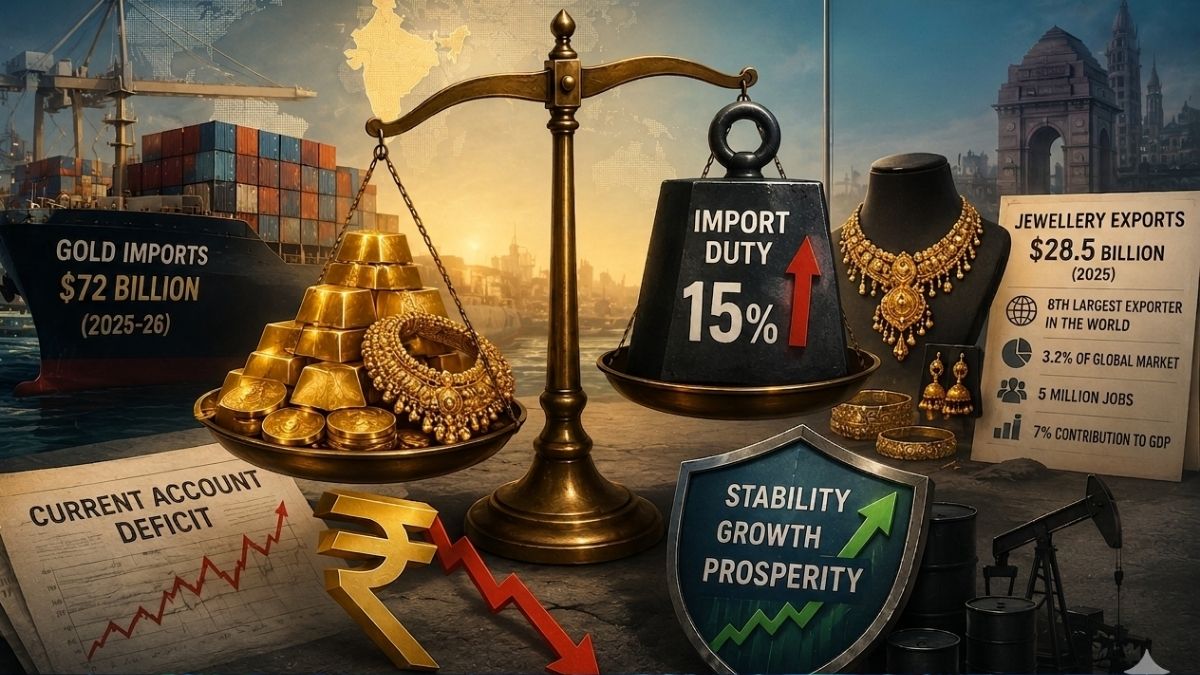
In May 2026, the Indian government raised the duty on gold imports from 6% to 15%. The objective is to curb demand and reduce imports. The underlying assumption is that gold imports are bad for the economy. But is this really the case?
India is a small producer of gold. Most gold in the country is imported. In 2025-26 gold imports were 72 billion dollars, an all-time high. The logic of gold imports harming the economy is as follows: Gold imports increase the current account deficit. This then weakens the rupee. Gold imports require the use of valuable dollar reserves. These reserves should be used for fuel and other essential imports instead.
In an environment of fuel shortages and high oil prices, every dollar spent on importing gold, is a dollar that should be spent on importing fuel instead. This only makes sense if we assume that gold imports are not of value in themselves. We all agree that fuel imports are valuable. Gold is not a necessity. But does that mean gold imports have no value?
Why Investors Should Ignore the ‘Unproductive Asset’ Myth
The famous value investor Warren Buffet was no fan of gold. He claimed it was unproductive as an investment and should be avoided. The logic of increasing gold duties relies on this. Gold investments are useless and should be discouraged.
But most investors today accept that this is not the case. Even if gold does not produce income, it is a valuable part of one’s portfolio. Financial advisors typically recommend holding 10-20% of one’s portfolio in gold. Gold is a hedge against uncertainty, inflation, and economic crises. By taxing gold imports, investors are made worse off. Suppose investors now buy less gold. If it turns out that gold prices end up rising over the coming months and years, discouraging imports will turn out to be a bad decision.
The $28.5 Billion Export Risk: Why the Jewelry Sector Needs Unrestricted Supply
Aside from investors, gold imports play another important economic role. Gold is key input into the production of jewelry. While India is a gold importer, it is an exporter of jewelry. Indian exports of jewelry were 28.5 billion dollars in 2025. India is the eighth largest exporter in the world, representing 3.2% of the global market. The contribution of jewelry exports to GDP is 7%. Total employment in the sector is around 5 million individuals. This is aside from the large domestic jewelry market that is affected.
An increase in gold duty directly harms the jewelry sector. A 9% increase in the duty means that the cost of gold jewelry will go up close to that amount. This makes the sector less competitive globally. Ironically, if jewelry exports go down, this harms the rupee and worsens the current account deficit. The US is one of the largest buyers of Indian jewelry. In the last year, the jewelry sector has been hit by US tariffs. But this is expected to recover as the India trade deal with the US takes shape.
It is understandable that the government wants to implement policies to shore up the rupee’s value. Since the West Asia conflict began, the rupee is down. A declining currency leads to inflation. A disorderly decline in the currency can cause panic. But there is a better way to deal with this problem.
Navigating the Current Account Deficit Without Triggering Panic
First, the RBI can use its dollar reserves to reduce volatility. In fact, they are already doing this. Dollar reserves are high enough to weather the current market disruption. Second, it is fine if the currency weakens, if there is no market panic. In the longer term, the current account deficit is helped by a weaker currency increasing exports. Interest rate hikes can be used to prevent inflation from getting out of hand.
Now, some economic pain is going to occur no matter what policies are enacted. There is an energy shock from the West Asia conflict. Fuel consumption must fall because there’s less fuel available. The question becomes how best to manage the shock.
An extra duty on gold imports is not particularly helpful. While it does reduce imports, it has two downstream effects. The first is on portfolio investors. And the second is on the jewelry sector. It is relatively easier for investors to deal with the duty, as they can shift to other haven assets.
For the jewelry sector, the effect is much worse. If the higher duty is permanent, then the sector ends up at a competitive disadvantage globally. And this could result in the sector shrinking, and ceding market share to other countries.
Disclaimer:
Note: The purpose of this article is to share interesting charts, data points and thought-provoking opinions. It is NOT a recommendation. If you wish to consider an investment, you are strongly encouraged to consult your advisor. This article is for strictly educative purposes only.
Asad Dossani is an assistant professor of finance at Colorado State University. His research covers derivatives, forecasting, monetary policy, currencies, and commodities. He has a PhD in Economics. He has previously worked as a research analyst at Equitymaster, and as a financial analyst at Deutsche Bank.