
India’s AI ambitions are entering a new phase. The focus is no longer just on using artificial intelligence but on building it at home. Backed by the ₹10,372 crore IndiaAI Mission over five years, the government is investing in domestic AI models, large-scale computing infrastructure, and Indian-language datasets.
More than 38,000 GPUs have already been deployed, creating the foundation for a homegrown AI ecosystem. A total of 190 projects have been approved under the IndiaAI Mission by 25 March 2026.
As the country works to reduce reliance on global technology companies and strengthen its digital capabilities, the opportunity is beginning to extend beyond software.
Companies powering the infrastructure behind AI could be among the biggest beneficiaries of this long-term shift. Let’s look at two core companies powering the sovereign AI infrastructure.
#1 Netweb Technologies: The Sovereign Tech Play Powering India’s Computing Boom
Netweb is India’s sole ‘full-stack’ indigenous provider of high-end computing systems. As such, it is deeply aligned with India’s push for a ‘Sovereign AI Infrastructure’ and with ‘IndiaAI Mission.’ Netweb functions as a foundational hardware and software manufacturer, uniquely positioned to accelerate this national transformation.
Sovereign AI Infrastructure: Anchoring India’s ₹10,372-Crore National Tech Push
The government is building the AI capacity through two primary channels: renting infrastructure from cloud service providers (CSPs) and developing its own on-premise facilities. Netweb is actively supplying to both avenues.
Netweb states that while much of the initial AI boom was driven by model training, it expects a second wave of demand driven by AI inference. The government’s ₹10,372 crore outlay for the IndiaAI Mission and the on-prem sovereign cloud infrastructure provides structural tailwinds.
AI Infrastructure Scaling: Dissecting Netweb’s FY26 Segment Performance
Netweb financial growth reflects the scale-up. In FY26, AI systems were the dominant driver of Netweb’s business, surging 459.6% year-on-year to contribute 43.4% of total operating revenue. The demand is such that Netweb’s management is fully focused on meeting domestic requirements before pursuing global exports.
It supplies dense compute infrastructure to emerging Indian cloud providers such as Yotta, as well as Global Systems Integrators such as TCS, Infosys, and Wipro. As these integrators develop platforms to service AI workloads, Netweb provides the underlying AI stacks and hardware, capturing a massive business opportunity.
Beyond Server Assembly: Forging Architectural Alliances With Nvidia, AMD, and Intel
The government’s IndiaAI Mission initially approved access to 10,000 GPUs for the AI Compute pillar with the potential to scale to 1,00,000 GPUs. To support this, Netweb has upgraded its manufacturing depth.
Netweb has launched a 15,000-square-foot facility with the latest Surface Mount Technology. This facility designs, manufactures, and tests the dense GPU systems required for both CSP deployments and government on-premise needs. Netweb does not simply assemble servers.
It also acts as an original equipment manufacturer (OEM), with deep in-house research and development capabilities. The company works directly with the world’s leading chipmakers like Nvidia, AMD, and Intel.
Leveraging this partnership, it plans to design and manufacture systems based on the advanced architectures, including the upcoming NVIDIA Blackwell and Vera Rubin platforms.
To handle multi-trillion-parameter LLMs, Netweb has launched specialized hardware, including the Tyrone Camarero Spark (for AI Edge Computing) and the Tyrone Camarero GB200. It has also launched ‘Make in India’ computing servers based on Intel Emerald Rapids and AMD Turin.
Breaking the 150-kW Limit: Advanced Liquid Cooling as a Strategic Moat
To further strengthen its AI infrastructure, Netweb has partnered with Vertiv to design and manufacture advanced liquid-cooled AI systems. This partnership aims to address cooling bottlenecks, as traditional cooling methods can’t handle the immense heat generated by the abovementioned modern AI chips.
Through the expansion and liquid cooling, Netweb can safely pack more compute power into a smaller footprint. This capability allows it to scale past the 150-kilowatt limit. This also focuses on next-generation hardware such as the NVIDIA Blackwell platform, enabling it to target much larger enterprise and government deployments.
Netweb provides the surrounding ecosystem required to ensure that high-end GPUs are not bottlenecked by slow data delivery. To feed data efficiently into AI systems, Netweb launched the Tyrone ParallelStor Velox. This unified data platform aims to eliminate data bottlenecks across High-Performance Computing, AI, and Private Cloud environments.
Eliminating Data Bottlenecks: Unifying High-End Hardware and Indigenous Orchestration
Hardware is only as good as the software managing it. To this end, Netweb connects the infrastructure through Skylus.ai. This is an indigenous unified AI orchestration utility designed to set up and manage GPU-based AI infrastructure “on the go.”
The 90% Revenue and 80% Profit Surge
Financially, beyond the AI scale-up, High-Performance Computing and Private Cloud contributed 24% of FY26 revenue. Management noted that HPC itself grew by around 31% YoY. Overall, revenue grew by 90% YoY to ₹2,183.6 crore. Operating EBITDA margin was 13%, while net profit grew by 80.9% to ₹205.8 crore.
The balance sheet also remained robust, featuring net free cash of ₹83.3 crore. But, as Netweb has secured large strategic AI orders, inventory days increased from 60 days in December 2025 to 86 days by March 2026. Short-term borrowings have also jumped to over ₹271.6 crore.
Working Capital Dynamics: Navigating Short-Term Debt vs a ₹4,432-Crore Pipeline
The company entered FY27 with an order book of around ₹2,400 crore, including a ₹300-crore L1 order. Beyond this order backlog, Netweb is actively tracking a massive ₹4,432 crore pipeline. Historically, it converts about 60% of its pipeline into firm orders over an 18-24-month period. Thus, the pipeline could convert into around ₹2,500 crore in inflows (conservatively).
The company is officially guiding to 35%-40% revenue growth over the coming years. Crucially, this guidance represents their organic, base business. It does not factor in the execution of their strategic AI orders, which will serve as an additional growth driver. But can Netweb maintain its growth trajectory as its revenue base scales up rapidly from current levels?
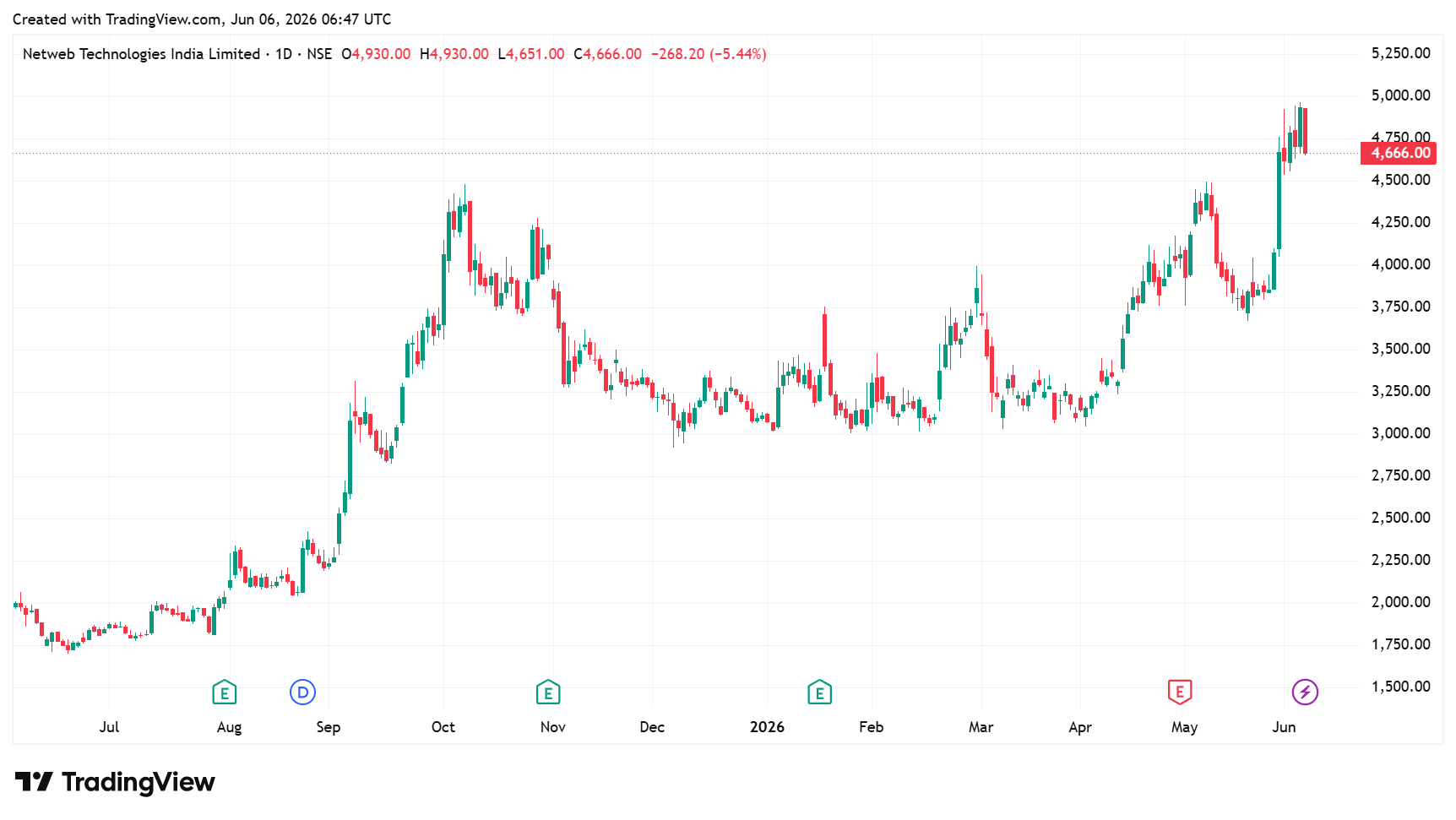
Netweb Share Price
#2 E2E Networks: The MeitY-Backed Vendor Securing 2,048 Blackwell GPUs
To be truly “sovereign,” infrastructure must minimize external dependencies and maintain data within domestic borders. Accordingly, E2E Networks has built a “Sovereign-by-Design” platform that relies on in-house-built software and infrastructure. It focuses on India first before catering to global demand.
Sovereign by Design: De-risking Cloud Architecture from Foreign Compliance
The company specifically targets organizations that want to create private or public clouds with minimal foreign software compliance requirements. Its Sovereign Cloud Platform caters directly to National Data Centers, government entities, educational institutions, and AI startups.
A backbone requires immense computing power. E2E is expanding aggressively to meet the industry’s shift from rule-driven software to AI-driven software. It currently operates about 5,050 Cloud GPUs across multi-region data centers in Tamil Nadu and Delhi NCR. These GPUs use existing Hopper (H100/H200) and Ampere infrastructure.
The ₹533-Crore CapEx Leap: Deploying India’s First NVIDIA Blackwell Clusters
E2E is also reinvesting in growth. The FY26 balance sheet includes a Capital Work in Progress of ₹533.4 crore for new GPUs under deployment. Through this CapEx, the company is taking a major technological leap, moving beyond its existing infrastructure.
E2E is deploying its first cluster of 1,024 NVIDIA Blackwell (B200) GPUs, which is expected to go live by mid-May 2026. This could be an earnings trigger. Further, it plans to deploy an additional 1,024 B200 GPUs, bringing the total to at least 2,048 Blackwell GPUs (plus spares) within FY27.
E2E is also actively planning for future generations, like the B300, GB300, and Vera Rubin architectures. Management expects the GPU contribution to reach 85% to 90% of total revenue in the coming quarters. However, raw GPUs are not enough to build a usable backbone; the hardware must be accessible.
Beyond Raw Iron: Forging the Full-Stack TIR Software Ecosystem
E2E has developed a dedicated AI/ML platform called TIR that combines compute, GPU acceleration, and integrated ML tooling into a single platform. TIR provides full lifecycle support from pre-configured to experimentation, development, training, deployment, and inference.
The company has also upgraded its software to improve the reliability, performance, and scalability of its GPU infrastructure. It has proven its full-stack capabilities by enabling LLM teams to run large-scale bare-metal and container-based training directly on the TIR platform.
Institutional Alliances: Navigating MeitY Allocations and L&T Financing Moats
Building an AI backbone also needs collaboration with key stakeholders and the government. E2E was awarded a contract under the MeitY’s IndiaAI Mission. They have actively supported the mission by providing scale and supplying Hopper series GPUs to designated allottees.
Its partnership with L&T could enable faster capacity expansion while reducing the capital burden associated with building GPU infrastructure. Management states that this helps E2E bring more GPUs under its management within the TIR stack through various private credit and financing models.
Fleet Economics: Unpacking E2E’s 80% Infrastructure Utilization Base
E2E network utilization and revenue generation also reflect its growing strength. It recorded an overall infrastructure utilization rate of approximately 80% (including CPU, GPU, and storage) in March 2026. This utilization rate was achieved despite a large capacity base of 3,900 (excluding 1,024 B200 GPUs), including CPUs, GPUs, and storage.
As a result, the company experienced a sharp revenue acceleration toward the end of the year, with the Monthly Revenue Runrate increasing to ₹37.4 crore by March 2026.
The Token Evolution: Shifting Focus Toward High-Value Corporate Workloads
Going forward, E2E is shifting its focus toward capturing “higher-value tokens,” that solve deep business problems and generate higher Return on Investment for customers. To this end, E2E will provide an optimized hardware-software stack to accelerate and improve the reliability of generating these high-value tokens.
Notably, high-value tokens could trigger margin improvement. This is because customers who generate these high-value tokens are typically less price-sensitive. This enables E2E to sustain favorable pricing and margins over the long term.
Asset-Heavy Scaling: Accelerated Depreciation vs Cash-Flow Realities
Finally, E2E delivered robust financial performance in FY26 with revenue and EBITDA expansion. Revenue grew by 50% year-on-year to ₹245.6 crore, driven by soaring demand for AI compute capacity and high utilisation rates. EBITDA increased by 30.6% to ₹126.3 crore with a margin of 51.4%. But, the bottom line was negative ₹15.6 crore.
This loss was due to the depreciation of GPU infrastructure. FY26 depreciation and amortization expenses surged to ₹169.3 crore. Management states that as infrastructure utilization ramps up, revenue is expected to outpace this depreciation, which will eventually improve reported net profitability.
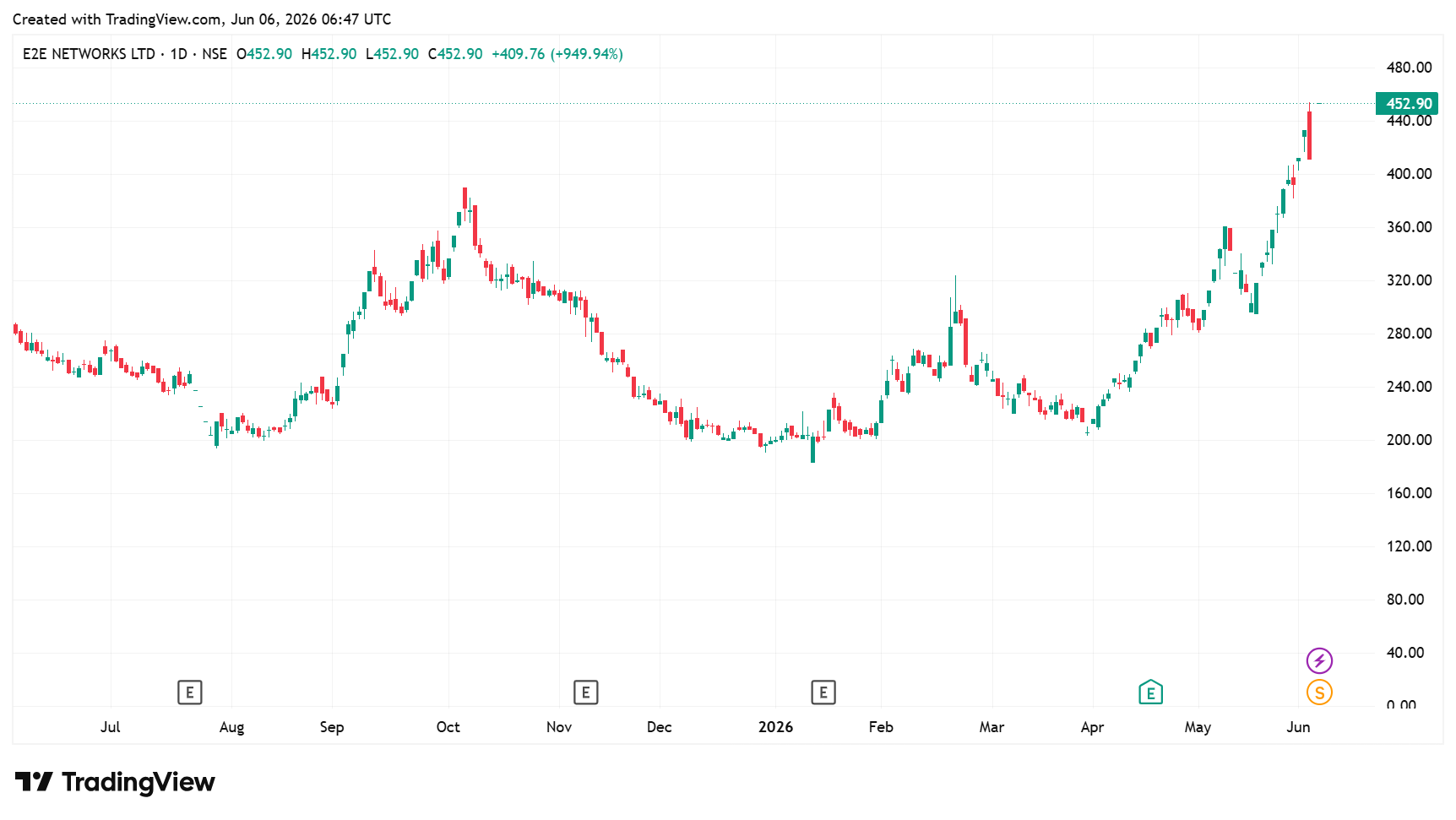
E2E Share Price
Comparative Analysis: Premium Valuations vs Return Profile Realities
Since Netweb is profitable, its Return on Capital Employed (ROCE) and Return on Equity (ROE) are not only positive but also strong. However, E2E is currently loss-making on a bottom-line basis. This is why we have used EV/EBITDA multiple to analyse their valuation multiples.
Accordingly, both companies are trading at a premium to their industry median. However, on a standalone basis, Netweb is trading below its 3-year median multiple, yet it trades at a rich high valuation. This could be attributed to its presence in a sunrise sector and its rapid financial growth. E2E trades at a much more moderate multiple.
| Particulars | EV/EBITDA Multiple (X) | Return Ratios | ||
| Company | 3Y Median | ROCE (%) | ROE (%) | |
| Netweb | 91.5 | 150.8 | 37.5 | 32.8 |
| E2E Networks | 54.0 | 35.5 | – | – |
| Industry | – | 12.2 | 15.6 | 10.5 |
| Source: Screener.in (As of 4th June 2026) | ||||
India’s sovereign AI push is still in its early stages, but the scale of ambition is clear. With a ₹10,372 crore IndiaAI Mission, over 38,000 GPUs already deployed, and plans to build domestic AI capabilities, the need for computing infrastructure is only set to rise.
Netweb and E2E Networks are positioned at different points in this value chain. The key question for investors is whether both can convert this opportunity into sustained growth while justifying their premium valuations. Meanwhile, it’s worth keeping them on your watchlist.
Disclaimer:
Note: Throughout this article, we have relied on data from http://www.Screener.in and the company’s investor presentation. Only in cases where the data were unavailable have we used an alternative, widely accepted source of information.
The purpose of this article is only to share interesting charts, data points, and thought-provoking opinions. It is NOT a recommendation. If you wish to consider an investment, you are strongly advised to consult your advisor. This article is strictly for educational purposes only.
About the Author: Madhvendra has been deeply immersed in the equity markets for over seven years, combining his passion for investing with his expertise in financial writing. With a knack for simplifying complex concepts, he enjoys sharing his honest perspectives on startups, listed Indian companies, and macroeconomic trends.
A dedicated reader and storyteller, Madhvendra thrives on uncovering insights that inspire his audience to deepen their understanding of the financial world.
Disclosure: The writer and his dependents do not hold the stocks discussed in this article.
The website managers, its employee(s), and contributors/writers/authors of articles have or may have an outstanding buy or sell position or holding in the securities, options on securities, or other related investments of issuers and/or companies discussed therein. The articles’ content and data interpretation are solely the personal views of the contributors/ writers/authors. Investors must make their own investment decisions based on their specific objectives, resources, and only after consulting such independent advisors as may be necessary.