In late 2001, a 30-year-old dot-com millionaire walked into a Moscow office to buy three refurbished intercontinental ballistic missiles. The Russians named a price he couldn’t believe, and then raised it.
He flew home on a commercial flight, opened his laptop somewhere over the Atlantic, and started building a spreadsheet. If raw materials cost only 3% of a rocket’s price, he reasoned, the rest was inefficiency. He could build the rocket himself.
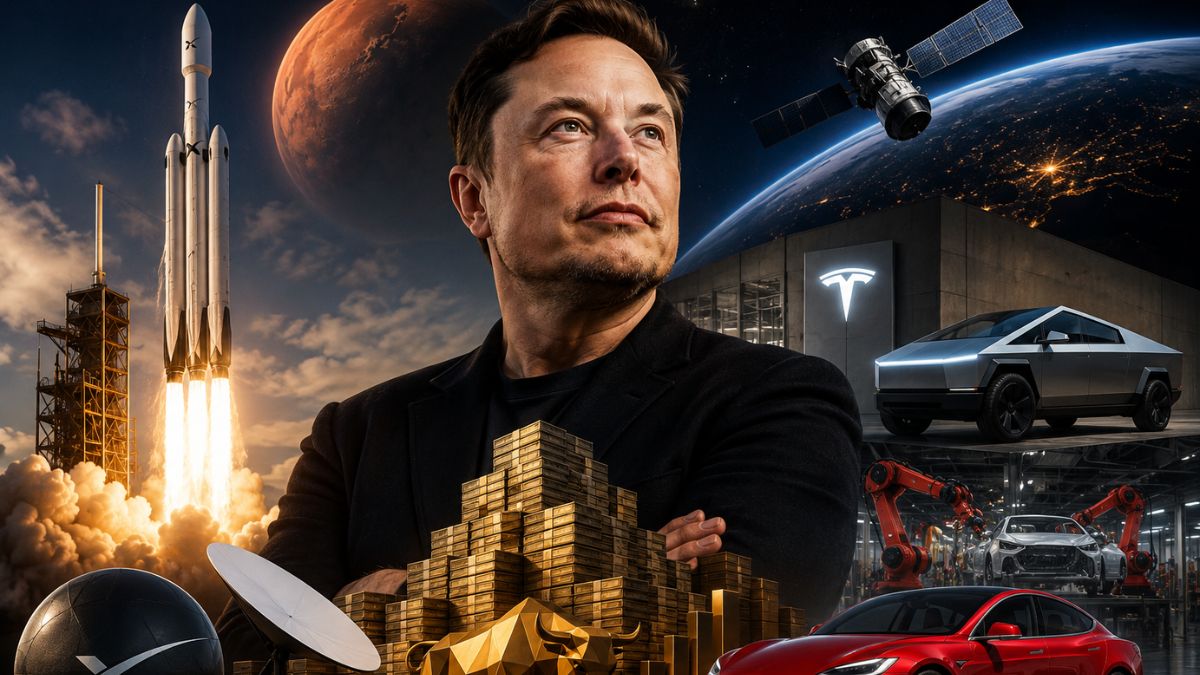
That spreadsheet became SpaceX. Nearly a quarter of a century later, the company he founded in a warehouse in El Segundo is now listed on the Nasdaq at a $1.9 trillion valuation. Making him world’s first trillionaire. That single sequence of rejection, failure, refusal to stop, and stubborn self-belief is Elon Musk‘s SpaceX story.
From South Africa to America
He was born Elon Reeve Musk in 1971, into a fractured upper-middle-class family in Pretoria, South Africa. His father, Errol Musk, was an electromechanical engineer. School was worse. He was bullied so badly at Pretoria Boys High that he was once hospitalised after being thrown down a flight of stairs.
He coped by reading the encyclopaedia. He coded his first video game, Blastar, at age 12 and sold it to a magazine for $500. By 17, he had decided South Africa was a dead end. He arrived in Canada in 1989 with a few hundred dollars in his pocket, slept on cousins’ couches, worked on a relative’s wheat farm, and cleaned boilers in a lumber mill for $18 an hour wearing a hazmat suit.
He talked his way into Queen’s University, transferred to the University of Pennsylvania, got a physics degree and a Wharton economics degree, and drove down to Stanford for a PhD in materials science. He lasted two days. It was 1995. The internet had happened
Musk’s entrepreneurial journey
Musk’s American entrepreneurial journey began in 1995 with Zip2, a software company he co-founded with his brother Kimbal. Compaq acquired it for $307 million in 1999, earning Musk $22 million for his 7% stake. That same year, he co-founded X.com, an online payment company that merged with Peter Thiel’s Confinity to become PayPal. When eBay acquired PayPal for $1.5 billion in 2002, Musk walked away with $175.8 million after taxes from his 11.7% stake.
He put $100 million of it into a rocket company, $70 million into an electric car company, and $10 million into a solar startup. By 2008, he was nearly out of money.
Musk’s nominal salary of $54,080 from SpaceX is a philosophy. He has built his entire fortune not by collecting paychecks but by owning large stakes in companies he believes will reshape the world, rockets, electric cars, artificial intelligence, brain implants, tunnels under cities. When those companies grow, so does he.
How he actually makes his money
Musk has said it himself: less than 0.1% of his wealth is held in cash. Everything else, more than 99.9% of it is tied to ownership stakes in the companies he founded or leads. He does not earn a salary. He earns value, through equity, as his companies grow.
Tesla is the foundation of that wealth. Musk holds approximately 519.7 million shares in the electric vehicle maker as of early 2026, representing roughly 13% to 20% of outstanding common stock depending on whether vested options are included. A February 2024 filing confirmed his shareholding at 20.5%, with a valuation exceeding $120 billion. In November 2025, Tesla shareholders approved a nearly $1 trillion, 10-year pay package for Musk, not a salary, but stock awards linked to performance targets tied to market capitalisation and operational milestones. Every tranche unlocks only if Tesla hits specific growth benchmarks. It is compensation designed for a man who bets on himself.
The SpaceX IPO that changes everything
If Tesla made Musk rich, SpaceX is what made him the first trillionaire. Based on SpaceX’s updated IPO prospectus, Musk owns shares in the company worth over $866 billion as of June 2026. The IPO is expected to value SpaceX at approximately $1.77 trillion in total. Musk would own nearly half that. Following the offering, he retains approximately 82.4% of the voting power within the company, according to the filing.
SpaceX itself is candid about what that means. “We believe that Mr. Musk’s substantial ownership interest in us provides him with an economic incentive to assist us to be successful,” the company stated in the risk factors section of its prospectus. After a mandatory 366-day lock-up period, the filing notes, Musk will be free to reduce his stake but few expect him to.
Musk’s holdings across just Tesla and SpaceX already total over $1.1 trillion on paper, making him, in effect, already the world’s first trillionaire in terms of combined equity stakes even before the IPO formally prices.
The xAI deal that pushed him past $800 billion
In early February 2026, SpaceX completed a historic merger with Musk’s artificial intelligence startup xAI, valuing the combined entity at $1.25 trillion. Musk’s net worth surged past $800 billion following the deal the first time any individual has ever been estimated to be worth more than $800 billion. Prior to the acquisition, Musk held about 42% of SpaceX and commanded 80% of the voting power, according to FCC filings.
xAI itself had been on a rapid growth track. In November 2024, it was valued at $50 billion with Musk owning 54%. By January 2026, the company completed a $20 billion funding round at a $250 billion valuation. Musk holds 49% ownership in xAI Holdings, with his stake valued at $122 billion. Following a $3.2 billion secondary purchase in February 2026, his direct and indirect holdings exceed 64% of xAI’s voting power. With xAI now a subsidiary of SpaceX, the artificial intelligence assets sit under Musk’s aerospace company consolidating two of his biggest bets under one roof.
An empire built across multiple companies
Tesla and SpaceX dominate the headlines, but Musk’s empire runs wider. X which he acquired in 2022 for approximately $44 billion, sees him as the controlling owner with an estimated 74% stake as of 2026. Following the xAI-SpaceX merger in February 2026, SpaceX became the direct owner of the X corporate structure, folding the social media platform into his broader constellation of companies.
Then there is The Boring Company, which Musk owns at approximately 90% and is valued at around $6 billion, and Neuralink, his brain implant technology venture. These are smaller bets today, but they add long-term dimensions to a fortune that is already almost incomprehensibly large.
Wealth with conditions attached
None of this is simple cash. Musk’s compensation packages come with conditions that would be extraordinary by any measure. SpaceX’s board has approved a plan awarding him 200 million super-voting restricted shares only if the company hits a market value of $7.5 trillion, and only if SpaceX establishes a permanent human colony on Mars with at least one million inhabitants under his leadership. Musk is also eligible for compensation across 15 tranches of 66,666,665 shares each, depending on the company’s performance. Tesla’s approved pay plan similarly consists of 12 tranches, each tied to market-cap gains and operational milestones.
Paper wealth, real stakes
It is worth remembering that virtually all of Musk’s wealth exists on paper. There is no vault, no pile of cash. Every dollar of his estimated fortune depends on how investors continue to value Tesla and SpaceX. Tesla’s stock fell 65% in 2022, wiping out hundreds of billions in his net worth in a single year, before recovering and climbing to new heights. Musk first became the world’s richest person in 2021, surpassing Amazon founder Jeff Bezos but that title is never guaranteed.
His fortune is overwhelmingly tied to his ownership stakes in Tesla Inc. and SpaceX, Musk has stated, adding that he has less than 0.1% in cash. He has also pointed out that employees at both companies participate in stock and ownership programmes, claiming he has created wealth for others “thousands of times over.”