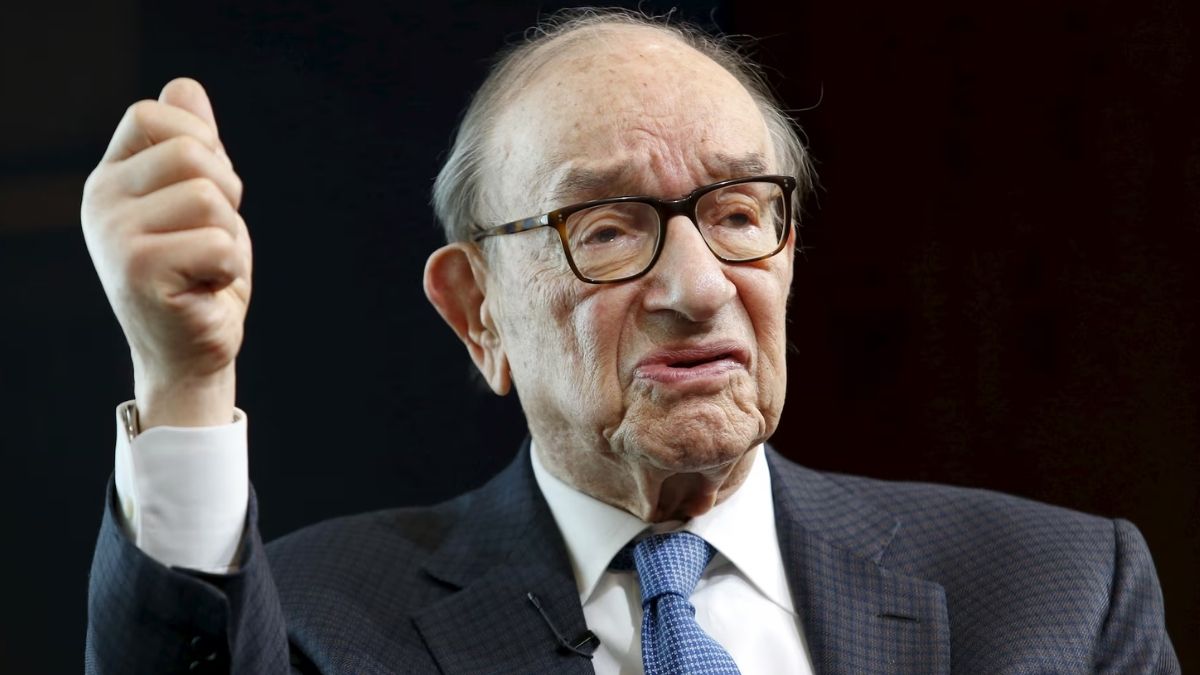
Alan Greenspan, an influential economist and former US Federal Reserve chairman, died on Monday at the age of 100. His wife, NBC News journalist Andrea Mitchell, said he died at their home from complications related to Parkinson’s disease.
Greenspan served as Federal Reserve chairman for almost 19 years under four US presidents and became one of the most powerful figures in global finance, reported NBC News. He guided the US economy through periods of growth, market turmoil and major changes in technology and trade. Admirers called him “the maestro” for his role in steering the world’s largest economy.
“Alan passed away at our home this morning at the age of 100 from complications of Parkinson’s disease,” Mitchell said in a statement. “He was a giant of a man who helped shape the US economy for decades under presidents of both parties, but was always honest in acknowledging his mistakes,” Mitchell added, as reported by NBC News
How did Greenspan shape US economy?
Greenspan was born on March 6, 1926, in New York City’s Washington Heights neighbourhood. He showed an early talent for mathematics and also developed a love for music. He attended the Juilliard School and played jazz saxophone and clarinet in a band.
He later studied economics at New York University and earned bachelor’s and master’s degrees before starting doctoral studies at Columbia University. During the early 1950s, he became associated with novelist and philosopher Ayn Rand. Her belief in free markets and limited government influenced his economic thinking for the rest of his life.
Greenspan entered politics in the late 1960s as an adviser to Richard Nixon’s presidential campaign. He later served in President Gerald Ford’s administration as chairman of the Council of Economic Advisers. During that period, he supported policies aimed at reducing inflation, reported NBC News.
In 1987, President Ronald Reagan appointed Greenspan as chairman of the Federal Reserve. His appointment came only months before the stock market crash known as “Black Monday”, when the Dow Jones Industrial Average suffered its biggest single-day percentage fall.
He then presided over one of the longest periods of economic expansion in US history. From 1991 to 2001, the United States experienced strong growth, rapid technological change and the rise of the internet economy, reported NBC News.
Alan Greenspan’s legacy
Despite his achievements, Greenspan’s record came under intense scrutiny after the global financial crisis of 2007-08. Critics say that his support for financial deregulation and his failure to address risks in the housing market helped create conditions that led to the collapse. A bipartisan Financial Crisis Inquiry Commission later said that decades of deregulation and reliance on self-regulation by financial institutions had removed safeguards that could have reduced the damage from the crisis, reported NBC News.
In testimony before Congress in 2008, Greenspan admitted he had underestimated the scale of the crisis. “The crisis, however, has turned out to be much broader than anything I could have imagined,” he said.
After retiring from the Federal Reserve in January 2006, Greenspan launched a consulting company and wrote several books, including his memoir, “The Age of Turbulence: Adventures in a New World.” In his writings and interviews, he shared candid views on the presidents he had served under and reflected on economic and political changes in the United States.
Greenspan received several major honours during his lifetime. France awarded him the Legion of Honor in 2000, Queen Elizabeth II named him an honorary Knight of the British Empire in 2002, and President George W Bush presented him with the Presidential Medal of Freedom in 2005.