High Voltage Direct Current (HVDC) technology is at the core of India’s grid transformation. India is transitioning toward cleaner energy, which is expected to account for 50% of the power mix by 2030. This shift is driving a sharp focus on building and expanding high-capacity transmission corridors as a national priority.
The Transmission Super-Cycle: Why HVDC is the New Solar
This is because HVDC systems are vital for long-distance bulk power transmission, minimizing energy losses, and ensuring grid stability. To accommodate the growing influx of renewable energy, the National Electricity Plan aims to increase HVDC capacity to 67 gigawatts (GW), up from approximately 33 GW in 2022.
JP Morgan estimates that opportunities worth $14-15 billion (around ₹1.4 lakh crore) will emerge in the HVDC sector over the next 5-6 years, driven primarily by robust medium-term demand. Furthermore, an industry tailwind, limited competition, and operating leverage will drive margin expansion.
Against this backdrop, this article explains three hidden gems positioned to benefit from this opportunity.
#1 BHEL: The 40-Year Moat in Ultra-High Voltage
BHEL is uniquely poised to lead the HVDC revolution, backed by its over 40 years of expertise in HVDC technology. The company has successfully executed six major landmark HVDC projects. It commissioned India’s very first HVDC link, the Lower Sileru-Barsoor project, in 1989.
Notably, BHEL doesn’t just assemble these systems. It also manufactures the high-technology components required for Ultra HVDC transmission. BHEL’s HVDC product portfolio includes converter transformers, smoothing reactors, switchgear, valves, and more.
From Khavda to Nagpur: De-risking the FY25 Order Pipeline
Recent orders reinforce BHEL’s strong market positioning in HVDC. BHEL secured an order from Power Grid to establish the ±800 kV, 6,000 MW LCC HVDC terminal stations connecting Khavda KPS2 in Gujarat to Nagpur in Maharashtra in FY25.
Further, the company received another Letter of Intent from Rajasthan Power Transmission to establish the ±800 kV, 6,000 MW HVDC terminal stations at Bhadla (Rajasthan) and Fatehpur (UP), complete with associated AC substations.
The SMR Pivot: Can Nuclear Capacity Drive a Long-Term Re-rating?
Further, many new HVDC projects are currently under planning and implementation, presenting a massive business opportunity for which BHEL is fully prepared. Beyond HVDC, BHEL holds a strategic edge as the country’s only domestic manufacturer of nuclear turbine generator sets.
As India targets 100 GW of nuclear capacity by 2047 and plans to operationalize five indigenous Small Modular Reactors by 2033, this positioning places the company at the center of a long-duration structural opportunity. The company is also expected to benefit from emerging sectors, including e-mobility, renewable energy, defence, and aerospace.
BHEL’s 7-Year Visibility: Can the Execution Match the Order Book?
BHEL’s financials have also improved in the recent quarter. Revenue rose 11% to ₹21,472 crore in 9MFY26. Operating profit expanded by 43.7% to 589 crore, while margin expanded by 60 basis points to 2.7%. Net Profit grew by 930% to ₹309 crore, albeit from a low base.
As of Q3FY26, BHEL’s order book stood at ₹2.2 lakh crore, providing around 7 years of order visibility, based on FY25 revenue of ₹28,339 crore.
BHEL Share Price
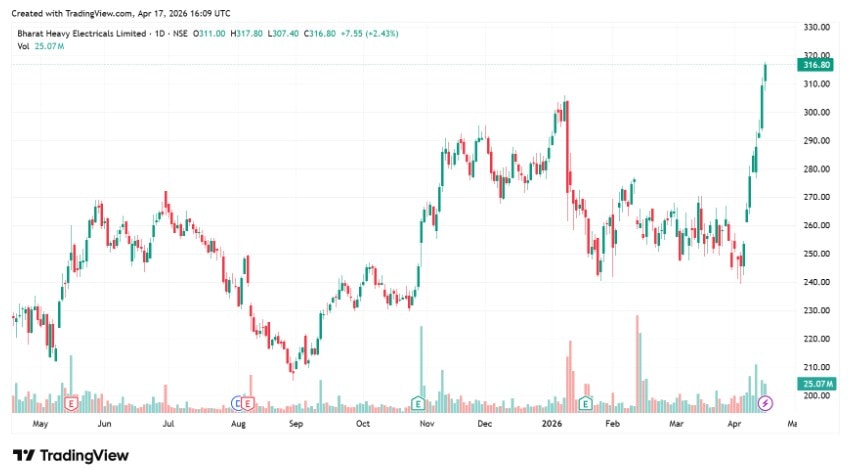
#2 The Transformer Oil Moat: Apar’s Role in 800 kV Projects
Apar Industries is the world’s largest manufacturer of aluminium and alloy conductors, the third-largest manufacturer of transformer oil, and India’s largest manufacturer of renewable cables. The cables division is the fastest-growing segment of the company.
The company is a one-stop solutions provider for power transmission and distribution, including turnkey reconductoring projects. Its footprint in the HVDC domain is anchored by its Specialty Oils and lubricant business. Notably, Apar is the only Indian company to supply transformer oil to all major 800 kV HVDC projects in India.
Global Footprint: Scaling Manufacturing to Capture the Middle East Boom
The division generated ₹4,062 crore in Q3FY26 revenue, with exports accounting for 41% of sales. To capture further global demand, APAR is actively scaling up manufacturing in Saudi Arabia to support the local market and the Middle East. It operates a strong lubricants and automotive segment under the ARKOS, POWEROIL, and BOLT brands.
Thus, Apar is expected to be a key beneficiary of increasing HVDC demand.
The company has contributed to the 1000 MW, 400 kV HVDC Aarey-Kudus transmission corridor in Maharashtra, a vital power link for the Mumbai Metropolitan Region. To this end, APAR supplied inhibited high-grade naphthenic transformer oil to ensure reliability and equipment performance.
R&D and Financials: Converting Intellectual Capital into 22% Revenue Growth
Furthermore, Apar’s intellectual capital and Research & Development efforts actively support the expansion of HVDC infrastructure. Their R&D division has successfully designed AL 59 conductors specifically engineered for 800 kV HVDC lines, ensuring they meet the heavy power transmission requirements of these next-generation grid networks.
From a financial perspective, the company’s 9MFY26 revenue rose 22% year-on-year to ₹16,299 crore, driven by domestic resilience and an improved product mix. Operating Profit surged 23.8% to ₹1,483 crore, while margins stood at 9.1%. Net Profit surged 26.6% to ₹723 crore.
The order book stood at ₹9,064 crore, providing revenue visibility of around 0.5 years, based on FY25 revenue of ₹18,581 crore.
Apar Share Price
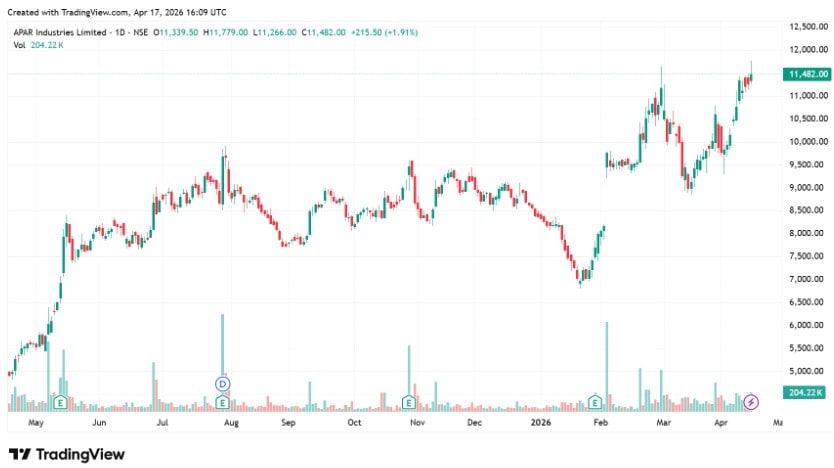
#3 GE Vernova’s Technology Edge in Renewable Integration
GE Vernova T&D India is the publicly listed Indian arm of the US-based GE Vernova Inc. It enables grid modernization and supports the country’s integration of renewable energy. While Apar supplies transformer oil for 800 kV HVDC projects, GE Vernova is a pioneer in introducing 800 kV HVDC technology in India.
Its portfolio encompasses equipment ranging from medium- to ultra-high-voltage (up to 1200 kV). Key products and services include power transformers, circuit breakers, gas-insulated switchgear, substation automation, digital software solutions, HVDC systems, and Flexible AC Transmission Systems.
HVDC transmission is a key technology for GE Vernova, primarily because it enables the reliable evacuation and transmission of renewable energy generated in remote locations to urban and industrial consumption centers.
The Refurbishment Edge: GE Vernova’s Recurring Revenue from Power Grid
GE Vernova has a strong track record and a growing portfolio of HVDC projects. It had previously demonstrated its execution capabilities by completing Phases 1/2 of the Champa-Kurukshetra project, which has an HVDC capacity of 6,000 MW. In Q3FY26, Power Grid even awarded a refurbishment order for this project to GE Vernova.
The Efficiency Factor: Why VSC Technology Commands a Premium
The company won a major VSC HVDC order from the Adani Group, which includes the supply of transformers. For this project, GE Vernova will build the HVDC terminal stations. The project has an execution timeline of approximately four years. The company expects another HVDC project (Barmer-South Kalamb) to be finalised by around Q2FY27.
From a financial perspective, the company’s revenue rose 46% year-on-year to ₹4,569 crore, driven by order-book execution. Operating Profit surged 118.5% to ₹1,239 crore, while margins stood at 27.1%. Net Profit surged 108% to ₹881 crore. The order book stood at ₹14,380 crore, providing revenue visibility of around 3 years, based on FY25 revenue of ₹4,292 crore.
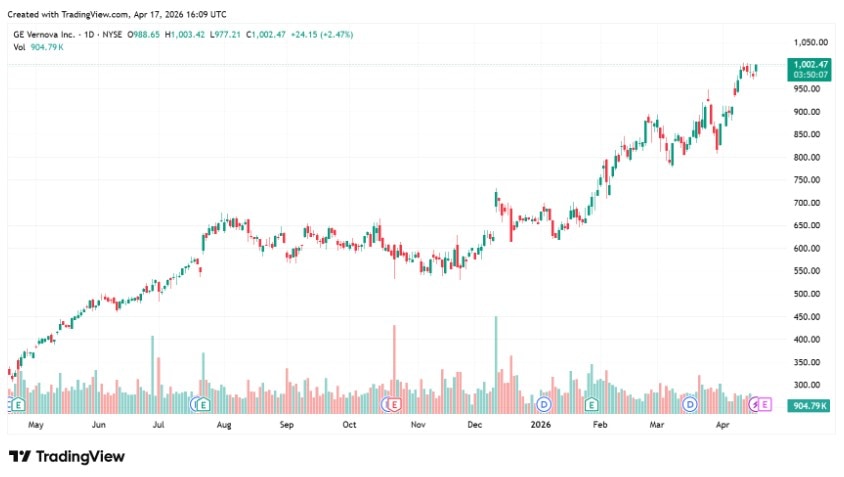
GE Vernova Share Price
P/E Ratios vs. Medians: Identifying the ‘Quality Premium’ in HVDC Stocks
GE Vernova stands out with strong Return on Capital Employed and Return on Equity, followed by Apar. BHEL, on the other hand, has poor return ratios due to uneven profitability.
In terms of valuation, all three companies are trading at multiples significantly higher than the industry median. BHEL and GE Vernova are trading at a slight discount to their 5-year average multiples, whereas Apar is trading at approximately double its historical valuation.
| Peer Comparison (X) | |||||
| Company | P/E | 5Y Median P/E | Industry Median P/E | ROCE (%) | ROE (%) |
| BHEL | 132 | 142.7 | 34.7 | 4.9 | 2.1 |
| Apar | 47.5 | 26.2 | 27.6 | 32.7 | 19.5 |
| GE Vernova | 94.9 | 102.7 | 35.4 | 54.7 | 40.4 |
| source: screener.in (As of 17 April 2026) | |||||
India’s push toward 50% clean energy by 2030 is accelerating investments in HVDC, with capacity targeted to double to 67 GW and a ₹1.4 lakh crore opportunity emerging.
Companies across the value chain, from equipment to critical components, are positioning themselves to capture this demand. Execution, order visibility, and operating leverage will ultimately determine who converts this structural tailwind into sustained earnings growth.
Meanwhile, keep them in your watchlist.
Disclaimer:
Note: Throughout this article, we have relied on data from http://www.Screener.in and the company’s investor presentation. Only in cases where the data were unavailable have we used an alternative, widely accepted, and widely used source of information.
The purpose of this article is only to share interesting charts, data points, and thought-provoking opinions. It is NOT a recommendation. If you wish to consider an investment, you are strongly advised to consult your advisor. This article is strictly for educational purposes only.
About the Author: Madhvendra has been deeply immersed in the equity markets for over seven years, combining his passion for investing with his expertise in financial writing. With a knack for simplifying complex concepts, he enjoys sharing his honest perspectives on startups, listed Indian companies, and macroeconomic trends.
A dedicated reader and storyteller, Madhvendra thrives on uncovering insights that inspire his audience to deepen their understanding of the financial world.
Disclosure: The writer and his dependents do not hold the stocks discussed in this article.
The website managers, its employee(s), and contributors/writers/authors of articles have or may have an outstanding buy or sell position or holding in the securities, options on securities or other related investments of issuers and/or companies discussed therein. The articles’ content and data interpretation are solely the personal views of the contributors/ writers/authors. Investors must make their own investment decisions based on their specific objectives, resources, and only after consulting such independent advisors as may be necessary.