The Indian IT sector is predominantly services-led, focusing largely on outsourcing and custom services. There are very few companies that have a product-led ecosystem. It’s even rarer to find a globally scalable IP-led technology platform in India. Aurionpro Solutions is one such company.
To be clear, the company has not outperformed the Nifty IT index or the broader market in the last year. In fact, Aurionpro Solutions’ share price has declined by about 45% during the period.
The reason for discussing this company, which has a market cap of nearly ₹5,000 crore, as of 17th April 2026, is its unique positioning and growth model. To add on, Foreign Portfolio Investors (FPIs) own 16% of the company.
The Pivot: Shifting from IT Services to IP-Led Products
Earlier, Aurionpro was a services-led company, focusing on custom integration, middleware, and digital transformation projects for banks.
In 2020, the company shifted its business model towards IP-led technology products. In simple words, it now builds and owns the technology stack and then licenses it to customers, instead of building new solutions from scratch.
The company operates through two business segments:
- Banking and FinTech
- Technology Innovation Group
Banking and FinTech
The Banking and Fintech division is the core business of the company. It brings in more than 50% of the company’s revenue.
Under the segment, Aurionpro offers retail & wholesale banking solutions, payment solutions, risk & compliance tools, and trade finance automation. The products are built on the company’s own technology platforms that are designed to easily connect to existing banking systems.
Unlike Infosys’s Finacle or Oracle’s Flexcube, which offer a core banking solution, Aurionpro offers niche solutions across transaction banking and lending. The company’s clientele includes HDFC Bank, Axis Bank, SBI, Bank of Baroda, and leading financial institutions in the Middle East and Africa.
Through its subsidiary, AuroPay is strengthening its presence in India’s digital payment ecosystem. AuroPay is similar to platforms like Razorpay, enabling businesses to receive payments securely and transparently.
Technology Innovation Group
Here is where things get interesting for the company. This segment adds to the growth momentum of the company. The core focus here is beyond traditional banking, offering technology services across three key verticals:
- Smart Transit Solutions
- Data Centres, and
- Hybrid Cloud Services
In the smart transit portfolio, Aurionpro has secured major orders from Titagarh Rail Systems and Delhi Metro Rail Corporation for building automated fare collection systems and platform screen door systems.
In the data center portfolio, the company has secured its largest-ever order, winning a multi-year contract valued at ₹350 crores. It has also won a strategic data center project with IDBI Bank.
Margin Stability vs. Efficiency: Analyzing the Financial Turnaround
After the change in business model, Aurionpro recorded a visible turnaround in financial performance.
Financial Trends at a Glance
| FY23 | FY24 | FY25 | 9MFY26 | |
| Revenue From Operations (₹) | 659 | 887 | 1,173 | 1,066 |
| Operating Profit: EBITDA (₹) | 145 | 193 | 242 | 216 |
| Operating Margin (%) | 22% | 21.8% | 20.6% | 20% |
| Net Profit (₹) | 102 | 143 | 188 | 150 |
Over the last three financial years, revenue from operations has almost doubled from ₹659 crore in FY23 to ₹1,173 crore in FY25, recording a CAGR of 33%. Operating margin is steady at a range of 20-22%.
Profitability and Return Ratios
| FY23 | FY24 | FY25 | 9MFY26 | |
| Earnings Per Share- EPS (₹) | 21.34 | 28.52 | 34.66 | 27.47 |
| Return on Equity- ROE (%) | 19.55 | 15.16 | 12.38 | 12 |
| Return on Capital Employed- ROCE (%) | 24.05 | 18.46 | 14.84 | 15.5 |
Return on Equity (ROE) and Return on Capital Employed (ROCE), both efficiency ratios, are declining. The key reason for the decline is an increase in the number of shares outstanding.
Overall, the growth momentum is strong, but returns are declining due to rising capital and investments.
Growth Potential
Whether the future growth momentum will be sustained or not, the order book status reveals a lot of information.
At the end of FY25, the company had an order book size of over ₹1,400 crores. It increased to over ₹1,700 crore at the end of December 2025, indicating steady new-deal momentum.
Key deal wins include:
- Mumbai Metro Line 5 for developing platform screen door systems
- Bhopal and Indore Metro for developing an automated fare collection system
- Multi-year contract with CSB Bank for the implementation of the next-generation cash management platform
While new-deal wins are key, Aurionpro’s unique business model ensures steady revenue flow even if new-deal momentum slows.
The company earns its revenue through license and implementation fees. This includes upfront payments and annual maintenance contracts. According to Ventura Securities’ report released on 1st April 2026, 60% of Aurionpro’s revenue is recurring, indicating strong and predictable future revenue visibility.
To add on, Aurionpro also benefits from higher customer stickiness. Since banks and enterprises rarely change core tech platforms, the company can generate more business from existing clients through upgrades and customisation.
Aurionpro Solutions has strategically positioned itself around three powerful megatrends: digital banking transformation, urban mobility expansion, and data center & digital infrastructure boom.
The Valuation Gap: Is the Current Correction Justified?
Aurionpro Solutions’ share price growth has been impacted by the broader sell-off in the IT stocks and valuation concerns surrounding small-cap stocks.
The stock had corrected by about 45% from its 52-week high level of ₹1,666 in the recent sell-off. It is currently trading around the ₹915 level, as of 17th April 2026.
Aurionpro Solutions 1-Yr Price Chart
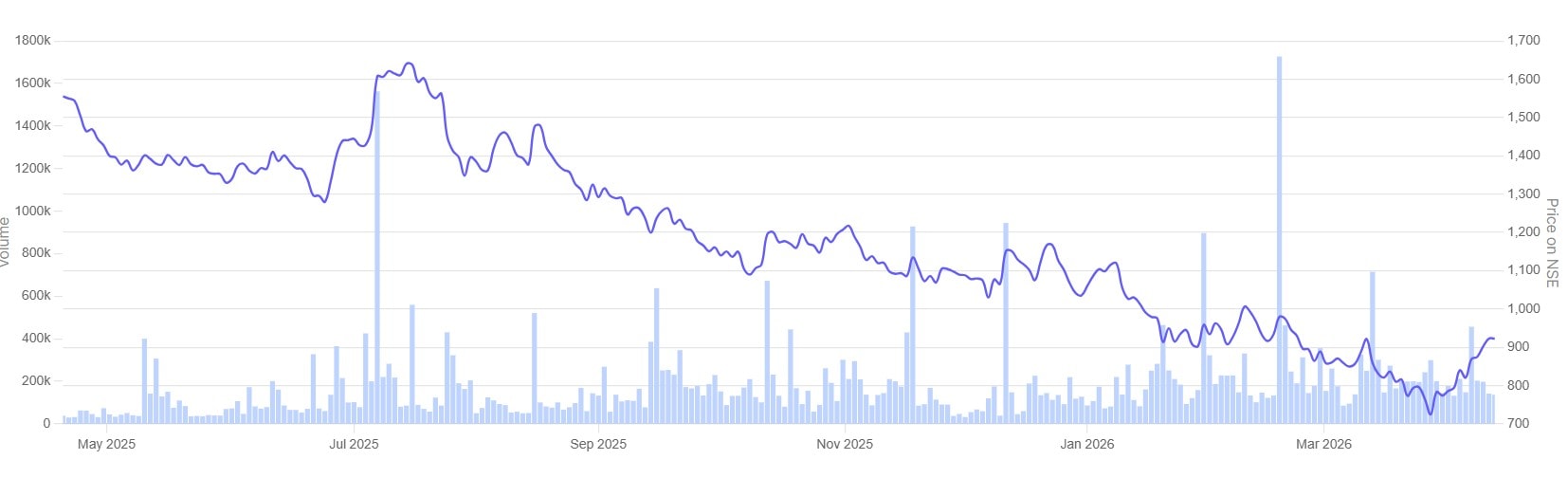
As a result, the valuations have moderated. Aurionpro Solutions is now trading at a P/E of 24.9, below its five-year median P/E of 32. EV/EBITDA (Enterprise value/ earnings before interest, taxes, depreciation, and amortisation) is at 15.3x, which is again below its 5-year median of 23.9x.
The Story Looks Strong, Execution Will Be Key
AI has emerged as a key risk for traditional Indian IT companies, particularly those that are services-driven. In that context, Aurionpro’s shift to an IP-led, platform-based model offers a relatively better position.
However, the company is not entirely immune. The next phase depends on how effectively Aurionpro integrates AI into its platforms and solutions. In many ways, AurionPro is still in a transition phase, from a services-led past to a scalable IP-led future.
The company has all the building blocks in place: a growing order book, a strong client base, strong recurring revenue, and exposure to long-term structural themes. But the outcome depends on execution.
For readers, Aurionpro Solutions represents a business with clear potential, but it needs to prove the durability of its model in a rapidly changing technology landscape.
Disclaimer:
Note: We have relied on data from www.Screener.in throughout this article. Only in cases where the data was not available, have we used an alternate, but widely used and accepted source of information.
The purpose of this article is only to share interesting charts, data points and thought-provoking opinions. It is NOT a recommendation. If you wish to consider an investment, you are strongly advised to consult your advisor. This article is strictly for educative purposes only.
Deepan Datta has spent over a decade studying stocks and mutual funds. His passion is to uncover interesting stories in the financial markets and share them through his writings with investors at large. He is focused on delivering clear, easy to understand and research-backed insights. Deepan began his career as a Research Associate at S&P Global, where he developed a strong foundation in financial research and data analysis.
Disclosure: The writer and his dependents do not hold the stocks discussed in this article.
The website managers, their employees (s), and contributors/writers/authors of articles have or may have an outstanding buy or sell position or holding in the securities, options on securities or other related investments of issuers and/or companies discussed therein. The content of the articles and the interpretation of data are solely the personal views of the contributors/ writers/authors. Investors must make their own investment decisions based on their specific objectives, resources and only after consulting such independent advisors as may be necessary.