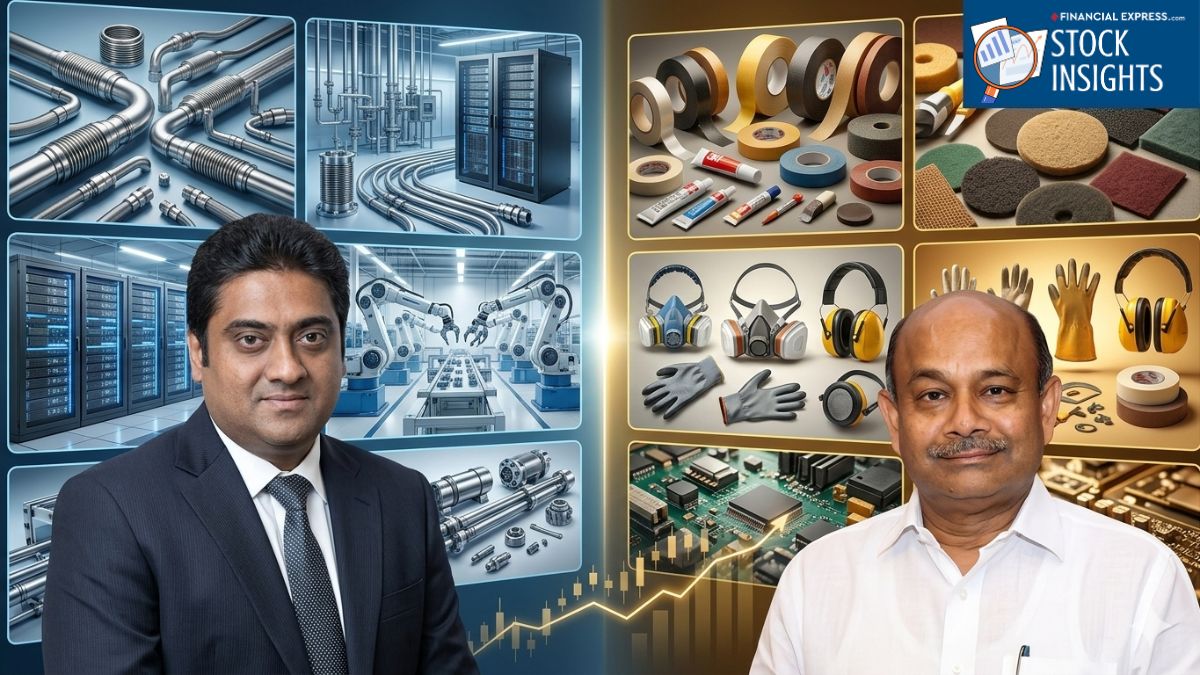
Factories do not run only on large machines and final products. They also need smaller but critical inputs. These include flexible flow products, adhesives, abrasives, tapes, safety products, tools, and other materials used in daily manufacturing. These products may not always be visible to the end customer. But they often keep production lines running smoothly.
Demand for such products is linked to India’s wider manufacturing push. As companies expand factories, build new plants, automate processes, and improve safety standards, the need for specialised industrial products also rises. The growth is not limited to one sector. It cuts across automobiles, electronics, chemicals, infrastructure, engineering, healthcare, and general manufacturing.
According to the data on Trendlyne.com this trend is also showing up in the portfolios of well-known market investors. Some of them have either raised exposure to select companies in this space or continued to hold them over multiple quarters. That makes the theme interesting for investors who want to look beyond the usual defence PSU or capital goods names.
In this article, we look at two listed companies that fit this broader manufacturing support theme. These are not pure-play defence companies. They are also not large final-product manufacturers. Instead, they supply products that help other industries function, scale, and operate better.
The stocks have been selected because they have a clear link with industrial usage. One has seen rising investor holding, while the other has seen stable holding. Both have products used across multiple sectors. This makes them relevant to India’s wider manufacturing and industrial growth story.
#1 Aeroflex Industries: High-precision flow solutions for the AI era
Incorporated in 1993, Aeroflex Industries manufactures and supplies environment-friendly metallic flexible flow solution products.
As of March 2026, Ashish Kacholia holds 2.3% stake of Aeroflex Industries. This is his shareholding pattern in Aeroflex Industries for the past eight quarters.
Ashish Kacholia Shareholding Pattern in Aeroflex Industries (June 2024 – March 2026)
| Jun-24 | Sep-24 | Dec-24 | Mar-25 | Jun-25 | Sep-25 | Dec-25 | Mar-26 |
| 1.8% | 1.8% | 1.8% | 1.9% | 2.0% | 2.0% | 2.0% | 2.3% |
Aeroflex Industries reported its highest-ever quarterly revenue, earnings before interest, tax, depreciation, and amortisation (EBITDA) and profit in Q3 FY26. The company said total income rose 21% year-on-year (YoY) to Rs 121 crore. Net profit grew 8% YoY to Rs 16.5 crore. EBITDA stood at Rs 28.5 crore, up 28% YoY, with an EBITDA margin of 23.6%.
The company fits the broader industrial enabler theme because its products are used inside other industries rather than sold as final consumer products. Its flexible flow solutions, assemblies, fittings, bellows and skid assemblies are used across manufacturing, infrastructure and newer areas such as data centres. This is the reason Aeroflex becomes relevant in an article looking beyond defence PSUs and towards companies that support industrial growth from behind the scenes.
The data centre pivot: Monetizing the liquid cooling opportunity
A key update in the quarter was the company’s entry into high-performance liquid cooling solutions for data centres. Aeroflex completed its first commercial dispatch of advanced flow-control components and skid assemblies for liquid cooling applications.
This is important because AI infrastructure and data centres need efficient cooling systems as computing intensity rises. The company is expanding skid assembly capacity to 15,000 units a year. The expansion is expected to be completed by June 2026.
Aeroflex is also setting up a new plant at Chakan in Pune. The unit will support skid assembly operations and add to capacity at existing plants. During Q3, the company added six new assembly stations. This took the total number of assembly stations to 46. It also added 1 million metres of hose capacity during the period, taking installed capacity to 17.5 million metres per annum. The remaining 2.5 million metres is expected to be commissioned in phases by Q2 FY27.
The company has also changed its capital allocation plan for the miniature metal bellows project. It has reduced the planned outlay from Rs 23 crore to Rs 10.5 crore. The proposed capacity has also been revised from 2.4 lakh pieces a year to around 50,000 pieces a year. Management said this would meet near-term demand and reduce project gestation risk. The balance funds will be used for other expansion projects where demand visibility is stronger.
Export Resilience: Navigating Global Tariffs with 74% Revenue Exposure
Exports remain central to the business. Aeroflex said exports account for about 74% of total business. The US and Europe together contribute around 85% of export revenue. The company said quarterly exports grew 30% YoY despite tariff-related pressure. Existing US customers continued to place repeat orders, though onboarding new customers has taken longer due to tariffs. Management also expects Europe to become a stronger growth market once the FTA benefits begin to flow through.
The domestic business also saw traction. Management pointed to steel, ports and terminals as key areas of demand. It also said Hyd-Air, its subsidiary, is seeing traction from railways. Hyd-Air reported revenue of Rs 8.5 crore in Q3, compared with around Rs 2.9 crore in the same quarter last year. The subsidiary is operating at around 70% capacity utilisation and Aeroflex plans to add more machines to support growth.
On longer-term capacity, management said the liquid cooling skid assembly business can generate Rs 300 crore to Rs 350 crore revenue at peak utilisation. This is expected around FY29. The hose and assembly business could reach Rs 650 crore to Rs 675 crore at peak capacity of 20 million metres, assuming assemblies form 70% of sales. Bellows can generate around Rs 85 crore at peak utilisation. Hyd-Air can contribute around Rs 45 crore based on current capacity.
The company also expects margins to stay in the 23% to 25% range over the next couple of years. Management did not share specific margins for liquid cooling due to customer confidentiality. It only said the margin profile is better than hoses and broadly in line with assemblies. That matters for the industrial enabler frame because the company is trying to move from plain products to more value-added solutions.
Overall, Aeroflex is not a conventional defence or capital goods story. It is closer to a specialised supplier that benefits when factories, ports, steel plants, railways and data centres spend on better systems. Its Q3 numbers show healthy growth. Its next phase depends on execution in liquid cooling, faster scale-up in assemblies, and export recovery in the US and Europe. The opportunity is visible, but timelines still matter. Several projects are expected to scale meaningfully only over the next two to three years.
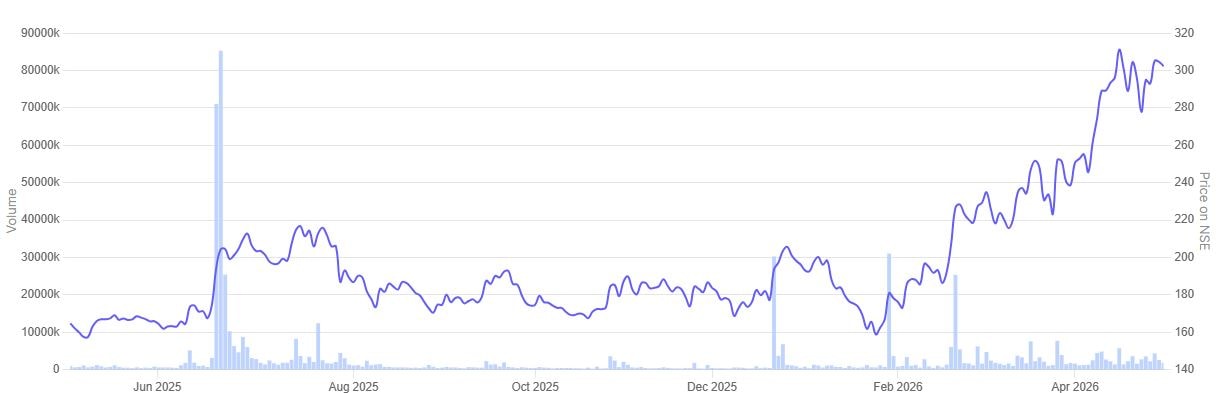
In the past year, the share price of Aeroflex Industries has rallied 84.1%.
Aeroflex Industries 1 Year Share Price Chart
#2 3M India: A Diversified Titan in Industrial Consumables
3M India is a subsidiary of 3M Company, USA. The company manages its operations in four operating segments: safety & industrial, transportation & electronics, health care and consumer markets.
As of March 2026, Radhakishan Damani holds 1.5% stake of 3M India. This is his shareholding pattern in 3M India for the past eight quarters.
Radhakishan Damani Shareholding Pattern in 3M India (June 2024 – March 2026)
| Jun-24 | Sep-24 | Dec-24 | Mar-25 | Jun-25 | Sep-25 | Dec-25 | Mar-26 |
| 1.5% | 1.5% | 1.5% | 1.5% | 1.5% | 1.5% | 1.5% | 1.5% |
3M India is a different kind of industrial play. It is not a pure capital goods company. It does not depend on one end market either. Its products sit inside factories, vehicles, hospitals, electronics, homes, power projects and safety systems. That makes it relevant to the broader theme of investors looking beyond defence PSUs and into companies that quietly support India’s manufacturing and industrial base.
For Q3 FY26, the company reported revenue of Rs 1,228 crore. This was up 12.7% the same quarter last year. However, profitability was hit by a one-time labour-code-related charge. 3M India reported a net loss of Rs 62 crore for the quarter, compared with a profit of Rs 114 crore a year ago. The operating picture was better than the headline loss suggests, but the exceptional item weighed on reported profit.
Segmental Strength: Decoupling Growth from the Q3 Headline Loss
The company’s India business is spread across four segments. Transportation and Electronics accounted for 36% of the sales mix for year-to-date (YTD) Q3 FY26 and grew 9.1%. Safety and Industrial contributed 32% and grew 14.7%. Healthcare had a 20% mix and grew 16.1%. Consumer contributed 11% and grew 15.5%. This shows that the growth is broad-based. It is not dependent on only one pocket of demand.
The industrial link is visible in the company’s priority areas. Globally, 3M has identified sectors such as aerospace, automotive, energy, electronics, data centres, industrial automation, safety and semiconductors as priority verticals. In India too, the company is trying to deepen its presence in such end markets. These are sectors where products like tapes, adhesives, abrasives, cable accessories, safety products, coatings and filtration materials can become part of the operating backbone.
3M India’s scale also gives it an edge. The company was incorporated in 1987 and has been publicly listed since 1991. It has three manufacturing facilities, one R&D centre and two customer technical centres in India. It reported FY25 sales of Rs 4,446 crore. For YTD Q3 FY26, sales were up 13.6%. This makes it a mature listed company, rather than a new manufacturing bet.
The company is also working on local manufacturing and local supply-chain strength. Its presentation mentions outsourcing and contract manufacturing, along with capacity expansion and new manufacturing lines for selected product portfolios. It has manufacturing operations at Electronics City, Ahmedabad and Ranjangaon.
The Ranjangaon plant also has an expansion area marked in the presentation. These facilities cover products such as acoustic materials, ear plugs, coatings, mixing, converting, pipe coating materials, non-wovens, emission control materials, heat shrink technology and respirators.
The R&D Advantage: Building ‘For-India’ Solutions via 5,300+ Technical
Local R&D is another part of the story. The company said it is building “for-India” products for priority markets and also bringing global new product introductions to India. Its R&D and customer technical infrastructure includes centres in Bengaluru and Delhi.
The company reported 173 patents filed and 5,365 customer technical centre visitors between January and December 2025. This matters because many 3M products are specification-led. They often need customer approval before they become part of a manufacturing or project process.
The company also highlighted examples of customer-led applications. These include materials used in new automotive models, finishing solutions for knee joints, airport interiors and exteriors, and cable accessories used in solar and wind power projects. This gives 3M India exposure to multiple themes at once. Auto, healthcare, power, infrastructure, industrial safety and electronics all remain relevant to its growth base.
There is also a leadership change to watch. Ramesh Ramadurai is Managing Director till March 31, 2026. Aseem Joshi will take over as Managing Director from April 1, 2026. For investors, the transition comes at a time when the company is trying to strengthen local R&D, improve commercial execution and expand selected manufacturing lines.
Overall, 3M India fits the article’s frame as a broad industrial support company. Its Q3 headline profit was weak because of an exceptional charge. But revenue growth and segment trends remained steady. The stock is not a narrow defence or capex proxy. It is a diversified industrial and technology supplier. That makes it useful for investors tracking companies that benefit when factories, infrastructure projects, hospitals, power assets and mobility platforms keep expanding.
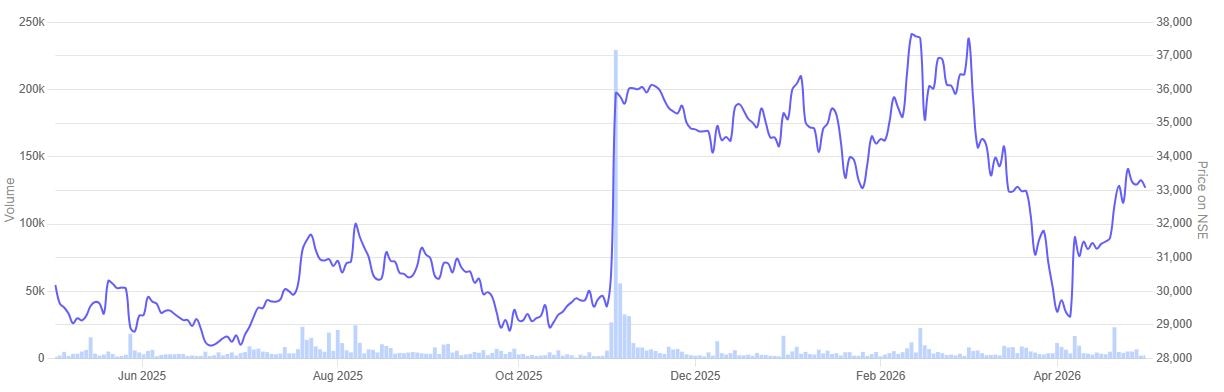
In the past year, the share price of 3M India is up 9.7%.
3M India 1 Year Share Price Chart
The Valuation Dilemma: Quality at a Premium?
Let’s now turn to the valuations of the companies in focus, using the Enterprise Value to EBITDA multiple as a yardstick.
Valuations of Companies in focus
| Sr No | Company | EV/EBITDA Ratio | Industry Median | ROCE | ROE |
| 1 | Aeroflex Industries | 30.1 | 13.8 | 22.3% | 16.6% |
| 2 | 3M India | 36.7 | 12.0 | 38.2% | 23.8% |
Both companies show healthy return ratios. Aeroflex Industries has a return on capital employed (ROCE) of 22.3% and return on equity (ROE) of 16.6%. 3M India is much stronger here, with a ROCE of 38.2% and ROE of 23.8%. In simple terms, both are making good use of the capital in the business. 3M India does it better.
The concern is valuation. Aeroflex Industries trades at an EV/EBITDA of 30.1 times, while the industry median is 13.8 times. 3M India trades at an EV/EBITDA of 36.7 times, while the industry median is 12.0 times. So, these are not cheap stocks. The market is already pricing in a lot of growth and quality.
The broader idea is linked to India’s factory and infrastructure cycle. When more plants, data centres, power projects and industrial facilities come up, they need many support products. These may not be visible to the final customer. But they are important for daily operations. Aeroflex supplies flexible flow solutions, assemblies, bellows and liquid cooling systems. 3M India works across adhesives, abrasives, safety products, automotive, electronics, healthcare and other industrial solutions.
Aeroflex is the more focused growth name. Its future will depend on exports, assemblies and data-centre cooling. 3M India is a bigger and more diversified business. It also has better return ratios. But valuations are already rich for both. Investors can track them to see whether earnings growth can catch up with the premium.
Conclusion
Aeroflex Industries and 3M India show that the industrial story goes beyond defence PSUs and large capital goods names. There are also companies that work behind the scenes. They supply products used in factories, data centres, power projects and transport systems.
The holdings of Ashish Kacholia in Aeroflex Industries and Radhakishan Damani in 3M India make this space worth watching. But retail investors should be careful before copying such moves. A well-known investor may enter early, hold longer and take more risk than a small investor can.
Valuation is the key question here. Both stocks trade above their industry medians. Aeroflex has growth triggers from exports, assemblies and liquid cooling. 3M India has a wider business and better return ratios. Investors can keep both on their watch list, but earnings growth will need to support the premium.
You can track how these are progressing by adding stocks to your watchlist.
Note: We have relied on data from www.Screener.in throughout this article. Only in cases where the data was not available, have we used an alternate, but widely used and accepted source of information.
The purpose of this article is only to share interesting charts, data points and thought-provoking opinions. It is NOT a recommendation. If you wish to consider an investment, you are strongly advised to consult your advisor. This article is strictly for educative purposes only.
Ekta Sonecha Desai has a passion for writing and a deep interest in the equity markets. Combined with an analytical approach, she likes to deep dive into the world of companies, studying their performance, and uncovering insights that bring value to her readers.
Disclosure: The writer and her dependents do not hold the stocks discussed in this article. The website managers, its employee(s), and contributors/writers/authors of articles have or may have an outstanding buy or sell position or holding in the securities, options on securities or other related investments of issuers and/or companies discussed therein. The content of the articles and the interpretation of data are solely the personal views of the contributors/ writers/authors. Investors must make their own investment decisions based on their specific objectives, resources and only after consulting such independent advisors as may be necessary.