Automation is slowly becoming a core part of India’s manufacturing story. Factories are no longer relying only on manual labour. Machines, sensors, robotics and digital control systems are entering production lines.
This shift is closely linked to the adoption of Industry 4.0, where factories use connected machines, data and software to improve efficiency and precision. What once looked like a future concept is now gradually becoming reality on Indian factory floors.
Several sectors are driving this change.
Automotive and auto components companies are adopting more automated production lines. Electronics and semiconductor manufacturing is expanding rapidly. Aerospace and pharmaceutical production is also becoming more technology intensive. As these industries scale up, the need for smarter factories, connected machines and real-time data systems continues to grow.
For investors, this shift opens an interesting opportunity. Automation and Industry 4.0 are not short-term trends. They are part of a broader transformation in how products are made. Companies are investing in robotics, digital manufacturing tools and industrial software to remain competitive. As manufacturing investment rises, businesses that supply these technologies could see steady demand.
The companies selected for this article operate across different parts of the automation ecosystem. Some supply factory automation equipment and industrial control systems. Others provide engineering and digital manufacturing solutions that support Industry 4.0 adoption. These businesses also show relatively strong fundamentals in terms of revenue growth, profitability and return ratios.
Together they offer exposure to technologies that are helping Indian factories become faster, more efficient and more connected.
#1 ABB India: Powering the Smart Factory Surge
ABB India is an integrated power equipment manufacturer supplying the complete range of engineering, products, solutions and services in areas of automation and power technology.
The company reported steady financial performance in the December quarter. Revenue stood at about Rs 3,557 crore. This reflects growth of around 8% year-on-year (YoY). Profit after tax stood at Rs 433 crore which is lower compared to Rs 528 crore reported in the same period last year.
Order momentum improved during the quarter. Total orders grew about 52%. Part of this came from delayed decisions that were finalised during the period. The company’s order backlog rose to about Rs 10,471 crore. This provides revenue visibility for the coming quarters. A share of these orders relates to large infrastructure and industrial projects. Such projects are executed over multiple quarters.
Demand is coming from several fast-growing segments of the economy.
Data centres are emerging as a key opportunity. These facilities require reliable power systems, switchgear and energy-efficient drives. Transportation and rail projects are also contributing to orders. Industrial customers are adopting motors, drives and robotics to automate production lines. These trends reflect the broader automation push across Indian industry.
The company is also expanding its product offerings.
ABB India recently introduced new energy-efficient drive systems. A next-generation machinery drive platform has also been launched. These products target industries that are upgrading to digital manufacturing systems. Localisation of technology remains an important strategy. It allows the company to serve both domestic and export markets.
Looking ahead, management remains positive on demand from infrastructure, energy transition and manufacturing investments. Automation, electrification and digitalisation are expected to remain long-term drivers. At the same time, global uncertainty and commodity price movements remain factors to watch. For now, a strong order book and broad sector exposure provide reasonable visibility for the company’s growth trajectory.
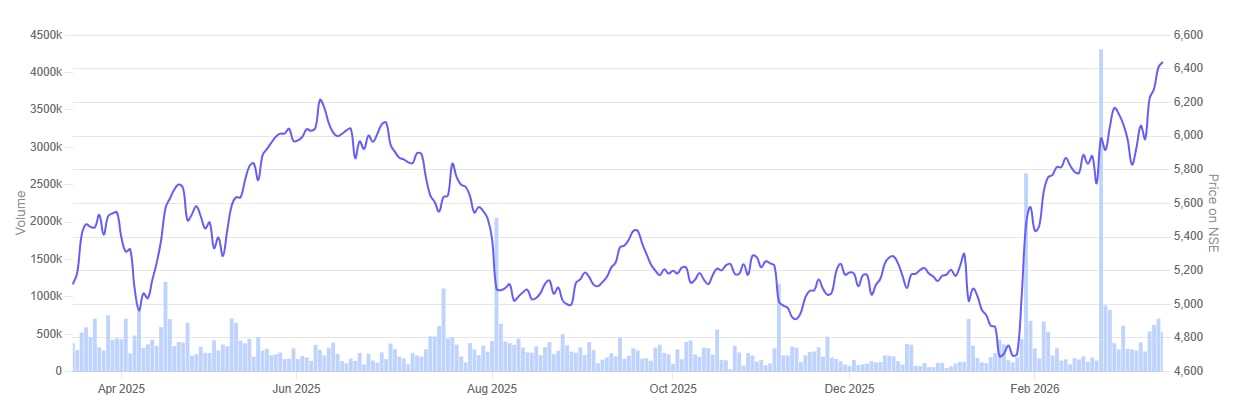
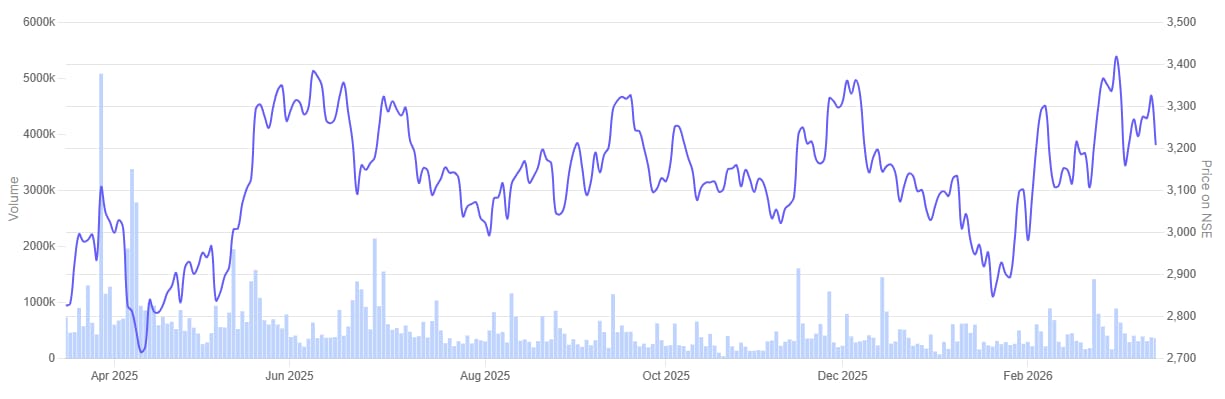
In the past year, the share price of ABB India rallied 24.8%.
ABB India 1 Year Share Price Chart
#2 Siemens: The Backbone of India’s Smart Infrastructure
Siemens offers products, integrated solutions for industrial applications for manufacturing industries, drives for process industries, intelligent infrastructure and buildings, efficient and clean power generation from fossil fuels and oil & gas applications, transmission and distribution of electrical energy for passenger and freight transportation, including rail vehicles, rail automation and rail electrification systems.
The company reported steady performance in the December quarter. Revenue stood at about Rs 4,120 crore in Q3 FY26. This reflects growth of around 12% year on year. Net profit came in at roughly Rs 463 crore. This represents growth of about 15% compared with the same quarter last year. Profitability improved as project execution increased across several segments.
Railways and Robotics: Inside Siemens’ High-Growth Order Book
Order inflows remained strong during the quarter. Demand came from transportation, manufacturing and energy sectors. Many of these projects require advanced automation systems and digital control technologies. This reflects the broader shift toward automated and connected production systems in industry.
Transportation infrastructure continues to be a key segment. The company is involved in railway electrification and mobility projects. These projects usually run over multiple quarters. They also require automation and energy management solutions.
Industrial companies are also increasing automation investments. Sectors such as automotive, electronics and engineering are adopting digital manufacturing tools. This includes robotics, industrial software and smart motion systems. Such investments reflect the wider Industry 4.0 push across Indian industry.
Looking ahead, demand visibility remains supported by infrastructure spending and manufacturing expansion. Government initiatives aimed at boosting industrial production are also encouraging automation investments. However, project execution timelines and global supply chain conditions remain factors to watch in the coming quarters.
In the past year, the share price of Siemens surged 25.7%.
Siemens 1 Year Share Price Chart
#3 Honeywell Automation India: Scaling Safety and Precision in Modern Airports
Honeywell Automation India was started in the year 1987 as a joint venture between Tata and Honeywell. It was known as Tata Honeywell Limited each holding 39.5% stake. Later in 2004 Honeywell Asia Pacific Inc. bought Tata’s stake and the name was changed to Honeywell Automation India.
The company reported steady performance in the December quarter. Revenue stood at about Rs 1,169 crore in Q3 FY26. It is a growth of 7.1% YoY. Net profit came in at around Rs 121 crore. This is lower than Rs 132 crore reported a year earlier.
Airport infrastructure has emerged as an important segment. The company has secured airfield ground lighting projects for multiple airports in India. These systems support runway visibility and airport safety. Such projects highlight the growing role of automation in modern airport infrastructure.
Beyond the Runway: Honeywell’s Pivot to Green Hydrogen and IoT
The company is also expanding into new technology areas. It delivered building automation solutions for a lithium-ion gigafactory. It is also involved in designing and controlling operations of a pilot green hydrogen electrolyser. In addition, it has supplied integrated fire, gas and surveillance systems for advanced manufacturing facilities. These projects reflect the rising demand for automation across energy and industrial sectors.
Digital platforms remain a key focus. The company is developing internet of things (IoT) systems that use real-time data, edge analytics and artificial intelligence. These tools help companies improve asset efficiency and reduce energy use. Demand is coming from sectors such as oil and gas, infrastructure, power, data centers and new manufacturing facilities.
Overall, Honeywell Automation remains closely linked to India’s automation cycle. Infrastructure spending and industrial expansion are supporting demand. Airport projects and smart facility systems are expected to remain important opportunities. However, large project timelines may continue to influence quarterly performance.
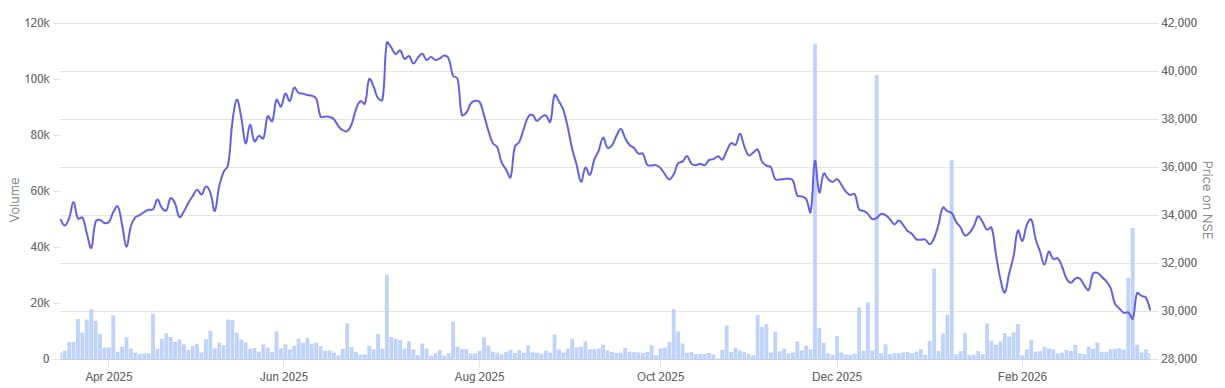
In the past year, the share price of Honeywell Automation India tumbled 11.4%.
Honeywell Automation India 1 Year Share Price Chart
#4 L&T Technology Services: Engineering the Digital Twin Revolution
L&T Technology Services is an engineering services provider incorporated in 2012, offers engineering, research and development (ER&D) and digitalization solutions to companies in the areas such as transportation, industrial products, telecom and hi-tech, medical devices and plant engineering.
The company reported steady performance in the December quarter. Revenue stood at about Rs 2,652 crore in Q3 FY26. This reflects growth of around 10% YoY. Net profit came in at roughly Rs 322 crore. This represents growth of about 9% compared with the same quarter last year.
Growth is being supported by rising demand for engineering services. Industrial companies are investing in automation and digital tools. This includes robotics integration, digital twins and predictive maintenance systems. Such technologies help factories improve efficiency and reduce downtime.
Transportation infrastructure is also becoming more technology-driven. Airports are adopting digital monitoring and automated control systems. These systems improve safety and operational efficiency. Engineering support is required to design and integrate these platforms.
The Global Engineering Play: Monetizing Digital Twins and E-Mobility
The company works with global clients across North America, Europe and Asia. Several projects are linked to electric mobility, digital manufacturing and automation. These areas are seeing higher investment as industries modernise production systems.
Overall, L&T Technology Services remains linked to the broader automation cycle. Manufacturers and infrastructure operators are increasing spending on digital engineering. This trend is expected to support demand for engineering and automation services in the coming years.
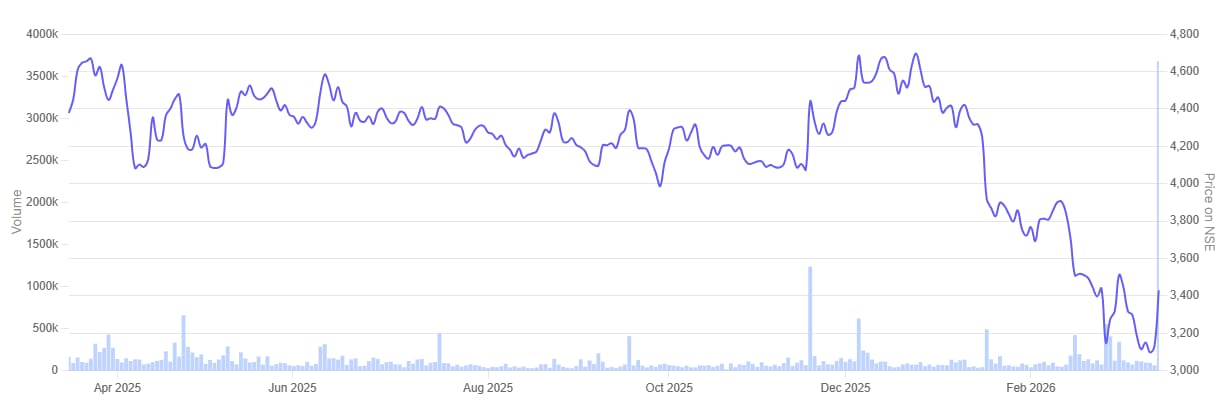
In the past year, the share price of L&T Technology Services nose-dived 20.8%.
L&T Technology Services 1 Year Share Price Chart
The Cost of Growth: Valuation & Return Ratios
Let’s now turn to the valuations of the companies in focus, using the Enterprise Value to EBITDA (Earnings before interest, tax,depreciation and amortisation) multiple as a yardstick.
Valuations of Companies in focus
| Sr No | Company | EV/EBITDA Ratio | 5-Year Average EV/EBITDA | Industry Median | ROCE | ROE |
| 1 | ABB India | 53.9 | 60.7 | 18.0 | 29.9% | 22.4% |
| 2 | Siemens India | 43.5 | 27.4 | 15.8% | 11.8% | |
| 3 | Honeywell Automation India | 30.4 | 51.5 | 15.1 | 18.4% | 13.7% |
| 4 | L&T Technology Services | 15.8 | 23.4 | 12.4 | 28.3% | 22.2% |
In terms of return ratios, ABB India and L&T Technology Services report the strongest numbers. ABB has Return on Capital Employed (ROCE) of 29.9% and Return on Equity (ROE) of 22.4%. LTTS reports ROCE of 28.3% and ROE of 22.2%. These levels indicate strong capital efficiency. Honeywell Automation India reports ROCE of 18.4% and ROE of 13.7%. Siemens India reports relatively lower returns with ROCE of 15.8% and ROE of 11.8%.
Investor Takeaway: Navigating High Valuations in a Growth Sector
Looking at valuations, most of these stocks trade above the industry median. ABB India trades at an EV/EBITDA of 53.9. This is below its five-year average of 60.7, but well above the industry median of 18. Siemens India trades at 43.5, higher than its five-year average of 27.4.
Honeywell Automation India trades at 30.4, below its five-year average of 51.5, but still above the industry median of 15.1. L&T Technology Services trades at 15.8. This is slightly above the industry median of 12.4, but below its five-year average of 23.4.
Conclusion
Automation is slowly becoming a bigger part of how industries operate. Many companies are trying to make factories more efficient with better machines and digital systems.
Because of this, demand for automation products and engineering services is increasing. Sectors like manufacturing, energy and infrastructure are driving most of this demand.
Each company plays a different role. ABB focuses on electrification and automation equipment. Siemens works in industrial technology and infrastructure systems. Honeywell provides automation solutions for buildings and industrial facilities. L&T Technology Services offers engineering and technology services to global clients.
If this trend continues, companies in this space could see steady opportunities ahead. It will be worth watching how the sector grows and how businesses execute their plans over the next few years.
You can track how these companies benefit from industry adoption 4.0 by adding stocks to your watchlist.
Disclaimer:
Note: We have relied on data from www.Screener.in throughout this article. Only in cases where the data was not available, have we used an alternate, but widely used and accepted source of information.
The purpose of this article is only to share interesting charts, data points and thought-provoking opinions. It is NOT a recommendation. If you wish to consider an investment, you are strongly advised to consult your advisor. This article is strictly for educative purposes only.
Ekta Sonecha Desai has a passion for writing and a deep interest in the equity markets. Combined with an analytical approach, she likes to deep dive into the world of companies, studying their performance, and uncovering insights that bring value to her readers.
Disclosure: The writer and her dependents do not hold the stocks discussed in this article.
The website managers, its employee(s), and contributors/writers/authors of articles have or may have an outstanding buy or sell position or holding in the securities, options on securities or other related investments of issuers and/or companies discussed therein. The content of the articles and the interpretation of data are solely the personal views of the contributors/ writers/authors. Investors must make their own investment decisions based on their specific objectives, resources and only after consulting such independent advisors as may be necessary.