NSE IPO, NSE IPO Price, NSE IPO Details, NSE IPO Launch Date: For years, it remained one of the biggest “what ifs” in India’s stock market. Every few months, fresh speculation would emerge. Every delay only added to the anticipation. Now, after years of waiting, India’s largest stock exchange, NSE has finally taken the biggest step towards Dalal Street by filing its Draft Red Herring Prospectus (DRHP) with SEBI.
But this isn’t just another IPO.
This is the public issue for India’s largest stock exchange. The issue comes with several surprising details that many investors may not know. Why can’t the exchange list on NSE? Who actually owns the exchange? Will retail investors finally get a chance to own a stake in the country’s biggest stock market infrastructure company? And what are the biggest risks?
The DRHP answers many of these questions, while also revealing fascinating details about the IPO’s structure, key shareholders, business model, legal overhangs, and the road that finally brought the exchange closer to a stock market debut.
We went through the DRHP to break down everything that matters. From the biggest surprises and lesser-known facts to the questions every investor is asking ahead of this much-awaited public issue, here’s everything you need to know before the mega IPO opens.
NSE files draft IPO paper with SEBI
After years of “this year”, “next quarter” and endless speculation over when the exchange would finally make its stock market debut, the NSE has put all the guessing to rest by filing its DRHP with market regulator SEBI on June 17.
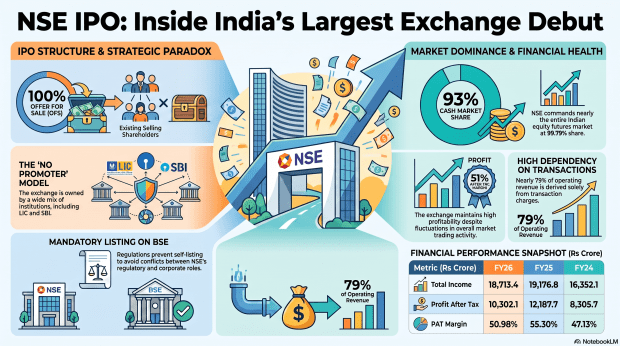
Unlike most public issues, NSE will not raise even a single rupee through fresh shares. The entire issue is a 100% Offer for Sale (OFS). The proposed offer comprises up to 14.89 crore equity shares with a face value of Rs 1 each. The final issue size, however, will depend on the price band announced closer to the IPO.
There is another interesting detail in the offer structure. Up to 5% of the post-offer paid-up equity capital has been reserved for eligible employees, while the remaining shares will be split among qualified institutional buyers (QIBs), non-institutional investors (NIIs) and retail investors through the book-building process.
| NSE IPO | Details |
| Issue Type | 100% Offer for Sale (OFS) |
| Fresh Issue | Nil |
| Total Shares on Offer | Up to 14.89 crore equity shares |
| Face Value | Rs 1 per equity share |
| Who Receives the IPO Proceeds? | Selling shareholders (after deducting offer-related expenses) |
| Funds Received by NSE | Nil |
| Employee Reservation | Up to 5% of the post-offer paid-up equity share capital |
| Qualified Institutional Buyers (QIBs) | Up to 50% of the Net Offer |
| Non-Institutional Investors (NIIs) | Minimum 15% of the Net Offer |
| Retail Individual Investors (RIIs) | Minimum 35% of the Net Offer |
NSE IPO: Objective of the issue
One question many investors are asking is: What exactly is NSE raising money for? The primary objectives are to facilitate the Offer for Sale (OFS) by existing shareholders and secure a stock market listing. The listing will improve its visibility, strengthen its brand and provide liquidity to existing shareholders.
Since the issue is entirely an OFS, NSE will not receive any IPO proceeds. Instead, the money raised after deducting offer-related expenses and taxes will go directly to the selling shareholders.
NSE: Business overview
Most investors know NSE as the place where they buy and sell stocks. But behind every trade lies a much larger ecosystem.
From matching buy and sell orders to clearing trades, managing settlement, operating the Nifty indices and even running an international exchange at GIFT City, NSE is largely embedded in India’s financial markets.
Its business spans trading, clearing and several data and technology services, making it one of the world’s largest integrated exchange groups.
| NSE’s Main Business Segments | What They Do |
| Trading Services | Equity, derivatives, listing, IPO book-building and data centre services |
| Clearing Services | Trade clearing, settlement and investment income from margins |
| Others | Index licensing, market data, analytics and strategic investments |
The exchange also offers products across almost every major asset class, allowing investors to trade everything from equities and ETFs to derivatives, debt securities and commodities – all on a single platform.
| Key Products Offered by NSE | Includes |
| Cash Market | Equities, ETFs, REITs and InvITs |
| Derivatives | Equity, currency and commodity futures & options |
| Debt Market | Wholesale debt, retail debt and interest rate futures |
| Listing Platforms | Mainboard, SME platform (EMERGE) and Social Stock Exchange |
The numbers reveal why NSE dominates India’s capital markets. It commands nearly 93% of the cash market, almost 100% of equity futures and serves over 129 million registered investors across more than 99% of India’s PIN codes.
The exchange’s technology infrastructure processes 12-14 billion messages every day, supports over 200,000 trading terminals in over 1,400 cities and towns, and can handle more than 200 million trades in a single day.
| NSE at a Glance | Fiscal 2026 |
| Cash Market Share | 92.99% |
| Equity Futures Market Share | 99.79% |
| Registered Investors | 129.09 million |
| Listed Companies | 2,978 |
| Trading Terminals | 2 lakh+ |
| Cities & Towns Covered | 1,400+ |
| Daily Processing Capacity | 12–14 billion messages |
| Maximum Daily Trade Capacity | 200+ million trades |
NSE IPO: Major shareholders
One of the most surprising things about the NSE IPO is that India’s largest stock exchange has no identifiable promoter.
Unlike many listed companies that are controlled by a promoter group, NSE is owned by a wide mix of institutions, foreign investors and individuals.
As of June 15, 2026, the exchange had over 2.12 lakh shareholders, making its ownership structure one of the most diversified in India’s corporate landscape.
So, who owns the biggest pieces of NSE?
| Top Shareholders (Pre-IPO) | Stake |
| LIC | 10.72% |
| Aranda Investments (Mauritius) | 4.54% |
| Stock Holding Corporation of India | 4.44% |
| SBI Capital Markets | 4.33% |
| Mahagony | 3.73% |
| State Bank of India | 3.23% |
The shareholder list also includes global investors, public-sector insurers and veteran investor Radhakishan Damani, who holds about 1.58%. Since the IPO is entirely an Offer for Sale (OFS), existing shareholders – not NSE – will be selling shares to the public.
Here are some of the biggest sellers in the IPO:
| Major Selling Shareholders | Max Shares Offered |
| State Bank of India | 2.47 crore |
| MS Strategic (Mauritius) | 1.60 crore |
| Canada Pension Plan Investment Board | 1.19 crore |
| Aranda Investments | 1.12 crore |
| Bank of Baroda | 1.10 crore |
Another interesting rule investors should know:
| Ownership Rule | Limit |
| General shareholder cap | 5% |
| Banks/Insurers/PFIs (with SEBI approval) | Up to 15% |
| Total foreign ownership cap | 49% |
That is why even the largest shareholder, LIC, owns just 10.72%. This highlights how tightly regulated and widely distributed ownership is in India’s most important stock exchange.
NSE IPO: Why NSE can’t list on NSE
One question that puzzles many investors is: If NSE is India’s largest stock exchange, why can’t it list its own shares on its own platform? The answer lies in India’s regulations. Under the SECC Regulations, a stock exchange is not allowed to self-list, meaning NSE cannot trade its own shares on the exchange it operates.
Instead, NSE has chosen to list on rival BSE, which has already granted in-principle approval for the IPO. The reason is simple: as India’s frontline market regulator, NSE oversees the companies listed on its platform.
Now, if NSE gets listed itself, it would create a conflict between its role as a regulator and as a listed company.
So, by listing on BSE, the exchange ensures independent regulatory oversight, while BSE will also act as the designated stock exchange for the IPO and the trading venue for NSE shares after listing.
NSE IPO: Financial performance
The exchange enjoys one of the highest operating margins among global stock exchanges.
Even after a moderation in trading activity during FY26, NSE remained highly profitable, with a PAT margin of nearly 51% and a Return on Equity (RoE) of 32.98%.
| Metric (Rs crore) | FY26 | FY25 | FY24 |
| Total Income | 18,713.40 | 19,176.80 | 16,352.10 |
| Revenue from Operations | 16,601.30 | 17,140.70 | 14,780.00 |
| Profit After Tax | 10,302.10 | 12,187.70 | 8,305.70 |
| EBITDA Margin | 66.85% | 73.78% | 66.78% |
| PAT Margin | 50.98% | 55.30% | 47.13% |
| EPS (Rs) | 41.62 | 49.24 | 33.56 |
Furthermore, the bulk of NSE’s revenue comes from transaction charges. This contributed nearly 79% of operating revenue in FY26.
Where does NSE earn from?
| Revenue Source (FY26) | Contribution |
| Transaction Charges | 78.65% of operating revenue |
| Trading Services | Rs 15,043.7 crore |
| Clearing Services | Rs 1,762.4 crore |
| Other Businesses | Rs 644.5 crore |
Other key financial highlights
| Metric | FY26 |
| Return on Equity (RoE) | 32.98% |
| Operating Cash Flow | Rs 23,836.2 crore |
| Total Dividend Paid | Rs 8,661.7 crore |
| SEBI Settlement Provision | Rs 1,391.2 crore |
NSE IPO: Risk factors
While NSE is India’s largest stock exchange, the DRHP also highlights several risks that investors should keep on their radar
Decline in trading volumes: “Any significant decrease in the volume and value of transactions executed on our stock exchange could significantly reduce demand for our products, constrain our growth, and adversely affect our business, financial condition, results of operations, cash flows, and prospects.”
Regulatory oversight: “NSE operates in a highly regulated industry under SEBI and may continue to receive inspections, observations, show-cause notices, warning or advisory letters relating to regulatory matters.”
Legal and enforcement proceeding: “Our Company has been, and continues to be, subject to enforcement actions, penalties, adjudication proceedings… The outcome of current and potential future proceedings is uncertain and could have a material adverse effect on our business, reputation, financial condition, results of operations, cash flows and prospects.”
Technology risks: “Disruptions, failures or inadequacies in IT infrastructure or third-party systems could impact operations, reputation and may invite regulatory action.”
Dependence on transaction charges: “In Fiscals 2026, 2025 and 2024, we derived 78.65%, 79.55% and 82.07% of our revenue from operations from transaction charges… Any failure to maintain or increase our trading volumes could result in loss of market share, reduced revenue from operations and other adverse effects on our business, financial condition and prospects.”
Conclusion
All eyes are now on the final IPO launch date for NSE. There are expectations that the IPO could potentially be on offer in the later part of 2026. However, the street will watch out for regulatory approvals and official announcements.
Disclaimer: This article is for informational and educational purposes only, analyzing the details of the Draft Red Herring Prospectus (DRHP) filed by the National Stock Exchange (NSE) with SEBI. It does not constitute an offer, invitation, solicitation, or recommendation to buy, sell, or subscribe to any securities or participate in the public issue. The exchange’s historical financial performance, ownership structure, and market share are presented descriptively and should not be treated as a guarantee of future returns, valuation, or performance. Equities and Initial Public Offerings (IPOs) involve substantial market risk, and investors should review the complete offer document and consult a SEBI-registered investment advisor or qualified financial professional before making any investment decisions. This disclaimer has been generated using AI to support user well-being and responsible content consumption.