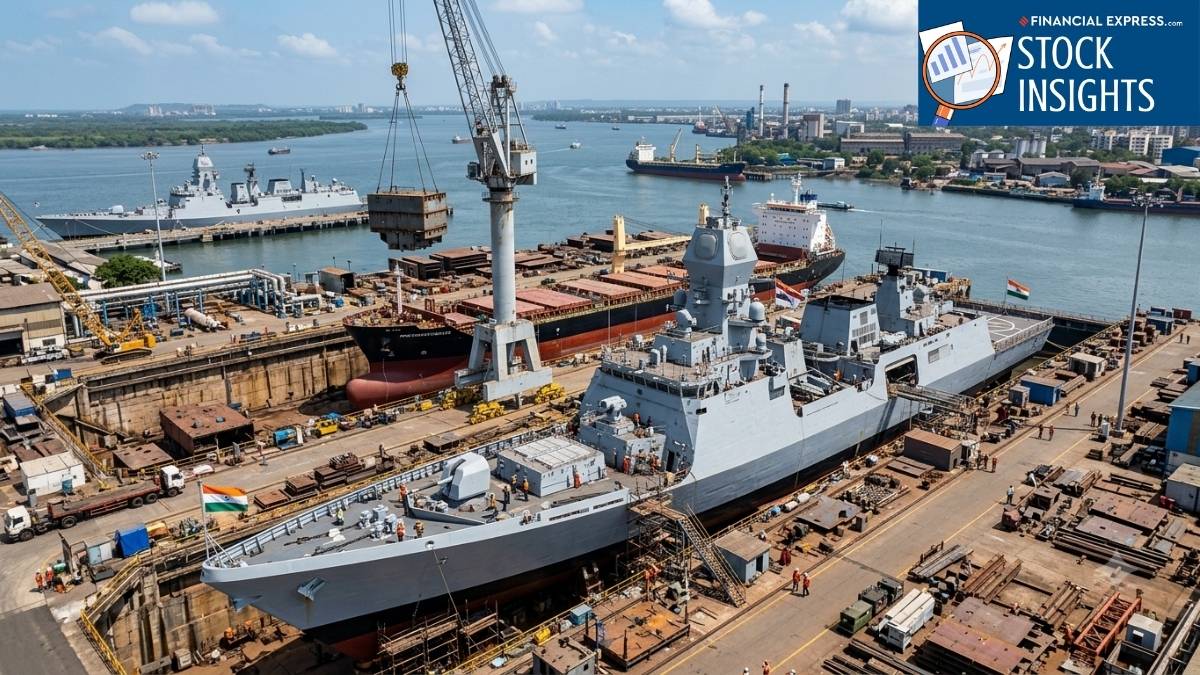
India’s shipbuilding industry is gaining strategic importance. Global supply chains are shifting. Domestic manufacturing is receiving policy support. The country’s maritime ambitions are also expanding. Shipyards are therefore becoming a more important part of India’s manufacturing and infrastructure story.
The defence angle is equally significant. The Indian Navy and the Coast Guard are adding new warships, submarines and support vessels. A large part of this requirement is being met through domestic shipyards. This has strengthened order visibility across the naval shipbuilding sector.
The opportunity ahead is substantial. According to the Ministry of Ports, Shipping and Waterways, India has identified a maritime opportunity worth around Rs 2.35 lakh crore across shipbuilding, ship repair and related activities over the coming decade. The pipeline is expected to support capacity expansion, domestic manufacturing and the wider maritime ecosystem.
Against this backdrop, order books have become an important metric to track. They indicate future revenue visibility and execution potential. For a like-for-like comparison, this article focuses on India’s three established listed public-sector shipbuilders. Each has a sizeable operating order book and a long track record in naval or defence vessel construction. Newer and smaller private-sector players have been excluded because their scale and order-book profiles are not directly comparable.
#1 Mazagon Dock Shipbuilding: A Rs 20,535-Cr Backlog Buffers Core Revenue Risks
Mazagon Dock Shipbuilders (MDL), Mumbai, established in 1774, is a prominent shipyard in India. Initially a small dry dock, MDL has evolved into a renowned shipbuilding company.
Mazagon Dock Shipbuilding Financial Performance
| Metric | FY26 |
| Revenue growth | 13.8% YoY |
| Net profit growth | 6.8% YoY |
| Order book | Rs 20,535 crore |
| ROCE | 36% |
| ROE | 29.2% |
| EV/EBITDA | 24.4x |
Mazagon Dock Shipbuilders closed FY26 with higher revenue and profit as deliveries under its naval programmes continued. Consolidated revenue from operations rose 13.8% year-on-year (YoY) to Rs 13,006 crore. Net profit increased 6.8% to Rs 2,578 crore.
Mazagon Dock’s order book stood at Rs 20,535 crore as of March 2026. This was around 1.6 times its FY26 revenue. The largest component was the P17A stealth frigate programme, with a balance value of Rs 8,257 crore. Three of the four frigates had already been delivered by November 2025. INS Taragiri was commissioned in April 2026. One vessel remains to be delivered.
Order Book Replenishment: The Core Catalyst for Mazagon Dock
The backlog also includes Rs 3,320 crore of offshore work for ONGC and Rs 2,690 crore for 21 Coast Guard vessels. An air-independent propulsion project accounted for another Rs 1,687 crore. Meanwhile, the P15B destroyer and Kalvari-class submarine programmes have largely reached the delivery stage. Their remaining order values mainly relate to pending work and spares. The company therefore needs new large naval contracts to extend revenue visibility beyond the current backlog.
Mazagon Dock is also widening its commercial and overseas presence. It acquired a 51% controlling stake in Colombo Dockyard for about Rs 237 crore. The transaction gives it operational control of Sri Lanka’s largest shipyard. It has also joined the Indian and Brazilian navies in an arrangement covering maintenance knowledge for Scorpene-class submarines and other military vessels.
In commercial shipbuilding, the company has orders for six hybrid-powered multipurpose vessels from a Norwegian customer. It also signed a contract with Shipping Corporation of India for a methanol dual-fuelplatform-supply vessel. Existing infrastructure allows it to build 11 submarines and 10 warships at the same time.
The stock trades at an EV/EBITDA multiple of 24.4 times. This is close to the industry median of 25.03 times. Its return on capital employed (RoCE) stands at 36%, while return on equity (RoE) is 29.2%. The balance sheet remains strong. However, the key trigger is now order replenishment. Large project wins will be needed to convert its technical capacity into sustained cash flows over the next decade.
In the past year, the share price of Mazagon Dock Shipbuilding is down 25.9%.
Mazagon Dock Shipbuilding 1 Year Share Price Chart
#2 Cochin Shipyard: New Structural Capex Offsets a 13.4% Profit Dip
Incorporated in the year 1972, Cochin Shipyard (CSL) is a leading player in construction of all kinds of vessels, repairs and refits of all types of vessels including periodic upgradation and life extension of ships.
Cochin Shipyard Financial Performance
| Metric | FY26 |
| Revenue growth | 12.7% YoY |
| Net profit growth | -13.4% YoY |
| Latest disclosed order book* | Rs 21,100 crore |
| ROCE | 16% |
| ROE | 12.5% |
| EV/EBITDA | 29.9x |
*The company has not disclosed an FY26-end order book. This is the latest figure available from Q1 FY26.
Cochin Shipyard ended FY26 with higher revenue but weaker profit and cash conversion. Consolidated revenue from operations rose 12.7% YoY to Rs 5,432 crore. Net profit fell 13.4% to Rs 717 crore. The decline came even as activity increased across shipbuilding and ship repair. Shipbuilding contributed Rs 3,366 crore, while ship repair brought in Rs 1,656 crore during the year.
The latest detailed order-book disclosure came in Q1 FY26. The company reported an order book of about Rs 21,100 crore. Defence projects accounted for Rs 13,700 crore, or 65% of the total. Commercial export orders stood at Rs 4,200 crore. Domestic commercial vessels contributed Rs 1,700 crore, while ship repair orders were about Rs 1,500 crore. Of the 75 vessels under execution, 13 were at an advanced stage. Another 37 had entered hull fabrication.
The order book also shows a gradual move beyond defence work. Green and conventional commercial vessels together accounted for Rs 5,900 crore. This includes export orders handled through the company and its subsidiaries. However, Cochin Shipyard has not disclosed an updated FY26-end order-book value. The Q1 figure should therefore be read as the latest detailed company disclosure, rather than the position as of March 2026.
Structural Capex vs Premium Valuations at Cochin Shipyard
Capacity has expanded ahead of this pipeline. The company has completed a Rs 1,800-crore large dry dock and a Rs 970-crore international ship repair facility. The dry dock can handle large vessels, including aircraft carriers and Capesize ships. The repair facility has capacity to service up to 82 vessels a year. Cochin Shipyard has also explored ship-repair clusters with Drydocks World of the UAE and shipbuilding opportunities with South Korea’s HD KSOE.
In February 2026, Cochin Shipyard signed a definitive agreement with global towage operator Svitzer to build at least four battery-electric tugs, with an option for four more. Initial deliveries are targeted for late 2027 or early 2028, subject to design, scheduling and regulatory approvals.
The stock trades at an EV/EBITDA multiple of 29.9 times, above the industry median of 25.8 times. ROCE stands at 16%, while ROE is 12.5%. The backlog offers visibility and the new facilities create room for growth. Still, the premium valuation leaves less room for delays. Faster execution and better conversion of profits into operating cash will be central to the case from here.
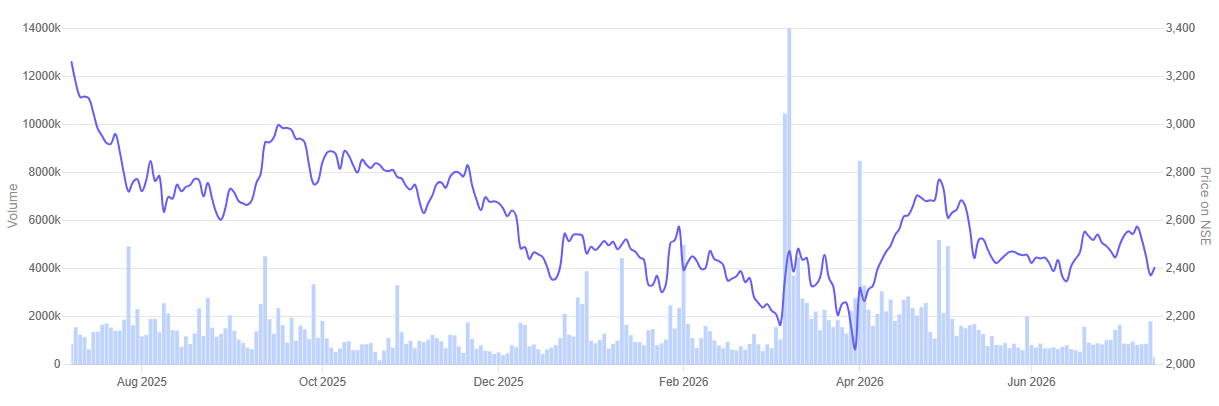
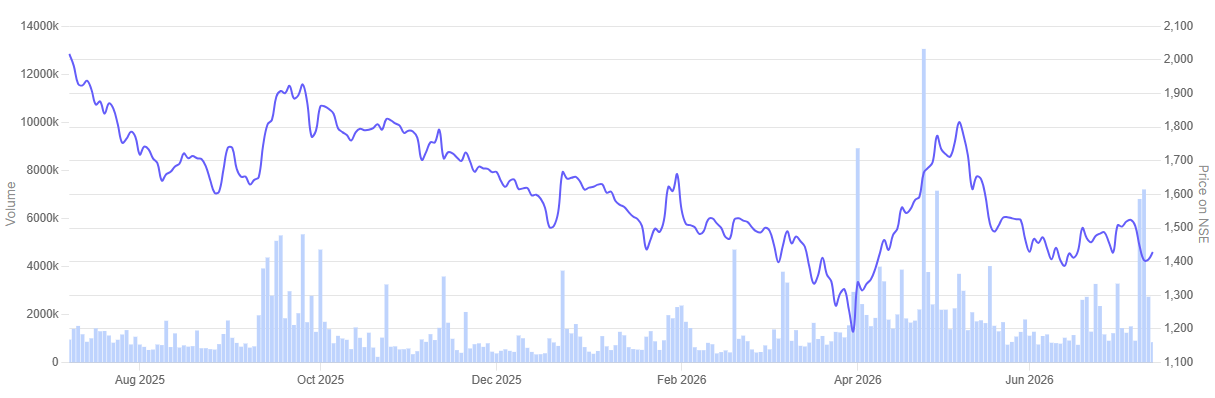
In the past year, the share price of Cochin Shipyard is down 29.3%.
Cochin Shipyard 1 Year Share Price Chart
#3 Garden Reach Shipbuilders and Engineers: A 42% Profit Surge Validates Near-Term Execution Targets
Garden Reach Shipbuilders & Engineers (GRSE) is a premier shipbuilding company in India under the administrative control of the Ministry of Defence, primarily catering to the shipbuilding requirements of the Indian Navy and the Indian Coast Guard. GRSE is a diversified, profit making and the first Shipyard in the country to export warships.
GRSE Financial Performance
| Metric | FY26 |
| Revenue growth | 38% YoY |
| Net profit growth | 42% YoY |
| Order book | ₹15,324 crore |
| ROCE | 43% |
| ROE | 31.8% |
| EV/EBITDA | 25.4x |
Garden Reach Shipbuilders & Engineers closed FY26 with its strongest financial performance so far. Revenue from operations rose 38% YoY to Rs 7,002 crore. Net profit increased 42% to Rs 748 crore YoY. The growth was backed by faster execution and a record delivery schedule during the year.
The company delivered eight warships to the Indian Navy in FY26. Three were handed over on the same day. It also delivered seven naval surface guns and 110 portable steel bridges. Export revenue crossed Rs 270 crore. The bridges division reported revenue of more than Rs 200 crore for the first time.
GRSE’s order book stood at Rs 15,324 crore at the end of FY26. Around 95% came from shipbuilding. Warship orders alone were worth about Rs 11,361 crore. The backlog included Rs 5,868 crore from the P17A frigate programme, Rs 5,168 crore from next-generation offshore patrol vessels and Rs 2,035 crore from anti-submarine shallow water craft. Non-defence projects formed about 22.5% of the total order book.
Navigating the S-Curve: GRSE’s Revenue Execution Pipeline
Execution remains spread across 39 platforms. The final P17A ship had reached around 74% physical completion and was scheduled for delivery in calendar 2026. Two anti-submarine craft had crossed 80% completion and entered the trial stage. The remaining two were at around 60% progress. The four-ship offshore patrol vessel programme is expected to run through FY29.
Commercial and research vessel projects are also moving ahead. GRSE is building 12 multipurpose vessels for a German client. Keel laying for three ships has been completed. It is also executing an ocean research vessel, an acoustic research ship, hybrid ferries and a dredger for Bangladesh.
The next major trigger is the proposed Rs 33,000-crore next-generation corvette order. GRSE is the lowest bidder and price negotiations have been completed. However, management expects meaningful revenue recognition only from the second half of FY28. Shipbuilding follows an S-shaped execution cycle. Revenue remains low during design and rises once hull fabrication and equipment installation begin.
GRSE is also expanding capacity. Its shipbuilding capacity is expected to rise from 28 platforms to 32 by the end of calendar 2026. It is planning two brownfield facilities in West Bengal and two greenfield facilities in West Bengal and Gujarat.
The stock trades at an EV/EBITDA multiple of 25.4 times, below the industry median of 35.8 times. ROCE stands at 43%, while ROE is 31.8%. The current backlog supports near-term execution. Still, the longer-term outlook depends on timely conversion of large naval tenders and continued growth in commercial exports.
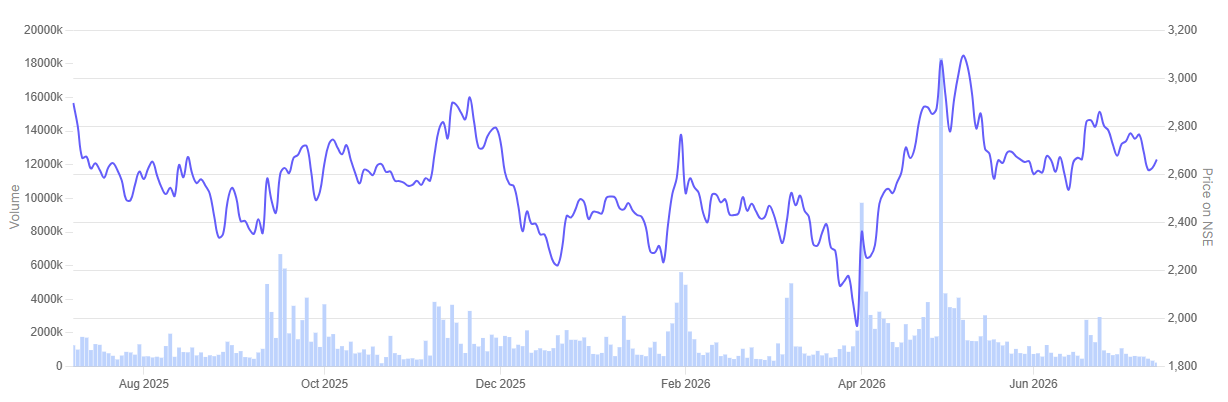
In the past year, the share price of Garden Reach Shipbuilders & Engineers is down 8.1%.
Garden Reach Shipbuilders & Engineers 1 Year Share Price Chart
Conclusion
India’s shipbuilding cycle is entering a stronger phase. Defence orders remain the main driver, while commercial vessels, green ships and ship repair are opening up another line of growth. The three companies covered here have sizeable order books and enough work to support revenue over the next few years.
Still, the numbers need to be read with care. Shipbuilding is a slow business. Revenue is booked in stages, while cash often comes only after key milestones are completed. A large backlog may look reassuring, but it does not remove the risk of delays, cost overruns or slow order conversion.
The next phase will therefore depend on execution. Timely deliveries, fresh contract wins and better cash generation will matter more than the headline order-book figure. Valuations are also no longer cheap across the sector. Investors will need to judge whether future earnings can grow fast enough to justify the premium.
Indian Shipbuilding Companies: Free Cash Flow vs Returns vs Valuation
| Metric | Mazagon Dock | Cochin Shipyard | GRSE |
| FY26 revenue growth | 13.8% | 12.7% | 38% |
| FY26 profit growth | 6.8% | -13.4% | 42% |
| Order book | Rs 20,535 crore | Rs 21,100 crore* | Rs 15,324 crore |
| ROCE | 36% | 16% | 43% |
| ROE | 29.2% | 12.5% | 31.8% |
| EV/EBITDA | 24.4x | 29.9x | 25.4x |
| Industry median EV/EBITDA | 25.03x | 25.8x | 35.8x |
| Key theme | Naval orders and submarine capability | Defence, commercial ships and repairs | Fast execution and fresh naval tenders |
*Cochin Shipyard’s Rs 21,100-crore figure is its latest detailed order-book disclosure from Q1 FY26. The company has not disclosed a separate FY26-end order book.
For now, the shipbuilding pipeline remains healthy. The three companies have sizeable orders and a strong tender pipeline.
The key test is execution. Timely deliveries, fresh orders and cash conversion will decide how much of this opportunity turns into earnings.
You can track how these are progressing by adding stocks to your watchlist.
Disclaimer:
Note: We have relied on data from www.Screener.in throughout this article. Only in cases where the data was not available, have we used an alternate, but widely used and accepted source of information.
The purpose of this article is only to share interesting charts, data points and thought-provoking opinions. It is NOT a recommendation. If you wish to consider an investment, you are strongly advised to consult your advisor. This article is strictly for educative purposes only.
Ekta Sonecha Desai has a passion for writing and a deep interest in the equity markets. Combined with an analytical approach, she likes to deep dive into the world of companies, studying their performance, and uncovering insights that bring value to her readers.
Disclosure: The writer and her dependents do not hold the stocks discussed in this article.
The website managers, its employee(s), and contributors/writers/authors of articles have or may have an outstanding buy or sell position or holding in the securities, options on securities or other related investments of issuers and/or companies discussed therein. The content of the articles and the interpretation of data are solely the personal views of the contributors/ writers/authors. Investors must make their own investment decisions based on their specific objectives, resources and only after consulting such independent advisors as may be necessary.