Gold, a safe-haven asset, is often the last option for raising cash during a crisis. In times like these, when the world is on edge and tensions in the Middle East show no signs of easing, some central banks are feeling the heat.
Two big countries have already dipped into their gold reserves. According to a recent World Gold Council report, Turkey sold 8 tonnes, and Russia sold 6 tonnes of gold in February.
However, Turkey’s situation is more complex than the numbers suggest. That decline in gold reserves largely happened before the Iran war began.
The report clarifies that in Turkey’s case, the reduction appeared to reflect a decline in Treasury holdings, rather than central bank reserves. In March, however, the Turkish central bank was highly active, with estimates indicating it used around 50 tonnes of its gold reserves for liquidity purposes and foreign exchange operations.
Turkey’s Central Bank Governor, Fatih Karahan, offered more clarity. In an interview with Bloomberg HT, he said that a significant part of these transactions are gold-currency swap futures — meaning when they mature, the gold will return to Turkey’s reserves.
Why Did Turkey Sell Gold?
At the end of 2025, Turkey held 613.70 tonnes of gold in its reserves. In 2025 itself, Turkey had added 26 tonnes to its kitty. So does the sale of almost 58 tonnes suggest Turkey is facing a currency crisis?
The answer lies in what is happening to the Turkish Lira. When foreign money leaves a country, demand for the dollar rises, putting pressure on the home currency. That is exactly what is happening with the Lira, which is under pressure as oil prices climb amid the Iran war.
Turkey’s broader economic condition is also not in great shape. Inflation in Turkey is sky high — down from highs of around 85% in 2022, but still at around 30% now, with interest rates hovering around 37%. With foreign reserves depleting, dipping into gold is the only option Turkey has left.
Global Central Banks: The Bigger Picture
But this does not mean countries have started selling gold across the board. Other than Turkey and Russia, central banks as a group actually bought a net 19 tonnes of gold in February. Poland (20 tonnes), Uzbekistan, Czech Republic, Malaysia, Cambodia, and China (1 tonne) were the major buyers in February.
Some of these countries are buying gold consistently. The Czech Republic has reported its 36th consecutive month of net buying, while China has reached its 16th consecutive month of net purchases.
That said, central bank buying of gold has clearly slowed. In 2025, the monthly average stood at 26 tonnes. In January and February 2026, central banks purchased a total of just 25 tonnes — bringing the monthly average down to 12.5 tonnes so far in 2026.
What About India’s Central Bank?
In 2025, the RBI significantly reduced its gold purchases to just 4.02 tonnes, down sharply from 72.6 tonnes in 2024. Total gold holdings of the RBI reached a record 880.3 tonnes as of end-2025. After a four-month pause, the RBI purchased a small amount of gold — 0.13 tonnes — in January, but none in February. Over the past year, only 1.3 tonnes of gold were purchased.
Moving Away From US Treasuries
Central banks are increasingly treating gold as a core part of their foreign exchange reserves. For the first time since 1996, central banks’ foreign exchange holdings in gold exceed their holdings in US Treasury securities.
Gold now accounts for 20% of foreign exchange reserve assets held by central banks — surpassing even the euro, which stands at 16%, after the US dollar, which retains 46%. In the case of the RBI, gold occupies 17.2% of India’s foreign exchange reserves.
This growing dependence on gold raises a bigger question about the dollar’s long-term role in international trade. The US dollar remains the most frequently used reserve currency in the world, but according to the IMF, its dominance is gradually declining. Gold becomes more attractive when shifting geopolitical forces threaten economic stability and faith in fiat currencies.
What Is Happening To Gold Prices?
Turkey and Russia’s gold sales also drew attention as prices started falling the day after the Iran war began. Gold fell to around $4,482, a 20% drop from its recent high of $5,602 in late January. Since then, gold has recovered some ground, trading at $4,677, but is still 13% lower than where it was when the war began.
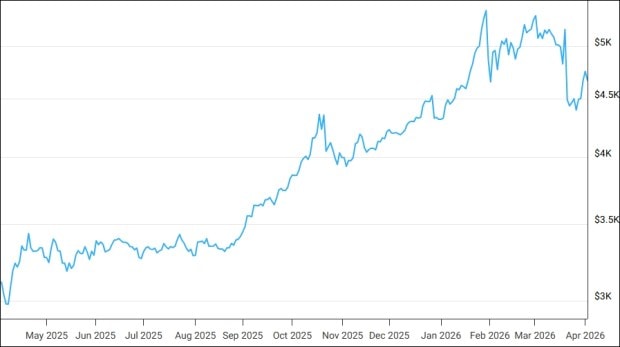
Source: Macrotrends; as of April 3, 2026
Gold price in India touched an all-time high of Rs 1,75,231 on January 29, 2026. Since then, the price for 10 grams, 24k, has rolled down to Rs 1,46,091 as of April 2, 2026, a fall of 16.5% from the peak.
Is there more correction left in gold? Going by history, there is more downside left, but the factors influencing gold prices can change swiftly.
Outlook for Gold
For now, as the Iran war continues, rising oil prices are bolstering the dollar. But a clearer picture will emerge once the conflict ends. What changes in the months ahead remain to be seen, but watch the dollar closely, as it will likely signal gold’s next move.
Disclaimer: This article provides factual analysis only and is not, and should not be construed as, an offer, solicitation, or recommendation to buy or sell securities. Investors must conduct their own independent due diligence and seek advice from a SEBI-registered financial advisor.