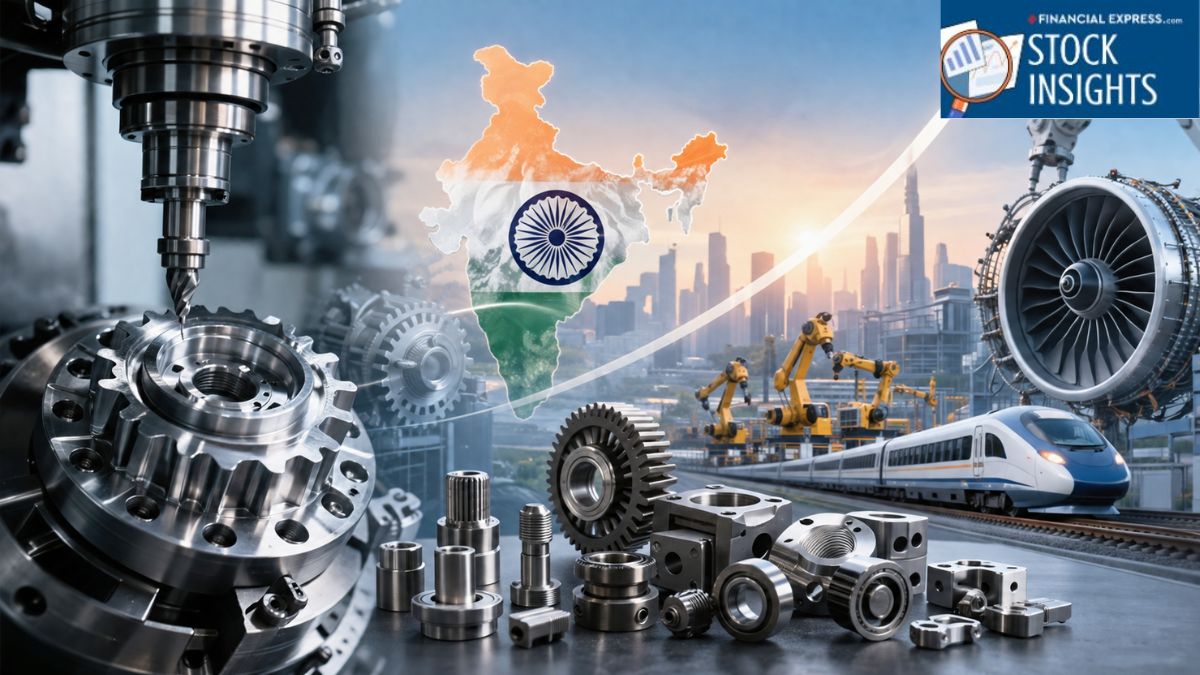
A jet engine turbine blade spins at temperatures hotter than its own melting point, surviving only because it was machined to tolerances finer than a human hair split a hundred ways.
A pacemaker keeps a heart beating because a component inside it was made without error.
A semiconductor wafer holds billions of circuits etched at a scale invisible to the eye.
None of this happens by accident. It happens because someone, somewhere, mastered the art of making things exactly right.
That mastery is precision engineering, and for years it was India’s quiet weakness. We assembled what others designed and machined what others perfected.
But all of that is changing.
As global supply chains hunt for alternatives to China and sectors from aerospace to medical devices demand parts that simply cannot be “almost” correct, a handful of Indian companies have built something genuinely hard to replicate: the ability to make the unmakeable, reliably, at scale.
Precision engineering demands the design that’s buried inside the products that carry it. And only a select few companies in India have that kind of expertise.
Here are five precision engineering stocks worth watching.
#1 Unimech Aerospace and Manufacturing
First on the list is Unimech Aerospace.
The company manufactures aero tooling, complex precision components and mechanical assemblies for companies in the aerospace, defence, power generation and semiconductor sectors.
Its manufacturing unit is in Peenya, Bengaluru. Unimech’s products stand out for their high complexity and “high-mix, low-volume” design, which is typified by high-precision, non-mass-produced goods.
This feature has helped Unimech post stellar margins over the years. Over the past three years, for instance, the company’s revenue and net profit has grown at a compounded annual rate of (CAGR) 88% and 191%.
The return ratios have been commendable too with a three year average return on equity (ROE) of 38% and return on capital employed (ROCE) of 47%.
Unimech Aerospace – Financial Snapshot
| Particulars (Rs m) | FY22 | FY23 | FY24 | FY25 |
| Revenue | 363 | 942 | 2,088 | 2,429 |
| Growth | NM | 159.1 | 121.7 | 16.4 |
| Operating Profit | 86 | 355 | 843 | 1,169 |
| Margins | 23.7 | 37.7 | 40.4 | 48.1 |
| Net Profit | 34 | 228 | 581 | 835 |
| Net Margins | 9.3 | 24.2 | 27.8 | 34.4 |
| ROE | 12.3 | 46.7 | 53.5 | 12.5 |
| ROCE | 16.5 | 58.7 | 65.9 | 15.1 |
Data Source: Ace Equity, Equitymaster
For Unimech Aerospace, FY26 was a year of strategic investments. The focus now remains on expanding capacity through new facilities, scaling its high-value engine tooling operations, and strengthening the order book along with customer base across key segments within its growing precision manufacturing business.
The industry is also doing well to help prospects of Unimech Aerospace and Engineering. Aircraft and engine manufacturers are accelerating production cycles supported by supply chain localisation and capacity expansion.
For instance, Airbus continues to ramp up assembly lines across the Western and Asian geographies, targeting a production of almost 75 A320 family aircrafts per month by 2027, up from the current 60 units per month.
Similarly, LEAP engines continue to scale with 500 engine deliveries in the last quarter, depicting a 40% year-on-year growth.
The company’s tooling segment, which accounts for all this, is about 78% of the total revenues. While it has seen moderate yet healthy performance amid the prevailing geopolitical uncertainties, future prospects look bright.
Also keep in mind that the company has been witnessing a slowdown as it evaluates the implications of the tariff environment.
However, given the diversification and strong customer relationship, the company should navigate this phase.
In the semiconductor space, several of its applications for various specialised parts are in the final approval stage. The continued evaluation of process and product delivery to the customer has resulted in customers gaining more confidence.
On successful approvals, these can lead to potential long-term orders.
#2 Aequs
Second on the list is Aequs.
Aequs is a vertically integrated precision component manufacturer with manufacturing capabilities in the aerospace segment and consumer segment. The advanced manufacturing capabilities enables the company to enter into new business segments by leveraging existing capabilities.
Its portfolio comprises over 5,000 distinct products across engine systems, landing systems, cargo and interiors, structures, assemblies and turning for its aerospace clients. It also manufacturers consumer electronics, plastics, and consumer durables for its consumer clients.
The company operates units in three manufacturing clusters in India, Belagavi, Hubballi, and Koppal, all situated in Karnataka and two manufacturing facilities in France and the US.
Coming to its financials, Aequs is currently a loss making entity, having only recently listed on the exchanges. Over the past three years, the company’s revenue has grown at a CAGR of 11%.
It has low debt on its book with the debt to equity ratio coming in at 0.2.
Aequs Financial Factsheet
| Particulars (Rs m) | FY21 | FY22 | FY23 | FY24 | FY25 |
| Revenue | 4,015 | 5,291 | 8,121 | 9,651 | 9,246 |
| Growth | -26.9 | 31.8 | 53.5 | 18.8 | -4.2 |
| Operating Profit | 54 | 225 | 670 | 1,509 | 1,134 |
| Margins | 1.3 | 4.3 | 8.3 | 15.6 | 12.3 |
| Net Profit | -1,139 | -1,029 | -1,087 | -121 | -1,024 |
| Net Margins | -28.4 | -19.4 | -13.4 | -1.3 | -11.1 |
| ROE | -65.3 | -35.7 | -39.7 | -1.5 | -14.4 |
| ROCE | -28.7 | -17.4 | -8.5 | 7.5 | -3.5 |
Data Source: BSE, Equitymaster
Aequs is the only precision component manufacturer operating within a single special economic zone in India to offer fully vertically integrated manufacturing capabilities in the aerospace segment. This sets it apart from peers with selective manufacturing capabilities.
In recent years, the company has strategically prioritised the selective outsourcing of lower value added activities, including 3-axis and 4-axis machining, within and outside its manufacturing ecosystem to third party subcontractors.
This has allowed Aequs to concentrate on producing more complex and higher value components through higher value-added activities, including 5-axis machining.
While the company continues to maintain its capacity in 3-axis and 4-axis machining, its focus going forward is on expanding its capabilities in 5-axis machining, so as to move up the value chain.
Further, Aequs aims to leverage its existing aerospace manufacturing capabilities to diversify customer base in aerospace segment by pursuing opportunities to develop new relationships and strengthening its presence in the segment.
Aequs has produced over 4,500 products within the aerospace segment under a variety of manufacturing and assembly programs with aerospace customers, including programs for single aisle (such as A220, A320, B737) and long range (A330, A350, B777, B787) commercial aircrafts.
All of this augurs well for the company going forward. With the company also likely to repay debt from the IPO proceeds, there is a possibility of better financial performance going ahead.
#3 Harsha Engineers
Third on the list is Harsha Engineers.
Harsha Engineers is a leading producer and exporter of high-precision engineered components and precision bearing cages, catering to customers worldwide. The company is the largest manufacturer of precision bearing cages in India with a 50-60% domestic market share.
It has strategically located manufacturing facilities, including leased facilities, with various warehouses at different locations worldwide.
The company supplies products to over 25 countries across 5 continents. In fact, Harsha Engineers supplies products to each of the top 6 global bearing manufacturers.
Coming to its financials, the company’s sales and net profit have grown at a CAGR of 10% and 33% respectively.
Its return ratios have averaged in double digits during the same time with ROE averaging at 11% and ROCE at a much better 17%.
Harsha Engineers Financial Snapshot
| Particulars (Rs m) | FY21 | FY22 | FY23 | FY24 | FY25 |
| Revenue | 8,738 | 13,215 | 13,640 | 13,923 | 14,077 |
| Growth | -1.4 | 51.2 | 3.2 | 2.1 | 1.1 |
| Operating Profit | 1,248 | 1,866 | 2,191 | 2,008 | 2,127 |
| Margins | 14.3 | 14.1 | 16.1 | 14.4 | 15.1 |
| Net Profit | 454 | 920 | 1,233 | 1,114 | 893 |
| Net Margins | 5.2 | 7 | 9 | 8 | 6.3 |
| ROE | 11.4 | 17.6 | 11.5 | 9.5 | 7.1 |
| ROCE | 18.1 | 22.9 | 16.9 | 13.7 | 10.7 |
Data Source: Equitymaster, BSE
The company has a wholly owned subsidiary, HEAL, which recently set up a greenfield project with an investment outlay of Rs 3.5 bn. This facility is now operational.
Overall, its geographically diversified manufacturing facilities and its long-standing relationships with reputed clientele in the bearing industry will support long-term growth.
#4 MTAR Technologies
Fourth on the list is MTAR Technologies.
From the rocket engines propelling India’s most prestigious space programs to the intricate assemblies critical for aerospace systems, MTAR Technologies has supported India’s space, civilian nuclear and clean energy sectors over the years.
The Hyderabad-based company manufactures high-precision engineering components for defense, aerospace, nuclear energy, and clean energy applications.
Its products include fuel cell assemblies, ball screws, rocket components, and water-lubricated bearings, the critical parts that go into systems where failure is simply not an option.
What sets MTAR apart is the complexity of what it makes. These are not off-the-shelf products. They require deep engineering capability, long qualification cycles and trusted relationships with clients like ISRO, Department of Atomic Energy, and International clean energy companies.
Coming to MTAR’s financials, its sales and net profit have grown at a CAGR of 26% and 11% over the past 5 years.
The ROE and ROCE have averaged 11% and 15% during the same period.
MTAR Financial Snapshot
| Particulars (Rs m) | FY21 | FY22 | FY23 | FY24 | FY25 |
| Revenue | 2,464 | 3,220 | 5,738 | 5,808 | 6,760 |
| Growth | 15.3 | 30.7 | 78.2 | 1.2 | 16.4 |
| Operating Profit | 844 | 1,032 | 1,735 | 1,185 | 1,260 |
| Margins | 34.2 | 32 | 30.2 | 20.4 | 18.6 |
| Net Profit | 461 | 609 | 1,034 | 561 | 529 |
| Net Margins | 18.7 | 18.9 | 18 | 9.7 | 7.8 |
| ROE | 9.7 | 11.7 | 16.7 | 8.3 | 7.3 |
| ROCE | 14.8 | 16.3 | 22.2 | 12.3 | 11.6 |
Data Source: Ace Equity, Equitymaster
Having confidence in the execution of orders on hand, the management has raised its revenue guidance for FY27 from 50-80% revenue growth, with EBITDA margins of around 24%. This is due to the initial expansion of capacities in sectors in clean energy, which has already commissioned.
Apart from clean energy, the oil and gas plant will also be commissioned by September.
The closing order book for MTAR as of FY26 stands at Rs 25.8 bn. The management estimates that the closing order book as at the end of FY27 will be much larger at around Rs 50 bn.
#5 Ameya Precision Engineers
Last on the list is Ameya Precision Engineers.
The company manufactures pump and valve components among other engineering products such as shafts, stems, overlays, precision trim parts, and assemblies. It collaborates with machining subcontractors to manage customer workloads when needed.
Ameya has a 68,000 square feet manufacturing unit in Pune, equipped with in-house capabilities for turning, grinding, milling, drilling, hard-facing, and overlay.
Exports make up for majority of its revenue, with the company hosting a roster of clients including Adams Armaturen Gmbh & Co, Crane Group, Flowserve Group, Sulzer Pumps, Trillium Flow Technologies, KSB Pumps, AR&DE (DRDO), among others.
Coming to financials, the company’s net sales and net profit have grown at a CAGR of 11% and 20% in the past 5 years.
The ROE and ROCE have averaged 15% and 20% during the same period.
Ameya Precision Engineering Financial Snapshot
| Particulars (Rs m) | FY21 | FY22 | FY23 | FY24 | FY25 |
| Revenue | 246 | 238 | 285 | 340 | 386 |
| Growth | 5.1 | -3.5 | 19.9 | 19.4 | 13.4 |
| Operating Profit | 52 | 32 | 33 | 52 | 68 |
| Margins | 20.9 | 13.3 | 11.6 | 15.2 | 17.6 |
| Net Profit | 27 | 15 | 18 | 30 | 44 |
| Net Margins | 11.1 | 6.4 | 6.5 | 8.7 | 11.5 |
| ROE | 22.7 | 11.3 | 9.5 | 12.9 | 16.2 |
| ROCE | 28.7 | 17 | 13 | 18.4 | 22 |
Data Source: Ace Equity, Equitymaster
FY26 was a record year for the company in terms of net profit and sales. Going forward, the company’s management anticipates traction in the defence segment.
The company is debt free, which should have a positive impact on its margins or cash flows.
Conclusion
A company that earns a reputation for never getting it wrong doesn’t just win one contract.
It keeps winning one after the other, because the cost of switching to an unproven supplier is a risk few buyers in aerospace, defence, or medical devices are willing to take. That stickiness is the moat, and it is far harder to build than a factory.
But note that it doesn’t make these stocks a sure thing. Precision engineering is capital-hungry, order books can be lumpy, and a valuation that already prices in a flawless decade leaves little room for the inevitable stumble.
The tailwinds are real but the names that look most exciting are often the ones where expectations have run furthest ahead of execution.
Investors should evaluate the company’s fundamentals, corporate governance, and valuations as key factors when conducting due diligence before making investment decisions.
Happy investing.
Disclaimer: This article is for information purposes only. It is not a stock recommendation and should not be treated as such. Learn more about our recommendation services here…
The website managers, its employee(s), and contributors/writers/authors of articles have or may have an outstanding buy or sell position or holding in the securities, options on securities or other related investments of issuers and/or companies discussed therein. The content of the articles and the interpretation of data are solely the personal views of the contributors/ writers/authors. Investors must make their own investment decisions based on their specific objectives, resources and only after consulting such independent advisors as may be necessary.