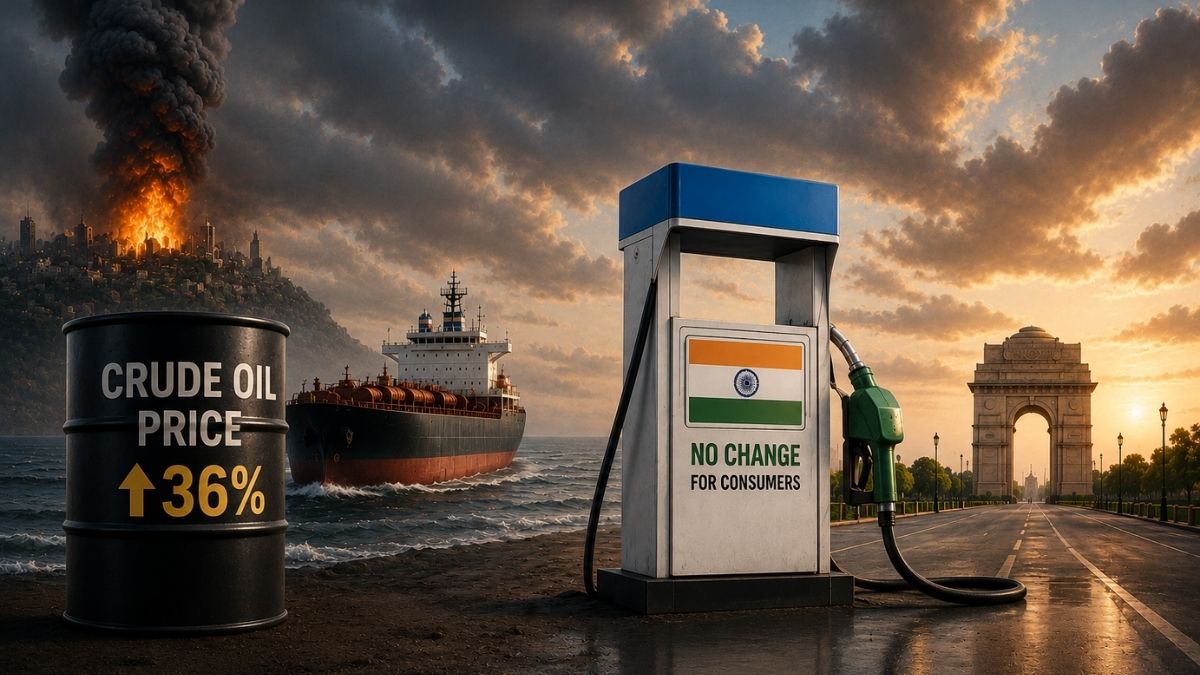
Since the start of the West Asia conflict, crude oil prices have increased by 36%. Petrol prices in India have not changed. In contrast, petrol prices in the US have increased by 41%. The cost of petrol has risen by more than the crude oil price, due to higher shipping costs.
The Indian government has chosen to absorb the higher cost of fuel. State owned refineries have taken losses. Fuel duty has been cut. What is the rationale for keeping fuel prices low at the retail level? There are certainly political motivations for doing so. But are there any economic benefits?
Reducing Price Volatility
The first economic reason is reducing price volatility. If fuel prices are held steady when oil prices rise, and when oil prices fall, consumers are shielded from price swings. This approach works, if in the long run, fuel prices reflect their true cost. The Reserve Bank of India uses this approach to manage the rupee’s value. They intervene to reduce volatility, but over time, the currency reflects its market value.
There is a downside to this approach. We don’t always know whether prices increases are temporary or not. The current policy of keeping fuel prices low assumes that the West Asia conflict will end soon. And once it ends, oil prices will go back down. This may be the most likely outcome. But there is a reasonable likelihood that this conflict will continue for a longer period. And oil prices stay elevated or rise further. In which case, fuel prices should be allowed to go up now.
Are Fuel Subsidies Beneficial?
In the long run, it is not sustainable for oil refineries to incur losses. Unless the government wishes to permanently subsidize fuel. A permanent fuel subsidy would have the following economic effects.
First, the current account balance would worsen. Second, the rupee would weaken. These effects could be offset by raising taxes to pay for the subsidy, or by reducing government expenditure elsewhere.
Ultimately, all subsidies are political choices. Goods that are subsidized are assumed have social benefits. This means benefits beyond just the individual. Is this the case with fuel? Possibly yes, if high fuel costs mean people cannot get to work. Or they cannot feed their families. If a part of the population experiences economic hardship, it ripples through the rest of the economy.
That said, fuel subsidies are not a good long-term solution. It would be much better if energy was cheaper to begin with. To this end, Indian energy policy should focus on increasing domestic production. Domestic production should be pursued across all forms of energy. This includes oil and gas, renewables, and nuclear.
Why was the US willing to start the conflict? In part, because it has domestic energy. If oil prices go up, the negative shock to consumers is partially offset by gains to domestic oil producers. Being overly reliant on energy imports is a liability. If something good comes out of the current energy shock, it would be a plan to increase domestic production.
Disclaimer:
Note: The purpose of this article is to share interesting charts, data points and thought-provoking opinions. It is NOT a recommendation. If you wish to consider an investment, you are strongly encouraged to consult your advisor. This article is for strictly educative purposes only.
Asad Dossani is an assistant professor of finance at Colorado State University. His research covers derivatives, forecasting, monetary policy, currencies, and commodities. He has a PhD in Economics. He has previously worked as a research analyst at Equitymaster, and as a financial analyst at Deutsche Bank.