The HDFC Bank stock hit a 52-week low of Rs 726.75 on April 2, a fall-out from the resignation of Mr Atanu Chakraborty on March 18, as the part-time chairman and independent director of the bank with immediate effect.
The HDFC Bank stock has been under selling pressure since the above development and investors have been keenly awaiting the March 2026 quarterly update, in a bid to understand the core performance of the bank.
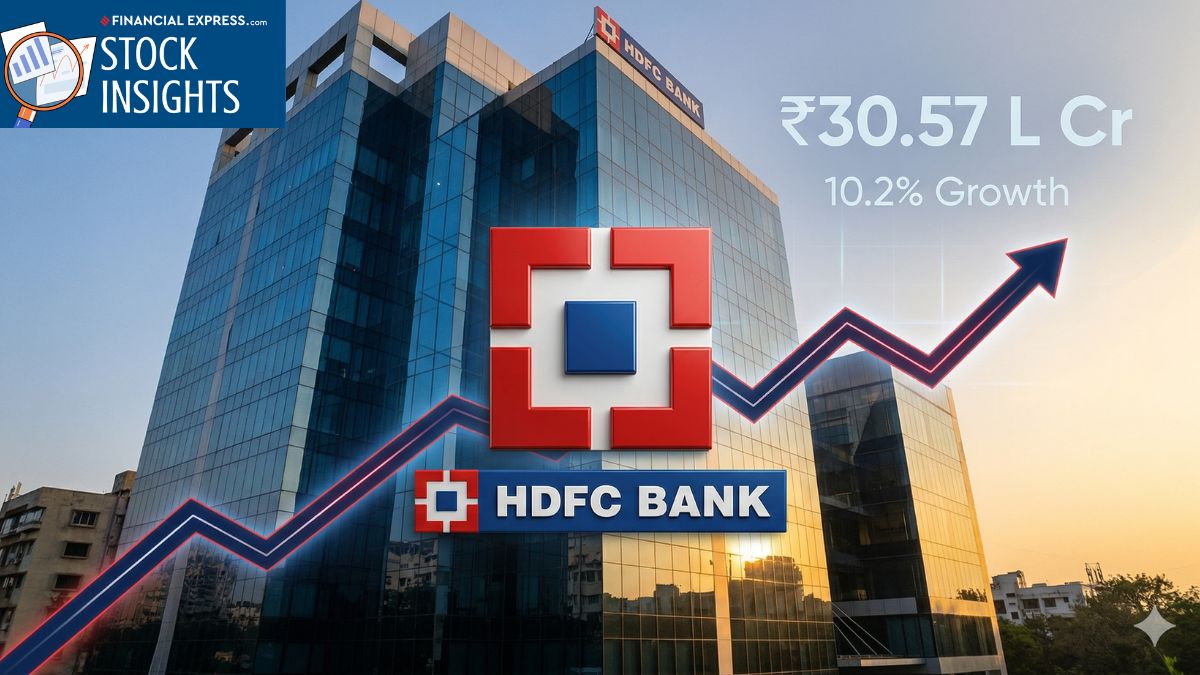
HDFC Bank, the largest private sector bank, on Saturday has highlighted that its advances in Q4FY26 grew 10.2% y-o-y to Rs 30.57 lakh crore.
The March quarter is typically a busy / peak season for credit, with individuals, small and large companies borrowing funds heavily before the close of the financial year.
Credit growth is an operational parameter of a bank that is keenly tracked, and investors have been keenly following this metric of HDFC Bank.
This is the second consecutive quarter of double-digit loan/credit growth for HDFC Bank – the largest private bank’s advances were Rs 28.21 lakh crore in the December 2025 quarter, a growth of 12% y-o-y. The third quarter of a financial year is also a peak credit season for banks.
The merger of HDFC Bank and HDFC on the effective date of 1 July, 2023, had resulted in the merged entity having a credit-to-deposit ratio of nearly 104.4% at the end of the March 2024 quarter. And it resulted in HDFC Bank very cautiously growing its loan book, to the disappointment of shareholders and Dalal Street.
Banks typically maintain a credit-deposit ratio of 75% to 80%.
The then RBI governor, Shaktikanta Das, in a media interaction in January 2024, had highlighted that the central bank does not prescribe any credit-deposit ratio for banks to maintain. He added that the RBI wants to ensure that there is no unnecessary exuberance in lending and that there remains some sort of correlation between credit extended by banks and deposits available with them.
For perspective, government-controlled State Bank of India (SBI), the largest bank in the country, its credit-to-deposit ratio was nearly 76.6% at the end of the March 2024 quarter.
To gain a better understanding of the double-digit loan growth at HDFC Bank, we dug deeper into the March 2026 quarter update, and compared with the loan growth reported in March 2025 quarter and that of March 2024 quarter.
March 2026 loan growth – breaking single-digit loan growth trend in a peak season
HDFC Bank – Loan growth trend over the years
| Loan growth – % change (y-o-y) | |
| March 2026 quarter | 10.2% |
| March 2025 quarter | 5.4% |
| March 2024 quarter (merger effect) | 55.3% |
HDFC Bank grew its advances by 10.2% y-o-y to Rs 30.57 lakh crore in the March 2026 quarter. The largest private sector bank has not provided detailed information on which sectors have reported strong loan growth.
Its deposits grew by 14.4% to Rs 31.05 lakh crore at the end of the March 2026 quarter, and that was largely owing to its time deposits (mainly fixed deposits) that grew 15.5% y-o-y to Rs 20.45 lakh crore during the quarter under review.
This would imply a credit-to-deposit ratio of nearly 98.5% in the March 2026 quarter.
Now, before we move to compare earlier year numbers, here are some data points showing where HDFC Bank stood “pre-merger” with HDFC.
In FY23, the last full year before the merger, HDFC Bank had grown its advances by nearly 17% y-o-y to Rs 16 lakh crore, and its deposits grew by 20.8% y-o-y to Rs 18.83 lakh crore. It had a credit-to-deposit ratio of nearly 85% at the end of FY23. On a point-to-point basis one can clearly see a higher than desired credit-to-deposit ratio. Not the best position to be in.
The post-merger sluggish loan growth trend – Comparing Q4 performance since 2023
Now let’s compare the earlier March quarter performance of HDFC Bank, since its merger took effect.
HDFC Bank had grown its loan book barely 5.4% y-o-y to Rs 26.2 lakh crore in the March 2025 quarter.
Its deposits were Rs 27.14 lakh crore at the end of the March 2025 quarter, a growth of 14.1% y-o-y. The Mumbai-based had a credit-to-deposit ratio of nearly 96.5%,
Going back further, in the March 2024 quarter, the merged HDFC Bank’s advances were Rs 24.84 lakh crore, a growth of 55.3% y-o-y.
Its deposits were Rs 23.79 lakh crore in the March 2024 quarter, a growth of 26.5% y-o-y. This would imply a credit-to-deposit ratio of nearly 104.4% for the Mumbai-based bank.
The numbers for March 2024 quarter are impacted by the merger that took effect on 1 July, 2023, and hence, the growth rates appear to be very high. But it can clearly be seen how the credit-to-deposit ratio jumped to nearly 104.4%.
Efficiency kings: HDFC Bank’s ROA is amongst the best in the industry
HDFC Bank has one of the highest Return on Assets (RoA) in the banking industry, over the past several quarters.
HDFC Bank’s return on average assets (not annualised) was 0.48% in the December 2025 quarter for both banks, and on annualising it for FY26 it would be nearly 1.92%.
In comparison, Kotak clocked the same RoA at 1.92% (annualized) in Q3FY26. Smaller rival, Axis Bank‘s return on Assets (annualised) was 1.49% in the December 2025 quarter.
Investors on Dalal Street
HDFC Bank – reasonable valuations
| Bank | Price-to-(standalone) book value |
| HDFC Bank | 2.1 times |
| Kotak Mahindra Bank | 2.8 times |
The HDFC Bank stock ended 1.2% higher at Rs 751 on Thursday, and hovering just above its 52-week low of Rs 726.75 on April 2, 2026.
On the preferred valuation matrix, price to (standalone) book value, the stock trades at nearly 2.1 times, according to Screener.in. HDFC Bank’s core banking operations are reflected in its standalone quarterly results.
Over the past 5 years, the HDFC Bank stock has traded at a price to (standalone) book value between 2.1 times and 4.8 times
Kotak Mahindra Bank trades at on a price-to-(standalone)-book value of 2.8 times. Over the past 5 years, Kotak Mahindra Bank has traded at a price-to- (standalone) book value between 3.1 times and 7.1 times.
HDFC Bank is currently trading at lower end of its price-to-(standalone) book value and at much lower valuations to Kotak Mahindra Bank.
Investors could add HDFC Bank to their watch list of stocks for the current calendar year and watch if the sustained turnaround in loan growth is an indication that the bank is finally emerging from the post-merger slowdown.
Disclaimer:
Amriteshwar Mathur is a financial journalist with over 20 years of experience.
The writer and his family have no shareholding in any of the stocks mentioned in the article.
Disclaimer: The website managers, its employee(s), and contributors/writers/authors of articles have or may have an outstanding buy or sell position or holding in the securities, options on securities or other related investments of issuers and/or companies discussed therein. The content of the articles and the interpretation of data are solely the personal views of the contributors/ writers/authors. Investors must make their own investment decisions based on their specific objectives, resources and only after consulting such independent advisors as may be necessary.