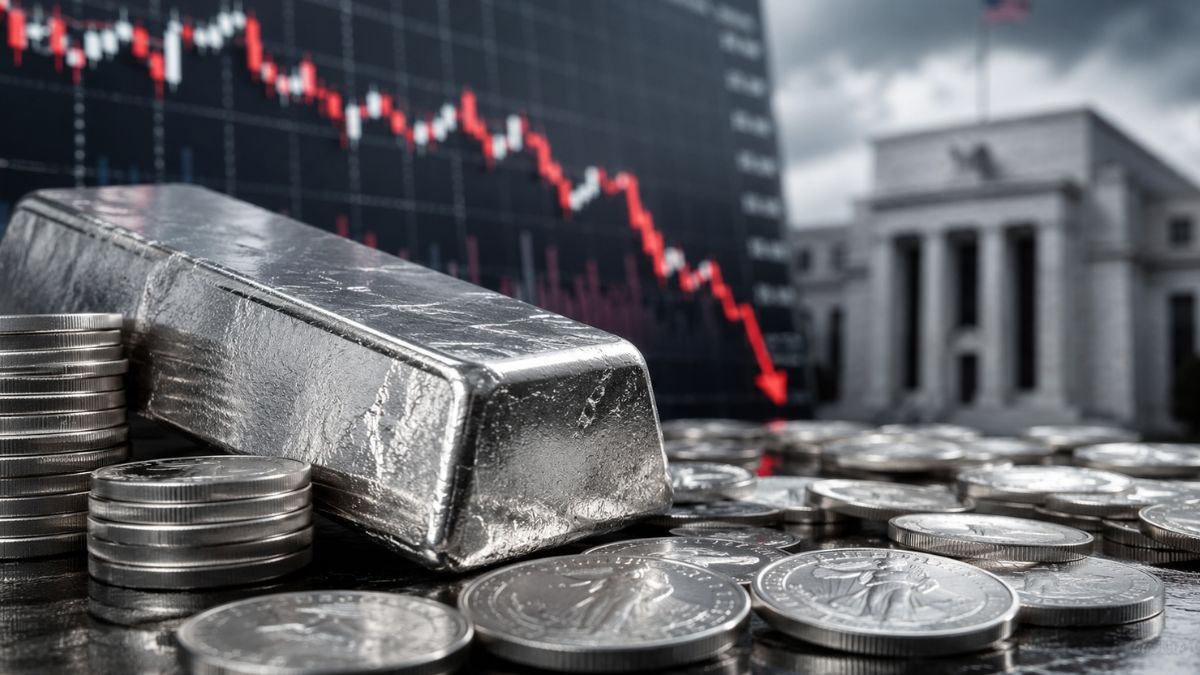
The global equity markets saw a sharp selloff in Tuesday’s trade, and the precious metals mirrored the rout. Silver, especially, plunged 5% intra-day, deepening the selloff since last week. Silver has now plunged to 2026 lows, and market experts do not rule out a possibility of the white metal slipping to December 2025 levels.
But they believe the long-term demand dynamics and fundamentals remain intact. Apart from the Fed rate hike fears and a strong dollar, experts believe that rapid deleveraging in silver futures and persistent ETF outflows amplified the decline. With today’s fall, silver has now erased over 10% since last week’s Federal Reserve meeting.
Silver Crash Snapshot
| Key Metric | Value |
|---|---|
| Current Silver Price | ~$60/oz |
| 2026 High | ~$120/oz |
| Fall From Peak | ~50% |
| Decline Since Fed Meeting | >10% |
| Intraday Fall (Tuesday) | 5% |
| Dollar Index | Above 101 |
| Silver ETF Trend | Persistent Outflows |
| Fed Hike Probability (Oct) | ~80% |
Dollar gains, silver in pain
Silver is now trading near its 2026 lows around $60 per troy ounce. This is nearly a 50% washout from the highs seen in late January. Silver had rallied as much as $120 per troy ounce. Interestingly, the Dollar Index, on the other hand, had shot up to 1-year highs above the crucial 101 mark. The Dollar Index is a measure of the value of the greenback against a basket of 6 major foreign currencies
The sharp price action has been a result of market concerns with regard to a Fed rate hike as early as September and elevated Treasury yields. Most market experts believe that investors are watching out for this week’s US PCE inflation report. This is the US Fed’s preferred measure of inflation and could potentially offer investors some cues with regard to the direction of interest rates for the rest of the year.
Navneet Damani, Head of Commodity Research, Motilal Oswal Financial Services, said, “The safe haven narrative has taken a back seat to easing tension in the Middle East. Progress in US-Iran negotiations. Near-term price movements in gold are being driven primarily by the strength of the U.S. dollar, expectations for monetary policy, and incoming inflation data, where we expect some more pain in the precious metals complex.”
Kaynat Chainwala, AVP Commodity Research, Kotak Securities, explained that the “The trigger was a hawkish projection by FOMC participants at Kevin Warsh’s inaugural meeting as Fed Chair, where nine of nineteen policymakers pencilled in at least one rate hike later this year. Short-term Treasury yields shot up, and CME FedWatch now places roughly an 80% probability of a hike by October, up from around 40% before the meeting. The chance of rates remaining on hold through December has collapsed from 40% to just 15%.”
Why does silver bear the brunt of shift in monetary stance
Though the selloff was global and spread across asset classes, silver decidedly bore the brunt of it. The question is why does this type of shift in monetary policy stance affect silver more than other asset classes?
According to Kotak’s Kaynat Chainwala “the metal carries no yield, so when real yield expectations climb and the dollar strengthens, the cost of holding silver rises with every basis point.”
What’s exacerbated the pain is the overall economic set-up. The “energy-driven inflation, with May CPI printing at 4.2% year-on-year, has kept the case for further tightening alive and the hawkish dots credible.” Chainwala added.
The Kotak expert believes that “Structurally, the global silver market is heading into its sixth straight annual supply deficit, but these fundamentals struggle to counter a strong macro tide. Rapid deleveraging in silver futures and persistent ETF outflows amplified the decline.”
Why is Silver falling?
| Driver | Impact on Silver |
|---|---|
| Stronger US Dollar | Makes silver costlier for foreign buyers |
| Rising Treasury Yields | Increases opportunity cost of holding silver |
| Hawkish Fed Outlook | Reduces appeal of non-yielding assets |
| ETF Outflows | Accelerates selling pressure |
| Futures Deleveraging | Triggers forced liquidation |
| Easing Middle East Tensions | Weakens safe-haven demand |
What’s the outlook for silver
How much more can silver fall from current levels? The 50% washout from this year’s peak has made investors apprehensive.
The street is worried if it can fall below $59/US dollar levels seen last December. Peter McGuire, CEO Australia of Trading.com, explained that the demand opportunity continues to remain the same when we look at “the industrial demand data centres, military technology and the general use from electric vehicles all the way through to every component that silver enjoys being a part of. That storyline has not failed, and that hasn’t changed.
Kotak estimates $56-59 as the key near-term support zone for silver. “On spot silver, support is seen at $55-59 with resistance at $67 and $72. On MCX, support is placed at Rs 2,22,780 per kg and then ar Rs 2,02,000 per kg, while resistance stands at Rs 2,53,800/kg and Rs 2,72,000/kg,” Kaynat Chainwala highlighted.
While today’s washout can be attributed to the sell-off across the South Korean markets and concerns arising from the global tech rout, “I still believe the 60 dollars is a psychologically important level. Sixty dollars to the downside could be there soon. Might get through it. But my overall opinion is still bullish. And I believe that the second-half prices will reinflate. I’m still bullish for precious metals.
Conclusion
Most analysts believe that the long-term fundamental drivers for silver remain intact. However, they do see a chance of the silver slipping to key support zones below $60/troy ounce levels.
Disclaimer: Market views, price targets, and support levels provided by analysts in this report are strictly for educational and informational purposes and do not constitute an offer, solicitation, or recommendation to trade in commodities, futures, or ETFs. Commodity investments involve significant market and volatility risks, and past performance is not indicative of future results. Readers are strongly advised to consult a SEBI-registered investment advisor or qualified financial professional before making any trading or investment decisions.
This disclaimer has been generated using AI to support user well-being and responsible content consumption.